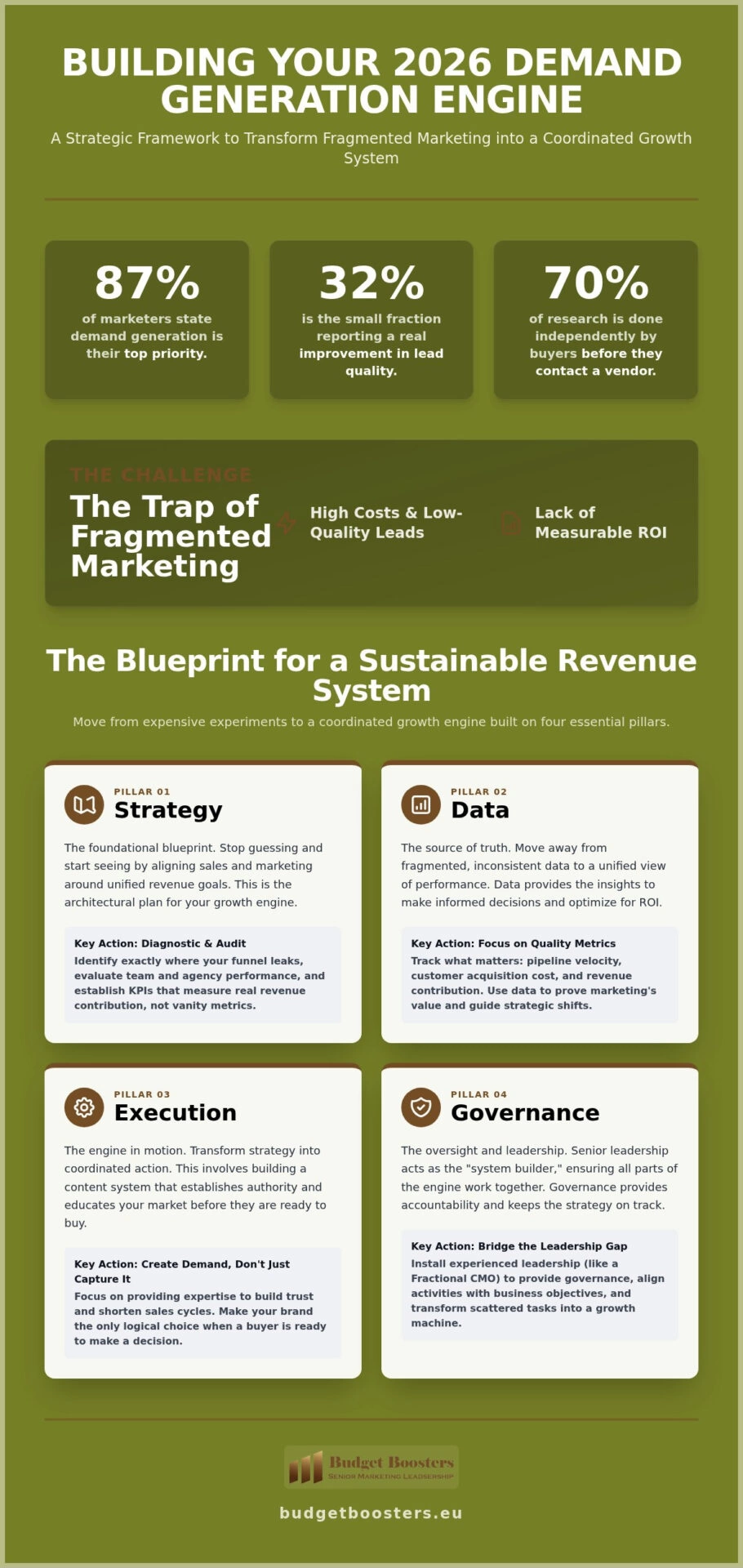
Did you know that while 87% of marketers say demand generation is their top priority, only 32% report a real improvement in lead quality? It’s a frustrating gap that often leaves leaders feeling stuck with high acquisition costs and fragmented campaigns that just don’t scale. You’re likely feeling the pressure to prove ROI while managing a marketing engine that feels more like a collection of random acts than a coordinated system. It doesn’t have to be this way. Building a modern demand generation strategy isn’t about running more ads. It’s about creating a structural system that gives you back your freedom and control.
I understand the weight of managing a budget without a clear strategic roadmap. You want a predictable pipeline and a sense of alignment where sales and marketing finally speak the same language. This article will show you exactly how to transform fragmented activities into a data-driven growth engine that delivers measurable results. We’ll explore the 2026 roadmap for sustainable revenue, focusing on how a system-builder approach can turn your marketing into a reliable, long-term asset. It’s time to stop reacting to the market and start leading it with confidence.
Key Takeaways
- Learn why a holistic demand generation strategy is the key to escaping the trap of low-quality leads and building genuine brand authority.
- Discover the four essential pillars, Strategy, Data, Execution, and Governance, that turn fragmented marketing into a coordinated growth engine.
- Understand how creating demand rather than just capturing it allows you to educate buyers early and significantly shorten your sales cycle.
- See how a marketing audit combined with AI-powered content systems can scale your output while keeping your brand voice consistent and high-quality.
- Explore how a fractional CMO acts as a system builder to bridge the leadership gap and ensure your marketing budget delivers a predictable revenue pipeline.
What is a Demand Generation Strategy in 2026?
Forget the old playbook of chasing every lead with a pulse. A modern demand generation strategy isn’t just a series of disconnected campaigns. It’s a living, breathing system designed to build authority and buyer intent before your sales team even picks up the phone. In 2026, the game has shifted. Buyers are smarter and more independent. They’re doing 70% of their research independently before they ever contact a vendor. This means your marketing can’t just be about capturing demand; it has to be about creating it. If you want to dive deeper into the specific mechanics for high-growth firms, our B2B demand generation guide provides the essential context you need to start this journey.
Think of yourself as a system builder. Instead of being a campaign manager who reacts to every market flicker, you’re constructing a coordinated revenue engine. This approach moves you away from “rented” audiences and towards owned authority. According to the foundational definition of What is Demand Generation, the goal is to create a predictable pipeline by aligning every touchpoint. In 2026, 87% of marketers report that demand generation is their top priority, yet many still struggle to connect these activities to actual revenue. It’s time to stop feeling overwhelmed by fragmented data and start building a system that gives you back control over your growth.
The Core Objectives of Modern Demand Generation
The primary goal is simple: build trust through education. You’re not just selling a product; you’re solving a problem. By providing original expertise, you create interest where none existed before. This approach aligns your marketing activities with real business goals. You’ll find that when you focus on quality over volume, your sales cycle naturally shortens. It’s about making sure that when a buyer is ready to spend their budget, your brand is the only logical choice they have in mind. This transformation turns marketing from a cost center into a strategic asset.
Why 2026 Requires a New Strategic Approach
The market has become incredibly crowded. With 96% of marketers now using AI for content creation, generic information is everywhere. To stand out, you need genuine expertise and a unique perspective. At the same time, new privacy laws in states like Indiana and Kentucky have raised the bar for data handling. Rented audiences and third party data are getting more expensive and less reliable. There’s also intense pressure on CEOs to justify every marketing spend. With average budgets hovering between 7.7% and 9.1% of revenue, every euro must work harder. You need a strategy that proves its worth through measurable ROI, not just clicks and likes.
Building a Sustainable Revenue System: The Strategic Framework
Construction requires a solid blueprint. A robust demand generation strategy isn’t built on luck. It stands on four essential pillars: Strategy, Data, Execution, and Governance. Without these, your marketing efforts often feel like a series of expensive experiments that don’t quite connect. Many teams make the mistake of jumping straight into tool selection. They hope a new CRM or a fancy AI platform will magically fix their revenue gaps. It won’t. Tools are force multipliers. If your underlying strategy is fragmented, a new tool will only help you fail faster. You need senior leadership to step in as the architect, aligning sales and marketing objectives so everyone is chasing the same revenue goals. This alignment is the heart of the modern marketing strategy roadmap.
Step 1: The Diagnostic and Audit Phase
Stop guessing and start seeing. The diagnostic phase is your first step toward total control. It’s about finding exactly where your funnel is leaking. Are you spending €240 on leads that never turn into conversations? Or is your team bogged down in manual tasks that could be automated? You need to look at your data inconsistencies with a fresh eye. Evaluate your team’s performance alongside your agency’s output. Are they delivering measurable growth or just keeping busy? Your new KPIs must go beyond vanity metrics. Forget about likes or impressions. Focus on pipeline velocity and actual revenue contribution. If you want to see how other growth-stage firms are handling this, the Fractional CMO Landscape Research 2026 offers great regional insights.
Step 2: Defining Your Go-to-Market Architecture
Your architecture is your brand’s voice in a crowded market. It’s about positioning yourself as the obvious, inevitable solution to a specific customer pain point. Don’t try to be everywhere at once. Instead, select the specific channels where your buyers actually spend their time and look for answers. While there are many demand generation strategies to choose from, the most effective ones are highly focused. Create a 90-day plan that balances quick wins with long-term scaling. This gives your team a clear sense of direction and immediate momentum. If you feel your current setup is a bit scattered, a professional marketing audit can provide the clarity you need to start building.
Are you tired of chasing leads that never pick up the phone? Traditional lead generation is often a volume game. It focuses on gathering as many email addresses as possible through gated ebooks or webinars. The problem? Most of these people aren’t ready to buy. They just wanted the PDF. A successful demand generation strategy flips this script. Instead of forcing a conversion, you share your best insights for free. You build trust. When the buyer is finally ready to solve their problem, they don’t look for a vendor. They look for you. This shift is about moving from quantity to intent.
The cost of bad leads is higher than you think. When you flood your sales team with low-intent contacts, you’re not just wasting money on ads. You’re draining your team’s energy. If an SDR spends their day calling people who don’t know who your brand is, burnout is inevitable. By focusing on improving content ROI, you ensure that every piece of material you produce actually moves the needle. It’s about creating a system where marketing does the heavy lifting of education. This allows sales to focus on closing deals instead of explaining basics.
The ROI of Educated Buyers
Educated buyers are more profitable. Because they’ve consumed your content and understand your methodology, they often have a higher perceived value of your service. This leads to larger average deal sizes. You’re no longer competing on price because you’ve already proven your expertise. Your Sales Development Reps will thank you. Providing them with warmer prospects who already trust your brand makes their job significantly easier. When you calculate your true cost of acquisition, you’ll see that a demand-led model is often much more efficient than traditional cold outreach.
When to Prioritize Each Approach
Don’t throw away lead generation entirely. It’s still useful for hitting short-term targets or promoting specific events. However, for sustainable, long-term growth, demand generation must be your foundation. Most companies thrive on a hybrid model. You capture the 5% of the market that is ready to buy right now through targeted ads. Simultaneously, you educate the other 95% for the future. Balancing these two requires senior strategic oversight. If you’re looking for simple frameworks to help you make these decisions, subscribe to our Budget Boosters Newsletter. You’ll get practical insights on building high-performing systems and receive the ebook “The CMO Edge” (a €29 value) for free.
Implementing Your Roadmap: From Marketing Audit to Execution
Your marketing audit is finished. You finally see the gaps in your funnel and the missed opportunities in your data. Now comes the exciting part: turning those insights into a high-performing demand generation strategy that actually works. You don’t need more random activities or disconnected campaigns. You need a system that builds itself over time. Start by transforming your audit findings into a structured execution plan. This isn’t about churning out more content; it’s about building a media machine that positions your brand as the only expert worth listening to. Explore The Content System for a structured approach that moves your team away from one-off tasks and toward a coordinated growth engine.
Building a High-Performance Content Engine
In 2026, content is no longer just about blogs. You are building a media machine led by subject-matter experts. Your goal is to move away from generic posts and toward original expertise that buyers can’t find elsewhere. Efficiency is your new best friend here. While 96% of marketers use AI, the key is to use it for research and distribution without losing your unique brand voice. AI should handle the heavy lifting of repurposing a single expert interview into ten different formats. Check out these 7 practical ways to use AI to maintain high quality while dramatically increasing your output. It’s about empowering your team to focus on strategy while the system handles the repetitive execution.
Want to stay ahead of the curve in the Baltic and Polish markets? Subscribe to the Budget Boosters Newsletter to learn how to structure your marketing as a coordinated system. We share practical insights on demand generation and go-to-market frameworks designed for growth-stage firms. As a bonus, subscribers receive “The CMO Edge” ebook (a €24 value) for free to help you make better strategic decisions without a full-time director.
Measuring What Matters: Metrics for 2026
Stop chasing MQLs that never turn into deals. In a modern system, you must measure what truly drives the business. Focus on “Sales Qualified Pipeline” and “Revenue Attribution” to see the real impact of your spend. You also need to account for “Dark Social.” This includes the influence that happens in private groups, podcasts, or direct messages where standard tracking pixels can’t reach. A fractional CMO introduces the governance and accountability needed to navigate these complex numbers. They act as the architect who ensures every marketing euro is an investment in a predictable revenue pipeline. Ready to find your hidden growth levers? A professional marketing diagnostic & audit is the quickest way to gain the clarity you need to scale with confidence.
Scaling with Senior Leadership: The Fractional CMO Advantage
Many growth-stage firms hit a ceiling where marketing activities no longer scale. You might have a talented junior team and several agencies on retainer, yet your revenue feels stagnant. This is the leadership gap. Agencies are built to execute specific tasks, and junior hires are great at keeping the wheels turning, but they often lack the senior oversight to build a comprehensive demand generation strategy. You don’t just need more hands on deck. You need an architect who can design the entire revenue engine. A fractional CMO fills this void by introducing corporate-level expertise into your business at a fraction of the cost of a full-time executive.
The market is shifting rapidly. According to the Fractional CMO Landscape Research 2026, companies across Poland and the Baltics are moving away from fragmented execution. They’re seeking senior, part-time leadership to handle the rising complexity of data and ROI pressure. This isn’t just a temporary fix. It’s a structural evolution. By bringing in a system builder, you gain the governance and strategic alignment necessary to turn marketing into a predictable growth engine. It’s about taking the pressure off your shoulders and putting it into a system that works for you.
System Builder vs. Campaign Manager
There’s a massive difference between running a campaign and building an infrastructure. A campaign manager lives from one launch to the next. They focus on short-term clicks. A system builder, however, focuses on long-term sustainability. They align your internal teams and external agencies under a single, clear vision. This ensures that every marketing euro spent is an investment in your company’s future value. In 2026, this level of coordination is the only way to maintain a competitive edge. You need a leader who introduces the frameworks and processes that give you back your freedom.
Next Steps: Starting Your Growth Journey
Transitioning from scattered activities to a coordinated engine doesn’t have to be overwhelming. You can start with a clear, low-risk step. A fixed-fee Marketing Audit is the perfect way to identify your current gaps and find your hidden growth levers. It provides the diagnostic clarity you need to stop guessing and start leading. From there, we can build the roadmap that leads to a predictable pipeline and measurable ROI. You deserve a marketing system that is as inspiring as the business you’ve built. Learn more about our Fractional CMO services and let’s start your journey toward sustainable revenue growth today.
Ready to Build Your 2026 Growth Engine?
Transforming your marketing from a series of scattered tasks into a coordinated revenue engine is the most empowering move you can make for your business. We’ve explored how a modern demand generation strategy focuses on buyer intent and long-term authority rather than just chasing email addresses. By shifting your focus toward a structural system, you’re not just improving your metrics; you’re creating a predictable path to freedom and scaling. Insights from our Fractional CMO Landscape Research 2026 show that mid-sized firms are increasingly choosing senior leadership to navigate this complexity without the overhead of a full-time hire.
You don’t have to stay stuck in the cycle of fragmented execution and rising acquisition costs. You can introduce corporate-level expertise and ROI-focused governance starting today. It’s about moving from being a campaign manager to a true system builder who aligns every marketing euro with actual business goals. Take the first step toward a more balanced and successful future by securing the strategic oversight your growth deserves. Build your revenue system with a Fractional CMO. The journey to sustainable growth is closer than you think, and I’m excited to see what you’ll achieve.
Frequently Asked Questions
What is the difference between demand generation and lead generation?
Lead generation focuses on the quantity of contact information you capture through gated content or forms. Demand generation is a holistic approach that builds brand authority and creates genuine buyer intent before the conversion happens. While lead gen often results in cold prospects; a successful demand generation strategy ensures that people entering your funnel are already educated and ready for a serious sales conversation.
How long does it take to see results from a demand generation strategy?
You can expect to see significant pipeline impact within 3 to 6 months. While quick wins often appear in the first 90 days through better ad targeting and content distribution; building a sustainable system takes time. This period allows your brand to establish trust with the 95% of the market that isn’t buying right now. It’s a long term investment that creates a predictable revenue engine rather than a one off spike.
Does our company need a full-time CMO to implement demand generation?
No, you don’t need a full-time executive to build a high performing system. Many growth stage firms in Poland and the Baltics use a fractional CMO to act as the architect of their growth. This leader introduces senior strategic oversight and governance without the massive overhead of a full time salary. You get corporate level expertise to align your teams while keeping your budget focused on execution and data driven results.
How much should a mid-sized company invest in demand generation in 2026?
Average marketing budgets for 2026 typically range between 7.7% and 9.1% of total revenue. If you’re looking at specific costs; benchmarks show that a lead in sectors like healthcare tech can cost around €640 to €880; while Meta ads often range between €40 and €80 per lead. Your investment should focus on building owned systems rather than just renting audiences; ensuring every euro spent contributes to long term brand equity.
What are the most important demand generation metrics to track?
Move beyond vanity metrics like likes or clicks and focus on Sales Qualified Pipeline and Revenue Attribution. You should track how many prospects enter the sales cycle already aware of your unique methodology. It’s also vital to monitor pipeline velocity and the cost per opportunity. These numbers tell you the true health of your revenue engine and help you make better decisions without needing a full time director on site every day.
Can AI help with demand generation without hurting our brand authority?
Yes, AI is a powerful tool for scaling distribution and research if you keep your unique expert voice at the center. Use AI to repurpose a single interview into multiple content formats or to analyze buyer intent data with precision. While 96% of marketers use AI; the winners are those who use it to handle repetitive tasks while leaving the strategic “system building” to experienced human leaders. This maintains your quality while dramatically increasing your output.
What is a marketing audit and why is it the first step in the strategy?
A marketing audit is a diagnostic deep dive that identifies exactly where your current funnel is leaking. You can’t fix a system if you don’t know which parts are broken. It evaluates your data; team performance; and current agency output to find hidden growth levers. Starting with an audit gives you the clarity to stop guessing and start building a roadmap based on facts. It’s the foundation for turning fragmented activities into a coordinated growth engine.
How do we align our sales team with our demand generation efforts?
Alignment happens when both teams share a single revenue goal and a clear definition of an “educated lead.” Instead of marketing throwing cold contacts over the fence; they should provide sales with warmer prospects who already understand your value. Regular feedback loops ensure that the content marketing creates actually helps sales close deals faster. When sales sees the quality of leads improving; the friction between departments naturally disappears and productivity rises.

Article by
Aurimas Guoga
Aurimas Guoga is a fractional CMO and founder of Budget Boosters, helping B2B companies turn fragmented marketing into a predictable growth engine. With over a decade of experience leading marketing strategy, he works with business leaders to improve ROI, build scalable systems, and drive measurable revenue growth. Aurimas is also the author of The CMO Edge, a guide for companies looking to gain a competitive advantage through senior marketing leadership.