What if your next €10,000 marketing spend wasn’t a gamble, but a calculated investment in a machine that’s already proven to work? You’ve likely felt the frustration of inconsistent lead flow or felt overwhelmed by the 14,106 marketing technology tools currently available on the market. It’s time to stop guessing and start building a high-performing business-to-business marketing strategy that treats growth as a science rather than an art form.
You want clarity on where every cent goes, and you deserve to feel confident in your ROI. We agree that marketing should be a predictable system, not a black hole for your budget. This guide will show you how to transform your operations into a data-driven revenue engine. We’ll walk through the exact steps to create a repeatable growth system that integrates strategy, tech, and execution for 2026.
Understanding the Tectonic Shift in Modern Company-to-Company Buying
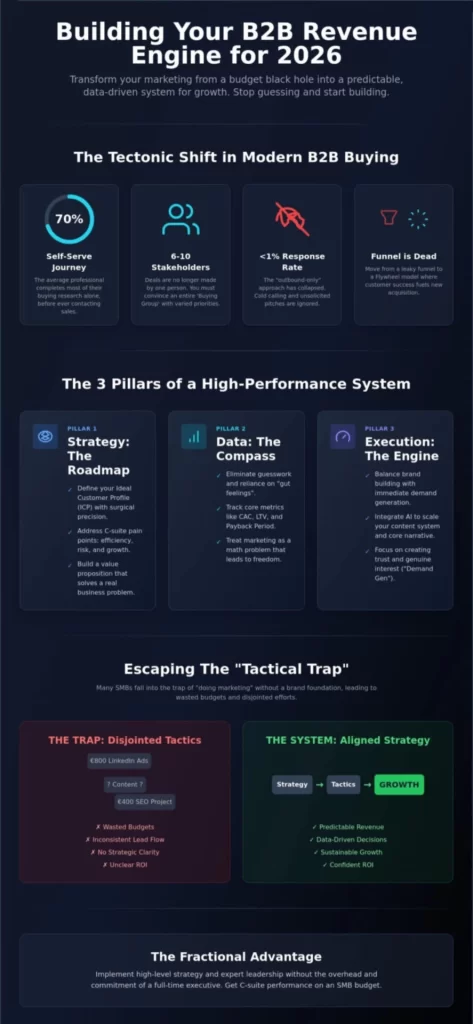
Think of your b2b marketing strategy as a roadmap. It’s the vital bridge that connects your solution to a specific, painful business problem. If that bridge is shaky, your growth will stall. It’s not your fault if the old playbook feels broken; the ground has shifted under everyone’s feet. By 2026, the “outbound-only” approach has hit a wall. Cold calling response rates have plummeted to below 1% across most sectors. Buyers are no longer waiting for a pitch. They’re taking control.
The rise of the self-serve buyer is the biggest change we’ve seen in a decade. Research from 2024 shows that the average professional completes 70% of their buying journey alone. They’re reading reviews, comparing features, and vetting your reputation in secret. If you aren’t visible and helpful during this silent phase, you’ve lost the deal before it even starts. This shift requires a total rethink of how we define a Business-to-business (B2B) relationship.
You aren’t selling to a single person anymore. You’re selling to a “Buying Group.” On average, 6 to 10 stakeholders now have a seat at the table for every major purchase. Each one has different fears and goals. Your strategy must speak to the CFO’s need for ROI just as clearly as it speaks to the end-user’s need for efficiency. Are you providing the right fuel for every member of that group?
The Death of the Linear Sales Funnel
The “leaky funnel” is an outdated metaphor that treats your customers like numbers dropping through a sieve. It’s time to embrace the Flywheel. In this model, customer success becomes the primary engine for new acquisition. We’re moving away from aggressive “Lead Gen” toward “Demand Gen.” This means creating genuine interest and trust in a digital-first world so that when a lead finally reaches out, they’re already convinced of your value.
Why SMBs Struggle with Strategic Clarity
Many small and medium businesses fall into the “Tactical Trap.” They might spend €400 on a random SEO project or €800 on LinkedIn Ads without a brand foundation. This lack of leadership leads to disjointed agency management and wasted budgets. Strategic Marketing is the alignment of business goals with customer needs. It’s the difference between “doing marketing” and actually driving growth.
Think of your marketing as a tripod. If one leg is shorter than the others, the whole structure wobbles. In the business-to-business world, we often see companies sprinting toward execution before they even know who they’re talking to. This creates a “Budget Burn” scenario where you spend thousands on ads or content that simply doesn’t convert. To build a b2b marketing strategy that actually scales, you need three balanced pillars: Strategy, Data, and Execution.
Strategy: The Foundation of Every Deal
Strategy isn’t a dusty document in a drawer. It’s your roadmap to freedom. You need to identify your Ideal Customer Profile (ICP) with surgical precision. Don’t just settle for “manufacturing companies with 50 employees.” Look for the pain points that keep their COO awake at 2:00 AM. Your value proposition must speak directly to C-suite priorities: efficiency, risk mitigation, and bottom-line growth. If your messaging feels generic, you’re losing money every day. You can fix this quickly through The Brand Positioning Sprint, which helps you find that unique angle without the bloated agency fees.
Data: Eliminating the Guesswork
Stop relying on gut feelings. Marketing is a math problem that leads to personal freedom. For a successful 2026 market entry, you should track three core metrics: Customer Acquisition Cost (CAC), Lifetime Value (LTV), and Pipeline Velocity. If a lead takes six months to close, you need to know why. Using a Marketing Diagnostic Service can help you spot where revenue is leaking out of your funnel before you scale your spend. For most mid-market firms entering new territories in 2026, setting aside a testing budget of at least €4,000 is a realistic starting point to gather meaningful data.
Execution & Systems: Building the Machine
The goal is to build a system that runs even when you aren’t watching. High-performing teams don’t just “post on social media.” They follow a repeatable process for demand generation. This includes following B2B content marketing best practices to ensure every piece of material serves a specific stage of the buyer journey. When your execution is systematized, your marketing becomes an asset, not an expense.
Staying on top of these systems is easier when you have the right mentors in your corner. If you’re looking for the latest fractional CMO developments in the Baltics and Poland, you should join the Budget Boosters Newsletter. You’ll get actionable advice delivered to your inbox, plus our free ebook, “The CMO Edge” (a €29 value), to help you outperform the competition. It’s time to turn your marketing into a predictable engine for growth.
Do you ever feel like you’re running on a treadmill? You’re working hard to capture leads today, but the moment you stop spending on ads, the pipeline dries up. This happens when your b2b marketing strategy is tilted too far toward short-term gains. To build a business that thrives in 2026, you must play two games at once. You need to capture the 5% of the market ready to buy right now while simultaneously building “mental availability” for the other 95%.
Think of brand building as the floor for your future efficiency. When potential clients recognize your name and trust your expertise, your sales team doesn’t have to start from zero in every meeting. A balanced budget keeps your engine running. For a monthly marketing spend of €4,000, a smart move is to allocate €2,400 to long-term brand positioning and €1,600 to direct demand generation. This 60/40 split ensures you aren’t just surviving today, but also owning tomorrow.
Demand Generation: Filling the Pipeline
Demand generation is your tool for immediate cash flow. You shouldn’t wait for customers to find you; you need to meet them where they’re already looking. LinkedIn is a goldmine for this, especially when you use search intent data to identify active buyers. Focus your efforts on creating high-intent content. These are resources like comparison guides, ROI calculators, or technical whitepapers that help a prospect who is already 70% through their decision-making process. To ensure your efforts are paying off, keep a close eye on your performance metrics. You can use a B2B Marketing KPIs Checklist to track whether your demand engine is actually converting or just generating noise.
Brand Positioning: Winning the Long Game
Brand isn’t a luxury; it’s a financial lever. High-quality thought leadership reduces your cost per acquisition (CPA) because it builds trust before a sales call even happens. When you position your leadership as experts, you stop being a “boring” professional service and start being a partner. We saw this clearly when turning a CEO’s LinkedIn profile into an €80,000 deal pipeline. By sharing authentic insights instead of corporate jargon, the brand became the first choice when the prospect was ready to buy. A distinct brand voice is what separates you from the sea of identical competitors.
Building Your Content System and Integrating AI
Stop looking at content as a series of random tasks. It’s a revenue engine. To win in 2026, your marketing strategy needs a repeatable system, not just a few lucky posts. Start by auditing your current assets. You likely have “Hidden Gems” buried in old slide decks, internal emails, or client presentations. Research from Forrester suggests 65% of content in most companies goes unused. Don’t let your hard work rot in a folder. Repurpose it.
Define your core narrative next. What’s the one problem you solve better than anyone else? Build your content pillars around this. Once you have a foundation, use AI to scale. It’s your research assistant, not your replacement. Use it to find data or structure your thoughts. Then, distribute. Don’t post everywhere. Focus on the two or three channels where your buyers actually spend their time. This focused b2b marketing strategy ensures your message hits home every time.
Streamlining with AI Tools
AI shouldn’t write your brand’s soul. Use it for the heavy lifting like technical research or creating detailed outlines. This keeps you fast without sounding like a robot. Quality control is vital because the market is already drowning in generic AI text. You can learn how to do this right with 7 Practical Ways to Streamline Content Creation with AI. It’s about working smarter, not just harder, to maintain your unique voice.
The Content System Framework
Break the cycle of “one-off posts.” You need The Content System to create a predictable flow. Start with one “Hero” asset, like a deep-dive report or a webinar. You can slice this into 20+ micro-assets for social media and emails. This approach makes improving content ROI much easier. You’ll see exactly which pieces drive deals, allowing you to double down on what works for your b2b marketing strategy. It’s about creating a machine that grows with you.
Scaling Without a Full-Time Executive: The Fractional Advantage
Many CEOs fall into a dangerous trap. They try to “do marketing” in the gaps between sales calls and product development. It doesn’t work. A 2023 industry report found that 46% of small business owners spend less than two hours a week on high-level growth planning. This lack of focus leads to wasted ad spend and inconsistent messaging. You don’t need to struggle with these decisions alone, but you might not be ready for a six-figure hire yet.
A Fractional CMO (fCMO) solves this leadership gap. They provide senior-level expertise for a few days a month. They don’t just manage social media posts; they build your b2b marketing strategy as a scalable system. This professional takes ownership of your growth roadmap, managing vendors and internal teams so you can focus on your role as CEO. It’s about gaining strategic clarity without the overhead of a full-time executive.
The financial logic is clear. Hiring a full-time marketing director in 2024 often requires a budget of €115,000 annually when you include benefits and taxes. A fractional leader provides the same strategic depth for approximately €3,200 to €5,600 per month. You get 15 years of experience for less than the cost of a mid-level manager. This allows you to reinvest those savings directly into your lead generation campaigns.
Ready to stop guessing? Your first step is to identify where your current engine is leaking. You can learn how to perform a Marketing Audit to find these gaps. It’s a practical way to assess your data, tools, and content before you spend another Euro on ads.
Frequently Asked Questions
What is the first step in creating a marketing strategy?
Your first step is conducting a deep-dive market audit to understand your ideal customer profile. You can’t build a growth engine without knowing who pays the bills. Research from Gartner in 2023 shows that 70% of successful campaigns start with direct customer interviews. Map out your buyer’s journey before you spend a single cent on ads.
How much should an SMB spend on marketing in 2026?
Plan to invest between 6% and 9% of your total annual revenue. For a company earning €1,000,000, this means a budget of roughly €64,000 to €88,000 after adjusting for currency and efficiency. This investment ensures your b2b marketing strategy remains competitive in a crowded digital space. High-growth firms often push this to 12% to capture market share quickly.
What is the difference between demand generation and lead generation?
Demand generation creates interest in your brand, while lead generation captures contact details for sales follow-up. Think of demand as the engine that warms up the market. Lead gen is the net that catches the fish. According to 2024 HubSpot data, companies focusing on demand generation see a 20% increase in lead quality. You need both to build a sustainable system.
Can I build a marketing strategy using only AI tools?
You can’t rely solely on AI because these tools lack the human empathy and strategic nuance required for complex sales. Use AI to automate 40% of your content production or data analysis. A 2024 McKinsey report highlights that human-led strategy combined with AI execution yields 15% higher ROI. AI is your co-pilot, not the captain of your growth roadmap.
How long does it take to see results from a new marketing system?
Expect to see initial traction within 3 to 6 months, with full system maturity at the 9-month mark. Marketing isn’t a sprint; it’s a structured build-out of your brand authority. Data from the Content Marketing Institute in 2023 indicates that 62% of successful companies stick to their plan for at least 270 days before pivoting. Patience pays off in predictable revenue.
Why do most marketing strategies fail for small businesses?
Most strategies fail because they lack a cohesive system and consistent execution. Small businesses often jump between tactics without a solid foundation. In 2023, a study found that 55% of SMBs stop their campaigns after just 60 days. You need a roadmap that integrates your goals with real-time data to stay on track. If you want to master these systems, join the Budget Boosters Newsletter. It’s the most comprehensive channel for fCMO developments in the Baltic countries and Poland, and you’ll get a free copy of “The CMO Edge” ebook, a €29 value.
What is a marketing audit and do I really need one?
A marketing audit is a comprehensive health check of your current assets, channels, and performance. You absolutely need one to stop wasting money on dead-end tactics. An audit reveals where your €1,000 investment actually turns into €5,000 in revenue. It’s the diagnostic tool that prevents expensive mistakes in your growth journey.
How do I know if I need a Fractional CMO or a marketing agency?
Hire a Fractional CMO if you need high-level strategy and leadership without the €140,000 annual salary of a full-time executive. Choose an agency if you already have a plan and just need hands to execute tasks like SEO or design. A Fractional CMO builds the system; the agency runs the machines. This approach helps you make better decisions without requiring a full-time marketing director.

Article by
Aurimas Guoga
Aurimas Guoga is a fractional CMO and founder of Budget Boosters, helping B2B companies turn fragmented marketing into a predictable growth engine. With over a decade of experience leading marketing strategy, he works with business leaders to improve ROI, build scalable systems, and drive measurable revenue growth. Aurimas is also the author of The CMO Edge, a guide for companies looking to gain a competitive advantage through senior marketing leadership.