Did you know that while 40% of marketers identify LinkedIn as their most effective channel, the average cost to earn a lead in 2026 has climbed to approximately €72? You’ve likely felt the frustration of a full pipeline that somehow never turns into closed deals. It’s exhausting to watch your budget disappear into a black box while your sales and marketing teams speak completely different languages. You deserve a system that provides clarity and control over your growth, rather than a pile of spreadsheets that don’t make sense.
This guide will show you how to master b2b demand generation to shift from chasing names to earning authority. You’ll learn how to build a predictable revenue engine that aligns your teams and shortens your sales cycles. We’ll dive into the 2026 GDPR updates and show you how to use AI to drive measurable ROI. To stay ahead, join the Budget Boosters Newsletter. It’s the most comprehensive channel for fCMO developments in the Baltics and Poland. You’ll even get our ebook, “The CMO Edge,” a €29 value, for free when you subscribe here.
Key Takeaways
- Escape the treadmill of low-quality leads and learn to build a marketing system that delivers predictable revenue and long-term growth.
- Master the art of b2b demand generation to earn authority and stimulate buyer interest well before they enter the active search phase.
- Understand the vital difference between creating demand and capturing it to ensure your budget is invested where it drives the highest ROI.
- Use a simple framework to define your ideal customer and map their journey, removing the friction that slows down your sales cycle.
- Bridge the leadership gap in your business by applying senior-level strategy that scales your growth without the cost of a full-time director.
Why Your Current Marketing Feels Like a Treadmill
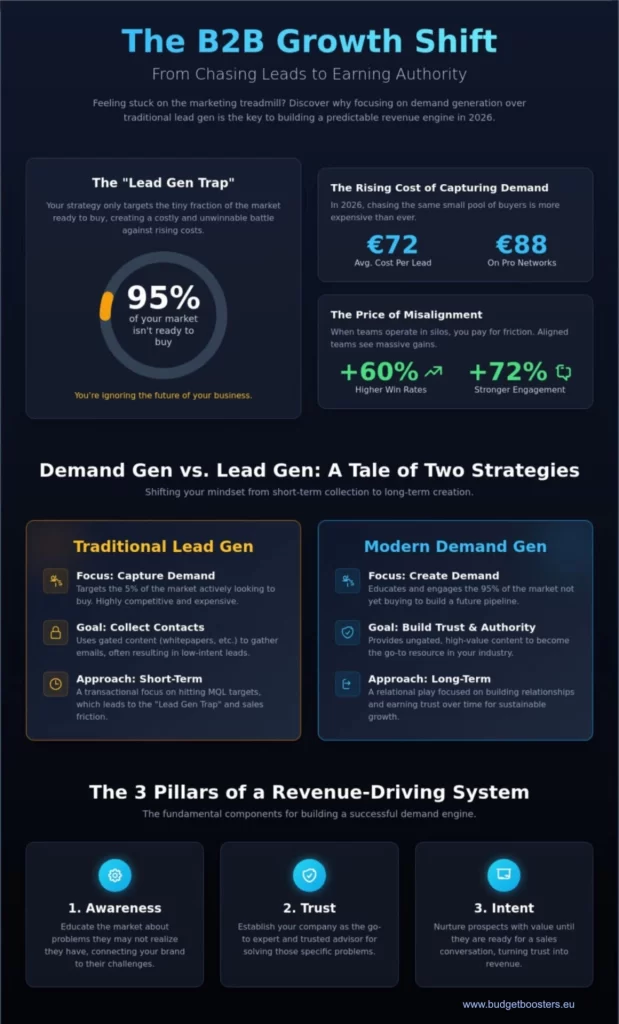
Do you feel like you’re running as fast as you can just to stay in the same place? It’s a common frustration for founders in May 2026. You’re hitting your lead targets, yet your revenue hasn’t moved an inch. This is the “Lead Gen Trap.” You’ve likely spent thousands on ads only to see your sales team roll their eyes at the results. Research shows that roughly 95% of your target market isn’t ready to buy right now. If your strategy only focuses on the tiny 5% who are already looking, you’re fighting a losing battle against rising costs. You’re chasing a shrinking pool of buyers while ignoring the future of your business.
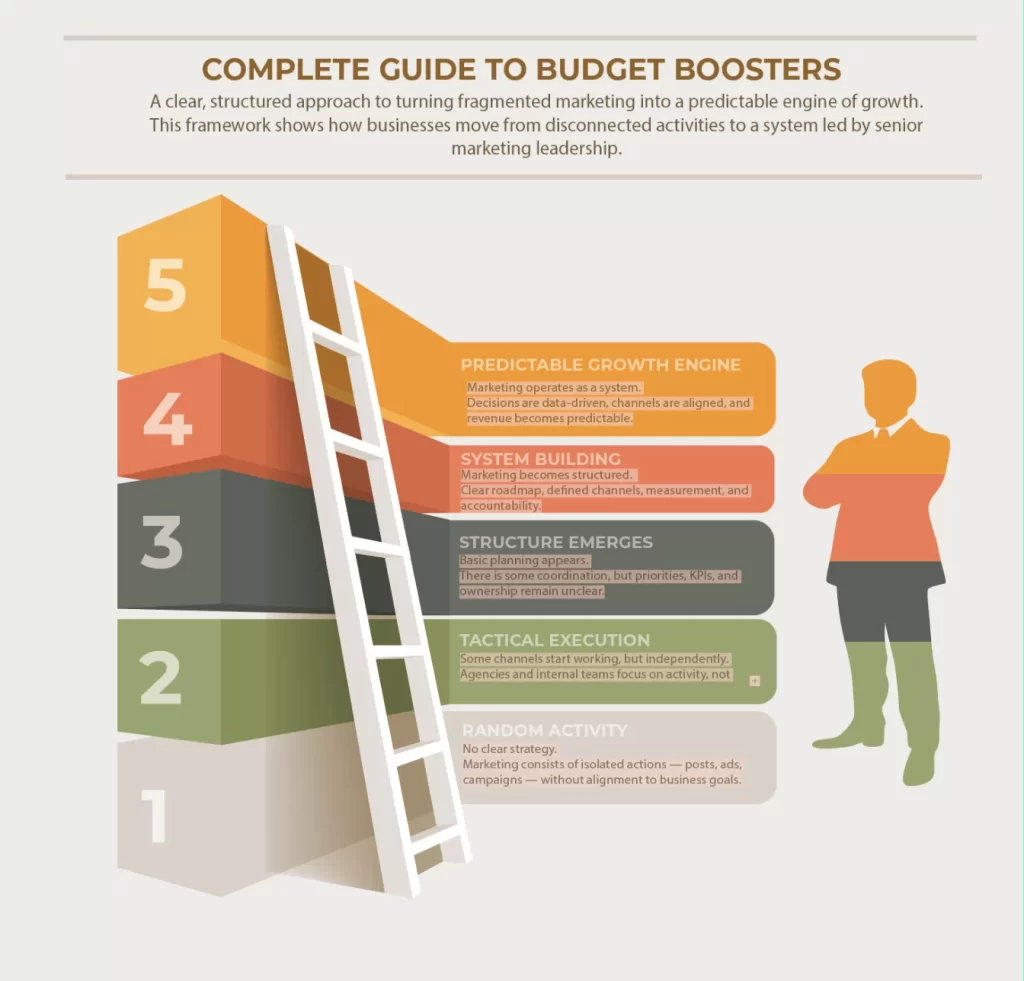
Many companies fall into “Random Acts of Marketing.” One week it’s a new social media trend, the next it’s a cold email blast. These disconnected tactics drain your budget without building any momentum. They lack a cohesive structure and a clear goal. Without a proper system, your marketing feels like a black box where money goes in, but predictable growth doesn’t come out. This is where a strategic approach to b2b demand generation changes everything. It’s about moving from disjointed campaigns to a revenue-driving engine that earns authority and trust over time.
The High Cost of Poor Sales and Marketing Alignment
When your teams operate in silos, you’re paying for friction. Marketing celebrates “leads” that Sales can’t use. This mismatch in KPIs directly impacts your bottom line. Aligned teams see 60% higher win rates and 72% stronger customer engagement. You need a unified roadmap to succeed. Our guide on Sales and Marketing Alignment shows you how to bridge this gap. It’s about ensuring every euro you spend works toward the same goal: revenue, not just a higher count of email addresses.
From Chasing Leads to Earning Authority
Capturing demand is becoming increasingly expensive. In 2026, the average cost per lead on professional networks has reached approximately €88. Creating demand is a smarter investment. It’s about building trust before a prospect even realizes they have a problem. What is demand generation? It’s the process of building awareness so that when a buyer is ready, you’re their first choice. You stop being just another vendor and become a trusted advisor. This shift requires a system, not just a series of lucky ads. It gives you the control and freedom you need to grow sustainably.
What is B2B Demand Generation? (And Why It Is Not Just Lead Gen)
Think of demand generation as the engine under the hood of your business growth. It’s not a single campaign or a clever headline. It’s a comprehensive system designed to drive revenue by building long-term relationships. While traditional lead generation focuses on the “capture,” b2b demand generation starts much earlier. It stimulates interest and creates awareness long before a prospect is even thinking about a purchase. You’re not just finding buyers; you’re creating them. This approach gives you the freedom to build a pipeline that doesn’t dry up the moment you turn off your ads.
Many founders confuse brand building with demand generation. Brand building tells the world who you are and what you stand for. It’s essential for trust, but it doesn’t always move the needle on sales. Demand generation takes that brand and gives it a job. It connects your identity to a specific problem your audience faces. It turns your reputation into a reason to buy. This is a long-term play for sustainable growth. It’s about building a system that earns authority and fills your pipeline with people who are already convinced of your value.
The Fundamental Pillars of Demand Generation
A successful system stands on three pillars. First is awareness. You must educate the market about problems they might not even realize they have. Second is trust. You establish your firm as the go-to expert for the solution. Third is intent. You nurture those prospects until they’re ready for a sales conversation. To help you structure this, you can explore 9 demand generation strategies that focus on building this momentum step-by-step. It’s about moving prospects through a logical journey from “Who are you?” to “How can we work together?”
Demand Gen vs. Lead Gen: A Side-by-Side Comparison
Lead generation is often transactional. It relies on gated content like whitepapers to collect email addresses. It’s short-term and often results in the “lead gen trap” we discussed earlier. Demand generation is the opposite. It focuses on ungated value. You give away your best insights for free to build authority. While you need both, demand generation must lead your strategy. It ensures that when you finally “capture” a lead, they already know, like, and trust you. This makes the sales process much smoother and faster for everyone involved.
Building this system doesn’t have to be a mystery. If you want to see how this works in the real world, take a look at our case study on turning a CEO’s profile into a deal pipeline. It’s a perfect example of creating demand through authority. For more practical insights on building high-performing content systems, join our Budget Boosters Newsletter. You’ll receive “The CMO Edge: Why Companies with Senior Marketing Leadership Outperform – and How to Get There” ebook (a €29 value) for free when you subscribe here. It’s the most comprehensive channel for marketing leadership in the Baltic region and Poland.
The Three Pillars of a Revenue-Driving System
Building a marketing system that actually grows your business isn’t about luck. It’s about balance. Think of your revenue engine as a structure supported by three critical pillars. When you have all three working in harmony, you stop guessing and start growing. This approach transforms b2b demand generation from a series of “random acts” into a predictable roadmap for success. You gain the freedom to focus on your vision because your pipeline is finally taking care of itself. It’s a level of control that every founder deserves.
These pillars aren’t silos. They’re a continuous loop. Creating demand builds the spark of interest. Capturing demand ensures you’re there when that spark turns into a search. Lead generation provides the final invitation for a conversation. If you only focus on one, your system will lean and eventually fail. If you only capture demand, you’re fighting for the same 5% of the market as everyone else. By building all three, you own the entire journey from the first “hello” to the final handshake.
Pillar 1: Creating Demand Through Authority
This is where you educate the 95% of the market that isn’t buying today. You don’t do this with sales pitches. You do it with high-value insights that solve real problems. Your leadership team is your best asset here. In fact, 40% of marketers identify LinkedIn as their most effective channel for building this type of trust. When your CEO shares expertise, they aren’t just posting; they’re building a deal pipeline. You can see this in action in our case study on Turning a CEO Profile into an €80k Pipeline. Authority is the currency of the modern market.
Pillar 2: Capturing Existing Market Demand
While you create demand for the future, you must also be visible to the “hand-raisers” who are ready to buy now. These are the people actively searching for solutions on Google or review sites. They’re giving off intent signals that you can’t afford to ignore. Capturing demand means being the obvious choice when they look for advice. It’s about optimizing your presence so that you’re the first name they see when they’re ready to make a decision. This pillar ensures that the authority you’ve built actually converts into revenue when the timing is right for the buyer.
The final piece is lead generation. This is the simple act of converting that ready-to-buy interest into a demo request or a contact form submission. It’s the destination of the journey you’ve built. When these three pillars interact, they create a high-performing system that shortens your sales cycles and increases your win rates. You’re no longer just a vendor; you’re the expert they’ve been following for months. That makes the final sale feel like a natural next step rather than a difficult mountain to climb.
A Simple Framework for Building Your Demand Engine
You don’t need a massive budget to build a growth engine. You just need a logical sequence. Most companies jump straight to tactics, but that’s like trying to build a house without a blueprint. A proper framework for b2b demand generation gives you the structure to scale with confidence. It replaces the anxiety of wondering where the next lead is coming from with a clear, step-by-step path to revenue. This isn’t a dry mathematical exercise; it’s the road to your personal and professional freedom.
First, define your Ideal Customer Profile (ICP). Go beyond basic demographics like company size. In May 2026, buyers are part of complex committees. You need to understand their daily frustrations and their “influence network.” Second, map the buyer’s journey. Identify where they get stuck. Is it your pricing page? Is it a lack of social proof on LinkedIn? Third, build a system to distribute value. Fourth, sit down with your sales team. Agree on what a “qualified” lead actually looks like. Finally, track your pipeline velocity. How fast do deals move from the first “hello” to a closed contract?
Building Your Content System for 2026
Producing enough high-quality content can feel overwhelming. AI is your ally here, but only if you use it to enhance your voice, not replace it. Over 80% of marketers use AI in their strategy, yet few use it to drive real impact. You can learn 7 practical ways to streamline content creation with AI to save time and maintain your authority. The goal is to produce more value with less manual labor. For a deeper dive into modern production, check out our AI for Content Creation guide. It’s about working smarter so you can focus on the big picture.
Measuring What Matters: ROI and Pipeline Health
Stop obsessing over clicks and downloads. They’re vanity metrics that don’t pay the bills. In 2026, the average cost per lead across all channels is approximately €72. If those leads don’t convert, you’re just burning cash. Instead, calculate the marketing impact on total revenue. Focus on the cost of acquiring a customer compared to their lifetime value. If you want to dive deeper into these numbers, our resource on improving content ROI provides the exact formulas you need. When you measure what matters, you gain the clarity to make better decisions for your future.
Ready to take control of your growth? Build your own content system today and start turning your expertise into a predictable revenue engine.
Scaling Demand Without a Full-Time Marketing Director
You’ve built a solid foundation, and your team is working hard. But you’re still missing that high-level strategy that ties every tactic together. This is the “Leadership Gap” many growing companies face. Great tactics fail without a senior roadmap to guide them. You need a system that runs itself, and that requires a senior architect. This is about moving from “gut feeling” to data-driven growth. It’s the shift that gives you back your time and provides the freedom to focus on your long-term vision.
In 2026, you don’t need a full-time executive to get executive-level results. A Fractional CMO provides the roadmap and the oversight without the burden of a massive salary. They act as a practical coach for your team, helping you master b2b demand generation through a system that combines strategy, data, and execution. This approach removes the guesswork. It ensures every euro you spend is an investment in your future, not just a temporary fix. You deserve a marketing system that works as hard as you do.
Is a Fractional CMO the Right Move for Your Business?
Are your marketing efforts feeling disjointed despite a high volume of leads? If your team is hitting “publish” but your revenue is stalling, you’ve likely outgrown your current setup. An interim leader doesn’t just give advice; they build the infrastructure. They integrate into your existing structure and align your sales and marketing efforts. You can learn more about how this works in our guide: What is a Fractional CMO?. It’s about getting the right leadership at the right time to boost your results.
Next Steps: Auditing Your Current System
Don’t start another campaign yet. Start with a diagnostic. Identify where your budget is leaking and where your pipeline is stuck. A marketing audit is the first step to scaling efficiently. It helps you identify immediate improvements that save your budget and increase your ROI. This clarity is the ultimate booster for your business growth. It’s time to stop chasing and start building a system that earns authority and drives predictable revenue.
Frequently Asked Questions
What is the main difference between lead generation and demand generation?
b2b demand generation is a strategic system focused on building long-term awareness and trust rather than just collecting email addresses. While lead generation is often transactional and relies on gated content, demand generation educates the 95% of your market that isn’t ready to buy right now. It ensures that when they are ready, your brand is the first choice they think of because you’ve already provided massive value.
How long does it take to see results from a demand generation strategy?
You should expect to see significant momentum within 3 to 6 months of launching a consistent strategy. While quick wins happen, building earned authority takes time. This is a long-term play for sustainable growth that replaces the stress of constant lead chasing with a predictable revenue engine. Consistency is your best friend during this period as you build trust with your future customers.
Can a small business with a limited budget do demand generation?
Yes, small businesses can effectively run demand generation by focusing on high-authority organic channels like LinkedIn. You don’t need a massive ad spend if you provide genuine value. Focus on a simple framework that maps your buyer’s journey and addresses their specific friction points. This approach allows you to compete with much larger players by being more helpful and human in your communication.
What are the most effective demand generation channels in 2026?
LinkedIn remains the top channel for 40% of marketers, especially with its real-time CRM integration. Video content is currently the fastest-growing format on the platform. Other key areas include “dark social” channels and niche newsletters where your audience already spends their time seeking advice. The goal is to show up where your buyers are already learning, rather than forcing them into your own silos.
How do I measure the ROI of my demand generation activities?
Measure your success through pipeline velocity and the cost of customer acquisition (CAC) rather than simple clicks. Look at how much marketing contributes to total revenue. In May 2026, the average cost per lead is approximately €72, so you must track how many of those actually turn into closed deals. This focus on revenue rather than vanity metrics gives you the clarity to make better decisions.
Do I need a full-time marketing manager to run a demand gen engine?
You don’t need a full-time director to manage a high-performing system. Many companies use a fractional CMO to provide senior strategy without the cost of a six-figure salary. This allows you to scale your b2b demand generation efforts professionally while keeping your overhead low. It’s about getting the right leadership at the right time to help your team execute a clear growth roadmap.
What role does AI play in modern demand generation systems?
AI is no longer just for writing; it’s used by 80% of marketers for autonomous research and real-time lead routing. AI agents help you enrich data and score leads based on their actual behavior. This technology allows you to act as a much larger team by automating the repetitive tasks that drain your energy. It gives you the freedom to focus on high-level strategy and creative thinking.
How do I align my sales team with our new demand generation efforts?
Alignment happens when both teams share the same revenue goals and definitions of a “qualified” lead. Aligned teams see 60% higher win rates. Hold regular feedback loops where Sales can share the quality of the conversations they’re having. This ensures Marketing stays focused on what actually drives growth. When both teams work toward the same vision, the friction in your buyer journey disappears.

Article by
Aurimas Guoga
Aurimas Guoga is a fractional CMO and founder of Budget Boosters, helping B2B companies turn fragmented marketing into a predictable growth engine. With over a decade of experience leading marketing strategy, he works with business leaders to improve ROI, build scalable systems, and drive measurable revenue growth. Aurimas is also the author of The CMO Edge, a guide for companies looking to gain a competitive advantage through senior marketing leadership.