
What if the reason your marketing feels like a black hole isn’t your budget, but the lack of a structural blueprint? You’ve probably felt the frustration of spending money on agencies without seeing a single qualified lead. It’s exhausting when the CEO has to be the default marketing director just to keep things moving. This happens because many companies lack a cohesive brand positioning strategy that actually connects with their market. You aren’t alone in this, and it isn’t your fault that the current systems feel fragmented.
You deserve a system that works as hard as you do. We’re going to help you transform that scattered activity into a predictable growth engine. In this guide, we’ll explore the 2026 roadmap for scaling SMEs across the Baltics and Poland. You’ll discover how to create clear differentiation that your sales team can finally use to win. We will break down the structural art of positioning so you can lower your CAC and regain your personal freedom. It’s time to stop guessing and start building a foundation that scales. Let’s get started.
Key Takeaways
- Master your B2B brand positioning strategy to turn chaotic marketing into a governed, predictable growth engine.
- Uncover your “Technical Truth” and build an Ideal Customer Profile that your sales team can actually use to close deals.
- Move from vague value claims to sharp problem-solving angles that resonate with the specific pains of your target market.
- Learn why SMEs in the Baltics and Poland are transitioning from fragmented execution to senior-led marketing systems.
- Gain the strategic oversight of a senior marketing brain without the heavy financial burden of a full-time executive salary.
Table of Contents
What is a B2B Brand Positioning Strategy and Why Does it Matter?
Think of positioning as the structural blueprint for your company’s growth. It isn’t just a catchy tagline or a polished logo. It’s the deliberate process of defining how your business is perceived to drive specific commercial outcomes. When you master your B2B brand positioning strategy, you stop shouting into the void and start whispering directly into the ears of your ideal clients. It’s about claiming a unique space in the market that your competitors can’t touch.
In a scaling SME, this strategy acts as a “Technical Supervisor” for all your marketing activities. Without it, you’re just doing things. You’re posting on LinkedIn because everyone else is; you’re running ads because an agency told you to. A clear market stance shifts you from activity-driven chaos to a system-driven engine. It ensures that every euro you spend and every post you publish serves a single, unified purpose. To truly understand What is Brand Positioning?, you must view it as the foundation of your entire commercial architecture.
SMEs that invest in senior leadership to guide this process consistently outperform those relying on fragmented execution. Why? Because a senior leader builds a system while a junior hire just manages tasks. Our latest Fractional CMO Landscape Research 2026 highlights that companies in Poland and the Baltics are increasingly ditching the “trial and error” approach. They’re moving toward governed structures that align marketing directly with sales goals.
The Cost of Poor Positioning in 2026
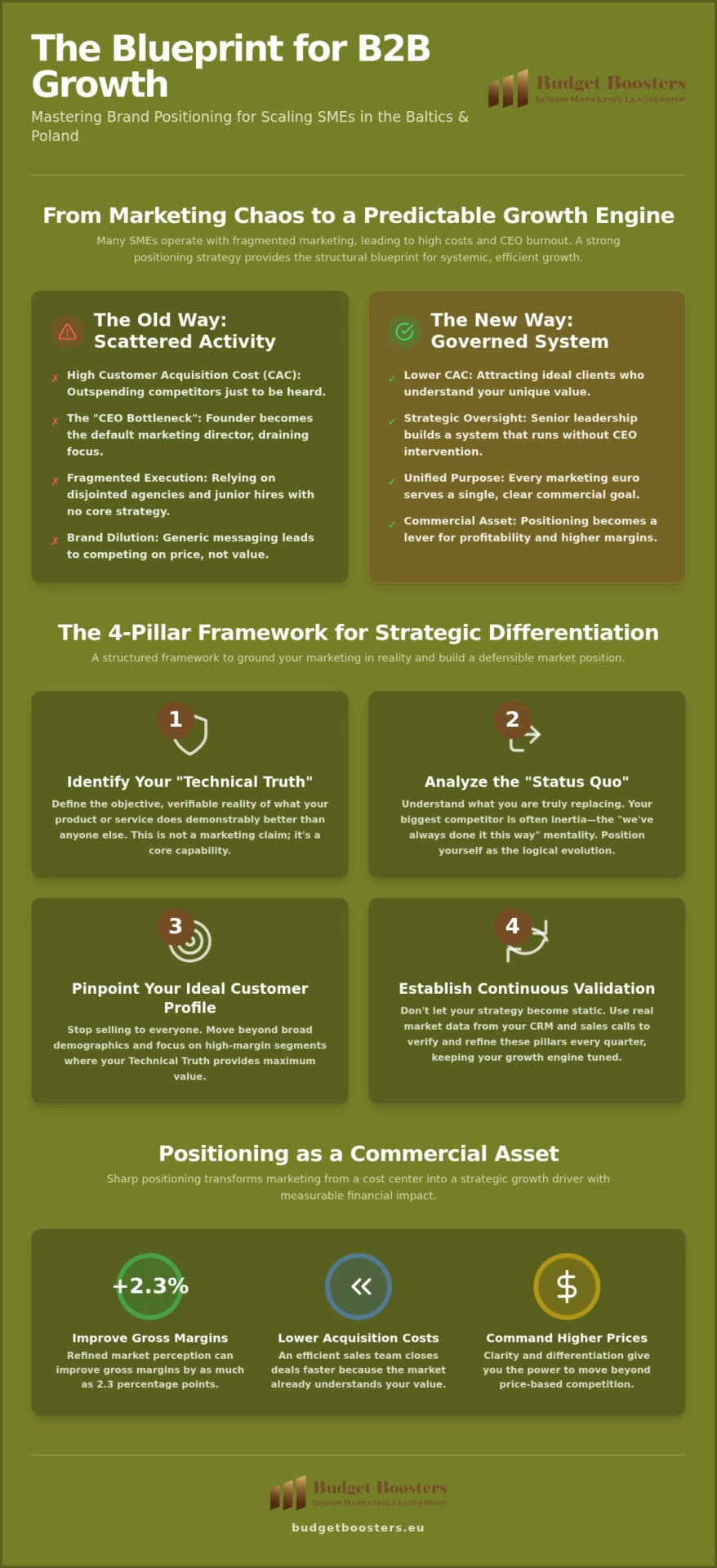
Generic messaging is expensive. If your brand sounds like everyone else, your Customer Acquisition Cost (CAC) will skyrocket. You’re forced to outspend competitors just to be noticed. This creates the “CEO bottleneck,” where the business owner becomes the default decision-maker for every minor campaign. It’s exhausting. It drains your mental energy and prevents you from focusing on high-level scaling. When you rely on fragmented agency work without a core strategy, your brand equity dilutes over time. You become a commodity, and commodities always end up in a race to the bottom on price.
Positioning as a Commercial Asset
Smart positioning is a lever for profitability. Research suggests that refining your market perception can improve gross margins by as much as 2.3 percentage points. It transforms your marketing from a tactical cost into a strategic growth engine. When your positioning is sharp, your sales team becomes more efficient. They don’t waste time explaining who you are; the market already knows. This clarity gives you the power to command higher prices and close deals faster. It’s the difference between chasing leads and attracting the right partners who value your specific “Technical Truth.”
The 4-Pillar Framework for Strategic Differentiation
Building a B2B brand positioning strategy requires more than a brainstorming session. It demands a structural framework for strategic differentiation that grounds your marketing in reality. You need to identify your “Technical Truth.” This is the objective reality of what your service does better than anyone else. It isn’t just a marketing claim. It’s a verifiable fact that your product or service delivers. When you find this truth, you gain the confidence to lead your market rather than follow it.
Next, you must analyze the “Status Quo.” Ask yourself: what are you really replacing in the customer’s mind? Often, your biggest competitor isn’t another company. It’s inertia. It’s the “we’ve always done it this way” mentality. By understanding what you’re replacing, you can position your solution as the only logical step forward. This shift gives you back control over your sales cycle. It turns your marketing into a tool for personal freedom because you’re no longer fighting invisible battles.
Finally, you need a repeatable cadence for validation. Don’t let your strategy sit on a shelf. Use real market data from your CRM and sales calls to verify these pillars every quarter. This keeps your growth engine tuned. It prevents your messaging from becoming stale or disconnected from the reality of Polish and Baltic business environments.
Pinpointing Your Ideal Customer Profile
Stop trying to sell to everyone. It’s the fastest way to burn your budget. You need to move beyond simple demographics like “SMEs in Poland.” Focus on high-margin segments where your Technical Truth shines brightest. We use the “Pinpoint Your People” framework to identify the specific financial drivers that make a lead worth your time. A focused ICP reduces wasted ad spend. It improves conversion rates because your message actually lands with the person feeling the pain.
Mapping Features to Audience Challenges
Your customers don’t care about your features until they understand how those features solve their specific problems. Use a “Value Map” approach to turn technical specs into business outcomes. But be careful. Leading with outcomes is a mistake if you haven’t established the “What” first. You need to prove you can do the job before you promise the moon. This alignment is the secret to Improving your content ROI and building a system that lasts.
If you want to stay ahead of marketing technology and high-performing content systems, consider joining our community. You can subscribe to the Budget Boosters Newsletter for practical insights and simple frameworks designed for growth. When you join, you’ll receive a free copy of our ebook, The CMO Edge. Why Companies with Senior Marketing Leadership Outperform – and How to Get There (a €29 value). It’s a great way to start building your own marketing system without the need for a full-time director.
Selecting Your Market Angle: From Value to Problem-Solving
Choosing the right angle for your B2B brand positioning strategy is like selecting the lens for your company’s future. It determines what your customers notice first when they encounter your brand. Some companies thrive on Value-Based Positioning. This approach anchors your identity to ROI and strict financial discipline. It speaks the language of CFOs who need to see a clear return before signing a check. It’s about proving that your solution isn’t a cost, but a smart investment.
Others find success with Problem-Solution Positioning. Here, you focus entirely on the specific “pain” of the business leader. You acknowledge the sleepless nights caused by the CEO bottleneck or the frustration of paying agency fees that yield no qualified leads. When you name the problem better than your customer can, they instinctively trust you with the solution. You’re no longer just a vendor; you’re a partner who understands their reality.
You might also consider Attribute-Based Positioning. This means leading with a unique technical or architectural advantage. If your system is built differently or more efficiently, say so. This angle works best when you have a clear “Technical Truth” that competitors simply cannot replicate. It provides a solid foundation for clear differentiation that your sales team can actually use to win deals.
The Role of AI in Modern Positioning
AI is a powerful ally for validating market gaps and spotting competitor weaknesses. You can use AI shortcuts to cut your analysis time from days to hours. This rapid data analysis allows you to pivot your messaging before the market even realizes it’s stale. By integrating these tools, you can preserve your unique brand voice while your content production time drops by 65%. If you want to master this, explore 7 Practical Ways to Streamline Content Creation with AI to see how technology fuels your growth.
Stay Ahead with the Budget Boosters Newsletter
Building a predictable growth engine requires staying informed about industry trends in the Baltics and Poland. Marketing should be a system that integrates strategy, data, and execution. Our newsletter provides the simple frameworks and ROI-focused thinking you need to make better decisions without a full-time marketing director. When you join our community, you’ll receive practical insights delivered straight to your inbox. Plus, you’ll get a free copy of our ebook, The CMO Edge. Why Companies with Senior Marketing Leadership Outperform – and How to Get There. This is a €29 value that explains why senior leadership is the key to outperforming your competition. It’s time to build a system that works for you.
Implementation Realities in the Baltic and Polish Markets
The Polish and Baltic markets are maturing at an incredible pace. We’re seeing a massive shift from fragmented execution to senior-led systems. Business owners in Warsaw, Tallinn, and Vilnius are realizing that “trying things out” is a luxury they can’t afford. They’re moving away from hiring junior staff who just follow orders. Instead, they’re looking for part-time senior leadership to build a robust Marketing Operating System. This transition is about governance and accountability. It’s about ensuring every activity aligns with your overall B2B brand positioning strategy.
You need evidence-based growth to succeed in this region. We look at Eurostat data and global insights to understand the local nuances. For instance, Poland has over 4.8 million registered enterprises. With 97 percent being micro-enterprises, the competition for attention is fierce. Deals over €40 000 now involve an average of 11.2 stakeholders. You can’t win those deals with scattered activities. You need a system that builds trust across the entire buying committee without the CEO being involved in every single email or post.
The Fractional CMO Landscape Research 2026
Growth-stage firms across our region are restructuring for efficiency. They’re moving from a “campaign manager” mindset to a “system builder” approach. This isn’t just about running ads. It’s about how marketing, sales, and data work together to create predictable revenue. Our Fractional CMO Landscape Research 2026 shows that companies are seeking real accountability. They want to know exactly how their investment translates into growth. You can download the report to see how your peers are navigating these changes and scaling more effectively.
Bridging the Gap to the Homepage
A great strategy is useless if it stays hidden in a PDF. You must translate that high-level B2B brand positioning strategy into a practical Go-to-Market sequencing plan. This means your website, your sales pitches, and even your social presence must tell the same story. Look at our case study on Turning a CEO’s LinkedIn profile into a €80 000 deal pipeline. It proves how alignment leads to tangible financial results. When your sales team uses the same positioning in every pitch, you reduce friction. You close deals faster because the buyer’s journey feels like a single, cohesive experience.
If you’re ready to stop the guesswork and start building a predictable engine, we can help. You can explore our Growth Programmes to see how senior-level oversight can transform your commercial outcomes.

Scaling with Senior Leadership: The Fractional CMO Advantage
Most SMEs eventually hit a growth ceiling. You have a great product, but your marketing feels like a collection of random acts. You know you need a sophisticated B2B brand positioning strategy to break through, but hiring a full-time marketing director is a massive commitment. A company earning €5M needs a CMO’s brain, but it doesn’t necessarily need a €220 000 annual salary on the payroll. This is where fractional leadership changes everything. It gives you access to high-level expertise without the executive price tag.
A fractional leader steps in as your “Technical Supervisor.” They don’t just manage campaigns; they build the systems that run them. They oversee your external agencies and internal teams, ensuring everyone stays aligned with the strategic blueprint. This oversight brings a level of governance that most scaling firms lack. Positioning isn’t a one-time project or a creative sprint. It is an ongoing system of governance. It ensures that as your market evolves in Poland or the Baltics, your brand remains the obvious choice for your customers.
The Marketing Operating System
We replace guesswork with a structured six-component framework. This system covers your ICP, Go-to-Market strategy, Channels, Measurement, Cadence, and Accountability. It turns marketing into a predictable department governed by financial discipline and data-driven roadmaps. When you have a clear plan, your team feels empowered rather than overwhelmed. You can explore the full details of this approach in our guide on The Modern Business-to-Business Marketing Strategy. It is the roadmap you need to move from “trying things” to “owning the market.”
Next Steps for Business Leaders
Ask yourself: is your marketing driving revenue or just consuming it? If the CEO is still the person making every small creative decision, you have a bottleneck, not a system. You can move from activity to impact in the next 90 days by implementing senior-level oversight. This transition isn’t just about business growth. It is about your personal freedom as a leader. Structured systems allow you to step back from the daily chaos and focus on the long-term vision. The path to a predictable growth engine is open. It’s time to take the first step toward a more professional, system-driven future.
Build Your 2026 Growth Engine
Your journey toward a system-driven business starts with a single, clear decision. By mastering your B2B brand positioning strategy, you stop the exhausting cycle of guesswork and start building a foundation that scales. You’ve seen how a structural blueprint and a sharp market angle can transform your commercial outcomes. In the competitive landscape of Poland and the Baltics, clear differentiation is no longer a luxury. It is a requirement for survival and a direct path to your personal freedom.
You can achieve this level of sophistication without the heavy overhead of a full-time executive. Fractional leadership provides the senior brain you need for €60 000 to €120 000, compared to the €250 000 or more required for a traditional hire. Our approach has already delivered a proven 22 percent increase in marketing efficiency for companies just like yours. We combine global insights with deep regional expertise to ensure your message lands exactly where it needs to. It’s time to take control of your processes and level up your performance.
Ready to turn your marketing into a predictable revenue driver? Build your predictable growth engine with a Fractional CMO and start your journey toward a more profitable future today. You have the vision. We have the system. Let’s make it happen together.

Frequently Asked Questions
What is the difference between brand positioning and a value proposition?
Positioning is the strategic “home” your brand occupies in the customer’s mind. It’s about how you compare to others and the specific space you own. Your value proposition is the promise of value you deliver to the client. Think of positioning as the map and the value proposition as the destination. You need both to build a successful B2B brand positioning strategy that actually drives revenue.
How often should an SME revisit its brand positioning strategy?
You should revisit your strategy at least once a year. Markets in Poland and the Baltics move fast. New competitors or technology can shift the status quo quickly. A regular health check ensures your “Technical Truth” still resonates with your target audience. If your CAC starts to creep up, it’s a clear sign that your market stance might need a tune-up.
Do we need a full-time CMO to handle our brand positioning?
No, a full-time executive is often overkill for a scaling SME. You need the expertise of a senior brain, but you don’t need the full-time cost. Fractional leadership allows you to access high-level strategy and systems building on a part-time basis. This model is perfect for companies that need to scale efficiently without adding massive fixed overhead to their balance sheet.
How much does a Fractional CMO typically cost for a positioning project?
Costs vary based on the scope and complexity of your business. While a full-time CMO can cost over €220 000 annually, fractional engagements are designed to be much more accessible. You’re paying for senior-level results and system building rather than just hours. This allows you to invest the savings back into your actual marketing campaigns and growth engines.
Can AI help in creating a brand positioning strategy without losing our unique voice?
AI is an incredible tool for data analysis and market research. It can help you spot competitor weaknesses in hours rather than days. However, you must lead the process to keep your unique voice. Use AI to find the gaps, but use your own “Technical Truth” to fill them. This keeps your communication authentic while boosting your production efficiency.
How do we measure the ROI of a new positioning strategy?
Look at your Customer Acquisition Cost (CAC) and sales cycle length. A sharp B2B brand positioning strategy should lower your CAC because your messaging lands more effectively. You should also see an increase in qualified leads. If your sales team is closing deals faster and spending less time explaining your basic value, your positioning is working.
Why is positioning particularly challenging for tech firms in the Baltics and Poland?
Regional tech firms often struggle to balance local roots with global ambitions. The Baltic and Polish markets are highly competitive and technically sophisticated. Many firms fall into the trap of sounding too technical without explaining the business outcome. You must bridge the gap between your engineering excellence and the commercial pain points of your buyers to truly stand out.
What are the most common mistakes SMEs make when defining their market stance?
The biggest mistake is being too generic. Many SMEs try to appeal to everyone and end up appealing to no one. They ignore their “Technical Truth” and use “me-too” messaging. Another common error is failing to align the sales team with the new strategy. If your sales pitch doesn’t match your website, you’ll lose trust and slow down your growth.

Article by
Aurimas Guoga
Aurimas Guoga is a fractional CMO and founder of Budget Boosters, helping B2B companies turn fragmented marketing into a predictable growth engine. With over a decade of experience leading marketing strategy, he works with business leaders to improve ROI, build scalable systems, and drive measurable revenue growth. Aurimas is also the author of The CMO Edge, a guide for companies looking to gain a competitive advantage through senior marketing leadership.

Article by
Aurimas Guoga
Aurimas Guoga is a fractional CMO and founder of Budget Boosters, helping B2B companies turn fragmented marketing into a predictable growth engine. With over a decade of experience leading marketing strategy, he works with business leaders to improve ROI, build scalable systems, and drive measurable revenue growth. Aurimas is also the author of The CMO Edge, a guide for companies looking to gain a competitive advantage through senior marketing leadership.