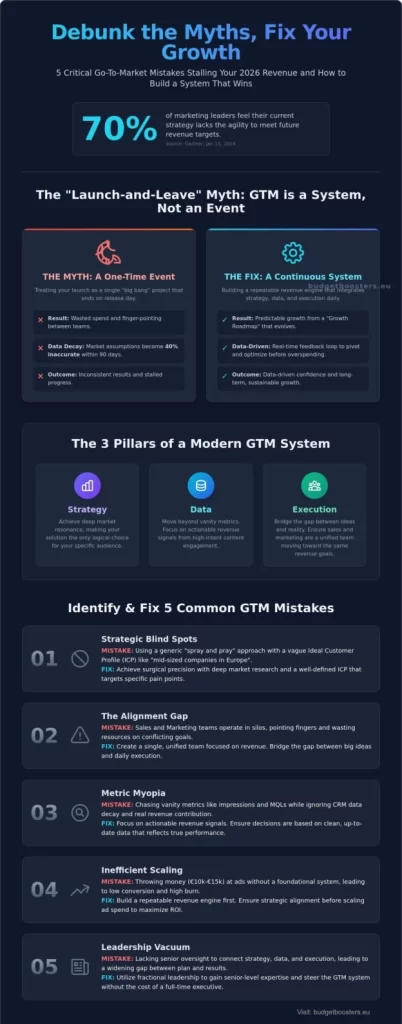
What if your 2026 growth isn’t being held back by your product, but by the outdated myths you’re still treating as gospel? On January 15, 2024, a Gartner report revealed that 70% of marketing leaders feel their current strategy lacks the agility to meet future revenue targets. You’ve likely felt the frustration of watching marketing spend vanish without a clear ROI. It’s exhausting when sales and marketing teams point fingers instead of fixing the go-to-market mistakes that stall your progress. You don’t have to settle for inconsistent results.
You deserve a clear roadmap to market entry that replaces guesswork with data-driven confidence. Stop the cycle of wasted spend. You’ll discover how to identify and fix these systemic errors and learn a framework for a successful launch. We’ll break down five critical myths and provide a strategy that turns your marketing into a high-performing system. Start growing today. It’s time to align your teams and take control of your future.
Key Takeaways
- Transform your launch from a one-off event into a continuous system that integrates strategy, data, and execution for long-term growth.
- Identify and fix the systemic go-to-market mistakes that stem from generic customer profiles and shallow market research.
- Bridge the alignment gap between sales and marketing to eliminate silos and create a unified team focused on revenue.
- Move beyond vanity MQLs and fix the “data decay” in your CRM to ensure your decisions are based on real revenue contribution.
- Discover how fractional leadership provides the senior-level expertise you need to scale efficiently without the cost of a full-time executive.
The “Launch-and-Leave” Myth: Why Go-to-market is a System, Not an Event
Stop thinking about your product launch as a finish line. It’s actually the starting gun. Many leaders fall into the trap of common go-to-market mistakes by treating a launch like a wedding; once the party’s over, they think the hard work is done. In 2026, this “launch-and-leave” approach is a guaranteed way to burn through your budget. A successful Go-to-market strategy isn’t a static document collecting dust in a cloud folder. It’s a living, breathing system that requires constant tuning.
When you treat GTM as a one-time event, your data begins to decay almost immediately. Industry benchmarks show that initial market assumptions can become 40% inaccurate within just 90 days of going live. You can’t afford to let your strategy go stale while your competitors are pivoting. You need a continuous loop where strategy, data, and execution feed into each other every single day.
The Three Pillars of a Modern GTM System
To win in 2026, you must integrate these three elements into a single workflow:
Strategy: This goes far beyond simple positioning. It’s about achieving deep market resonance. You’re looking for that “click” where your solution feels like the only logical choice for your specific audience.
Data: Stop chasing vanity metrics. Forget about impressions or general website traffic. Focus on actionable revenue signals. Are the right stakeholders engaging with your high-intent content?
Execution: This is the bridge between your big ideas and daily reality. It’s about ensuring your sales and marketing teams aren’t working in silos but are moving toward the same revenue goals.
Why Mid-sized Firms Fail at the Systemic Level
Mid-sized companies often struggle because they lack senior oversight to connect these pillars. In the Baltic and Polish markets, we see a recurring pattern: firms try to scale rapidly by throwing money at ads without a foundational system. They skip the strategic alignment and jump straight to spending €10,000 or €15,000 on lead generation that doesn’t convert. Without a fractional CMO or experienced leader to steer the ship, the gap between the plan and the results grows too wide to close.
A GTM system is a repeatable revenue engine that transforms market insights into predictable growth.
Instead of a fixed plan, you need a “Growth Roadmap.” This is an evolving document that adjusts based on real-time feedback. It allows you to pivot your messaging or shift your channel focus before you waste your entire quarterly budget on a tactic that isn’t working. If you’re ready to stop guessing and start growing, it’s time to build a system that lasts.
Strategic Blind Spots: Misreading Markets and the Ideal Customer
You want growth, but you’re casting a net that’s far too wide. One of the most expensive go-to-market mistakes involves treating your Ideal Customer Profile (ICP) like a generic template. If your target is simply “mid-sized companies in Europe,” you’re already bleeding cash. Real growth requires surgical precision, not a “spray and pray” approach. You need to know exactly who feels the pain your product heals.
Shallow market research is the silent killer of 2026 expansion plans. Many teams rely on secondary data or outdated reports from 2022. They skip the hard work of talking to real people. This leads to messaging that sounds like everyone else. It fails to spark interest because it doesn’t speak the specific language of the buyer’s daily struggles. You can’t guess your way to a €1.000.000 pipeline.
The Trap of the “Everyone is a Customer” Mentality
When you try to speak to everyone, you end up speaking to no one. This lack of focus dilutes your marketing ROI and leaves your sales team chasing low-quality leads. It’s frustrating for them and expensive for you. You must narrow your focus based on high-intent signals. Look at your last five successful deals. What was the specific trigger that made them buy? Was it a regulatory change, a recent funding round, or a specific software integration failure?
Focusing on a tight niche isn’t about limiting your potential. It’s about winning a specific territory before moving to the next. This clarity is the first step toward improving content ROI. When your content speaks to a specific person with a specific problem, your conversion rates naturally climb. Stop guessing and start targeting.
Don’t ignore regional nuances either. In Poland, a market of 38 million people, business often relies on deep relationship building and localized trust. In the Baltics, digital-first efficiency and tech-savviness are the primary drivers. A single English campaign won’t resonate the same way in Warsaw as it does in Tallinn. Localization is more than just translating words; it’s about translating the value proposition into the local business culture.
Messaging That Solves Symptoms, Not Pains
Are you selling features or solutions? Most companies fall into the trap of feature-led positioning. They talk about “fast processing” or “intuitive UI.” These are symptoms. The real pain is the €5.000 lost every month due to manual errors or the burnout of a team working 60-hour weeks. Use customer interviews to uncover these hidden objections. Ask them: “What happens if you don’t solve this problem today?”
Before you commit your full budget to a 2026 launch, use this 3-step framework to validate your messaging:
Hypothesis: Define one core pain point you believe your customers have.
Micro-testing: Run €200 worth of targeted LinkedIn ads with two different hooks to see which gets more clicks.
Feedback Loop: Take the winning hook and use it in five cold outreach calls to see if it starts a real conversation.
Building a marketing system that actually works requires a blend of strategy and execution. If you want to stay ahead of the curve in the Baltics and Poland, join the Budget Boosters Newsletter. It’s the go-to resource for fractional CMO insights, helping you build high-performing content systems without the overhead of a full-time director. Plus, you’ll get our ebook, “The CMO Edge,” a €29 value, for free.
The Alignment Gap: Why Sales and Marketing Silos Kill Growth
“Our teams work hard, they just don’t talk to each other.” Do you hear this often in your office? It’s the most common defense for stagnant revenue. Hard work is valuable, but when it happens in isolation, it creates friction that slows everything down. If your marketing team is celebrating 500 new “leads” while your sales team complains they’re all low quality, you aren’t growing. You’re just spinning your wheels. This disconnect is one of the most expensive go-to-market mistakes you can make as you plan for 2026.
The cost of this “finger-pointing” culture is measurable. A 2023 study by Aberdeen Group research revealed that companies with tightly aligned sales and marketing teams experience 32% higher revenue growth. When definitions of a “qualified lead” vary between departments, your customer acquisition cost skyrockets. You need a unified roadmap to fix this. Start by using a proven GTM Strategy Template to define your shared goals and language from day one.
Operationalizing Signal Sharing Across Teams
Marketing and sales must look at the same data. Intent signals are the digital footprints your prospects leave behind. This includes visiting your pricing page, downloading a specific whitepaper, or spending time on your “Compare Us” section. A 2024 report showed that 68% of the buyer journey happens before a prospect ever talks to a salesperson. If these signals stay trapped in a marketing dashboard, your sales team is flying blind.
Shared Dashboards: Create a single source of truth that tracks the journey from first click to closed deal.
Alignment Sprints: Run 45-minute sessions every 14 days. Use this time to review lead quality and adjust targeting based on real-world feedback.
Joint KPIs: Stop measuring marketing solely on volume. Start measuring both teams on pipeline value and conversion speed.
The Fractional CMO as the Alignment Catalyst
Internal teams often struggle to break silos because they’re too deep in the daily operations. An external, senior perspective acts as the glue that binds these departments together. A fractional CMO doesn’t just “do marketing”; they build the system that allows sales to win. They provide the strategic oversight needed to turn individual efforts into a high-performance engine.
This leadership model is incredibly efficient. It typically reduces executive leadership costs by 40% compared to a full-time hire while delivering immediate ROI. We’ve seen this in action, such as when we focused on turning a CEO’s profile into an €80k pipeline. It wasn’t just about posting content; it was about aligning personal branding with the sales team’s outreach strategy. This is how you avoid common go-to-market mistakes and build a sustainable growth machine.
Metric Myopia: How Stale Data Derails GTM Feedback Loops
Many teams celebrate a 20% increase in Marketing Qualified Leads (MQLs) while their actual revenue stays flat. This is one of the most common go-to-market mistakes. You’re focusing on the wrong numbers. Metric Myopia is the failure to see the revenue for the clicks. When you prioritize volume over value, you build a bridge to nowhere. By 2026, the gap between “interest” and “intent” has widened. Chasing MQLs is often a distraction from the only metric that keeps your doors open: revenue contribution.
Your CRM might be your biggest enemy. Data decays at a rate of roughly 2.1% every month. This means by the time you’ve finished your quarterly planning, 6% of your database is already useless. AI now plays a vital role in maintaining data hygiene. It scrubs outdated titles and identifies job changes in real time. This ensures your team doesn’t waste energy on dead ends. You can also use these tools for streamlining content with AI to ensure your output matches the actual needs of your current audience, not the audience you had two years ago.
Moving from Activity Metrics to Impact Metrics
Counting the number of daily posts or total clicks feels productive. It isn’t. These are activity metrics that mask underlying problems. In the Baltic region, calculating your “Real Cost of Acquisition” is essential. For example, if a lead costs €104 to generate but requires €480 in sales hours to close because they aren’t a fit, your strategy is failing. You must perform a Post-Launch Audit every 30 days. This helps you identify where the funnel leaks before you lose your budget. Focus on the quality of the conversation, not the quantity of the noise.
Building an AI-Enhanced Feedback Loop
You need a system that learns as fast as the market moves. Use AI tools to automate data collection and perform sentiment analysis on every discovery call. This allows you to iterate your GTM plan based on fresh evidence rather than gut feelings. When you see a pattern in why prospects say “no,” you can pivot your messaging immediately. You deserve a strategy that evolves with you. Marketing is a system that integrates strategy, data, and execution to create freedom and growth.
Scaling Without the Burn: How Fractional Leadership Fixes GTM Mistakes
You’ve built something impressive. Now, it’s time to scale it without burning out your team or your budget. Most growth-stage companies hit a ceiling because they lack a strategic pilot. You might have talented specialists, but without a unified system, you’re likely repeating the same go-to-market mistakes that stall progress. A fractional leader bridges this gap by providing the strategic “why” behind the tactical “how.”
The Fractional CMO (fCMO) model is a game-changer for SMBs. It offers corporate-level expertise at a fraction of the cost of a full-time executive. You don’t need a six-figure salary on your permanent payroll to access world-class strategy. Instead, you hire a mentor and architect who builds your marketing as a system. This system integrates strategy, data, and execution to ensure every Euro you spend works harder for your bottom line.
The Growth Roadmap: Your First 90 Days
A fractional leader doesn’t guess; they diagnose. During week one, a marketing diagnostic reveals the hidden friction in your sales funnel. You’ll stop making decisions based on “gut feelings” and transition to a data-driven roadmap. According to recent industry benchmarks, companies that align their data with their strategy see a 19% increase in growth compared to those that don’t. Your fCMO also acts as the strategic manager for your internal teams and agencies. They cut through the noise, hold vendors accountable, and ensure your content systems actually generate demand rather than just “likes.”
Next Steps for Baltic and Polish Enterprises
Is your company ready for fractional leadership? If your revenue is stagnant or your customer acquisition costs are rising, the answer is likely yes. Enterprises in the Baltics and Poland are rapidly adopting this model to stay competitive in a global market. You can gain a massive advantage by professionalizing your marketing department before your competitors do.
Own Your Market Evolution
Growth isn’t a lucky strike; it’s a deliberate choice you make every day. You now understand that GTM is a continuous system rather than a one-off launch. By fixing common go-to-market mistakes, you align your sales and marketing teams into a single, high-performing engine. Companies in Poland and the Baltic states are increasingly turning to fractional leadership to build ROI-focused roadmaps without the overhead of a full-time executive. This approach gives you the strategic edge needed to scale efficiently by 2026. You’re not just managing a budget; you’re designing your path to professional freedom.
Frequently Asked Questions
What are the most common go-to-market mistakes for mid-sized companies?
Mid-sized companies often fail by targeting too many segments at once without a clear Ideal Customer Profile. This lack of focus drains your resources and dilutes your core message. Research from 2024 shows that 70% of companies struggle with sales and marketing alignment. You can fix these go-to-market mistakes by narrowing your scope to the top 3 high-value segments where you’ve already seen success.
How does a Fractional CMO help avoid GTM failure?
A Fractional CMO provides the senior leadership you need to spot strategic gaps before they drain your budget. They build a repeatable system that connects your product to the right buyers effectively. You get the expertise of a veteran leader at a fraction of the cost of a full-time hire. It’s about getting the strategy right from the start so your team’s execution actually pays off.
Why is my GTM strategy failing despite having a great product?
A great product fails without a distribution system that reaches the right people at the right time. Your strategy might be failing because you’re focusing on features instead of solving a specific pain point. In 2025, 65% of buyers reported that they ignore generic marketing messages. You need to shift from what you built to how you help to see real traction in the market.
What is the difference between a launch plan and a go-to-market system?
A launch plan is a one-time event, while a go-to-market system is a continuous cycle of growth. Launch plans focus on the single day of release and initial buzz. A GTM system integrates strategy, data, and execution to drive long-term revenue. Think of it as the difference between a single race and a training program that keeps you winning year after year.
How much does it cost to fix a failing GTM strategy in 2026?
Fixing a broken strategy often costs 2 to 3 times more than building it correctly the first time. Industry reports from 2024 suggest that companies lose roughly €40,000 for every month they delay a necessary pivot. Don’t wait until your cash flow is critical to make a change. Investing in a strategic audit now saves you from massive losses and protects your future growth.
Can AI help in preventing go-to-market mistakes?
AI helps you avoid go-to-market mistakes by analyzing customer data to predict which segments will actually convert. Tools like predictive lead scoring can increase your conversion rates by 25%. You can use AI to automate repetitive tasks, which lets your team focus on high-level strategy. It’s a powerful way to ensure your decisions are based on hard facts rather than gut feelings.
How often should a GTM plan be updated?
You should review and refresh your GTM plan every 90 days to stay agile in a changing market. This quarterly rhythm allows you to adjust your tactics based on real-world performance data. Market conditions shift fast, especially in the Baltics and Poland. Regular updates ensure your team stays aligned with your 2026 goals and avoids the stagnation that kills momentum.

![]()
Article by
Aurimas Guoga
Aurimas Guoga is a fractional CMO and founder of Budget Boosters, helping B2B companies turn fragmented marketing into a predictable growth engine. With over a decade of experience leading marketing strategy, he works with business leaders to improve ROI, build scalable systems, and drive measurable revenue growth. Aurimas is also the author of The CMO Edge, a guide for companies looking to gain a competitive advantage through senior marketing leadership.