What if you could transform the friction between your departments into a 32% increase in annual revenue growth? For many B2B SMBs, marketing feels like throwing cash into a black hole while sales reports that 70% of leads are completely useless. You’ve likely felt the sting of this disconnect. It’s exhausting to watch marketing celebrate "record numbers" while your sales team struggles to find a single qualified prospect in the pile. You deserve a system where every dollar spent translates into a clear result.
Achieving true sales and marketing alignment isn’t about holding more boring meetings; it’s about building a unified revenue engine that empowers everyone. We’ll show you exactly how to bridge this gap to eliminate guesswork and drive the predictable revenue your business is capable of. We’re breaking down the specific framework to sync your goals, define lead quality once and for all, and create a winning culture where your teams finally pull in the same direction.
Key Takeaways
-
Transform your separate departments into a single, high-performing revenue engine through strategic sales and marketing alignment.
-
Stop paying the "Alignment Tax" and reclaim wasted budget by identifying exactly where your B2B leads are slipping away.
-
Master the five essential pillars of growth that allow your SMB to scale efficiently without the weight of enterprise overhead.
-
Implement a high-impact "Smarketing" (when sales and marketing wok hand in glove) rhythm to eliminate guesswork and keep your teams focused on driving predictable revenue.
-
Learn how a Fractional CMO can act as your revenue architect to bridge team gaps and build a foundation for long-term freedom.
Table of Contents
What is Sales and Marketing Alignment (Smarketing)?
Stop treating your sales and marketing teams like rival sports teams. They aren’t. In a high-growth B2B environment, these two functions must fuse into a single revenue engine. We call this "Smarketing." It’s much more than a buzzword; it’s a strategic commitment to shared success. You’re moving away from isolated silos where departments guard their own data. Instead, you’re building a unified front where every action serves the same bottom line.
A successful Marketing strategy requires this bridge to be built early. Real alignment is about shared goals, not just better communication. It’s not enough to "talk more." You need a shared Revenue Roadmap to eliminate the guesswork that kills 20% of SMB growth potential each year. This roadmap acts as your North Star. It ensures that every dollar spent on an ad and every hour spent on a sales call pulls the company in the same direction. When you align, you don’t just work harder; you work smarter.
The "Smarketing" Vision for B2B SMBs
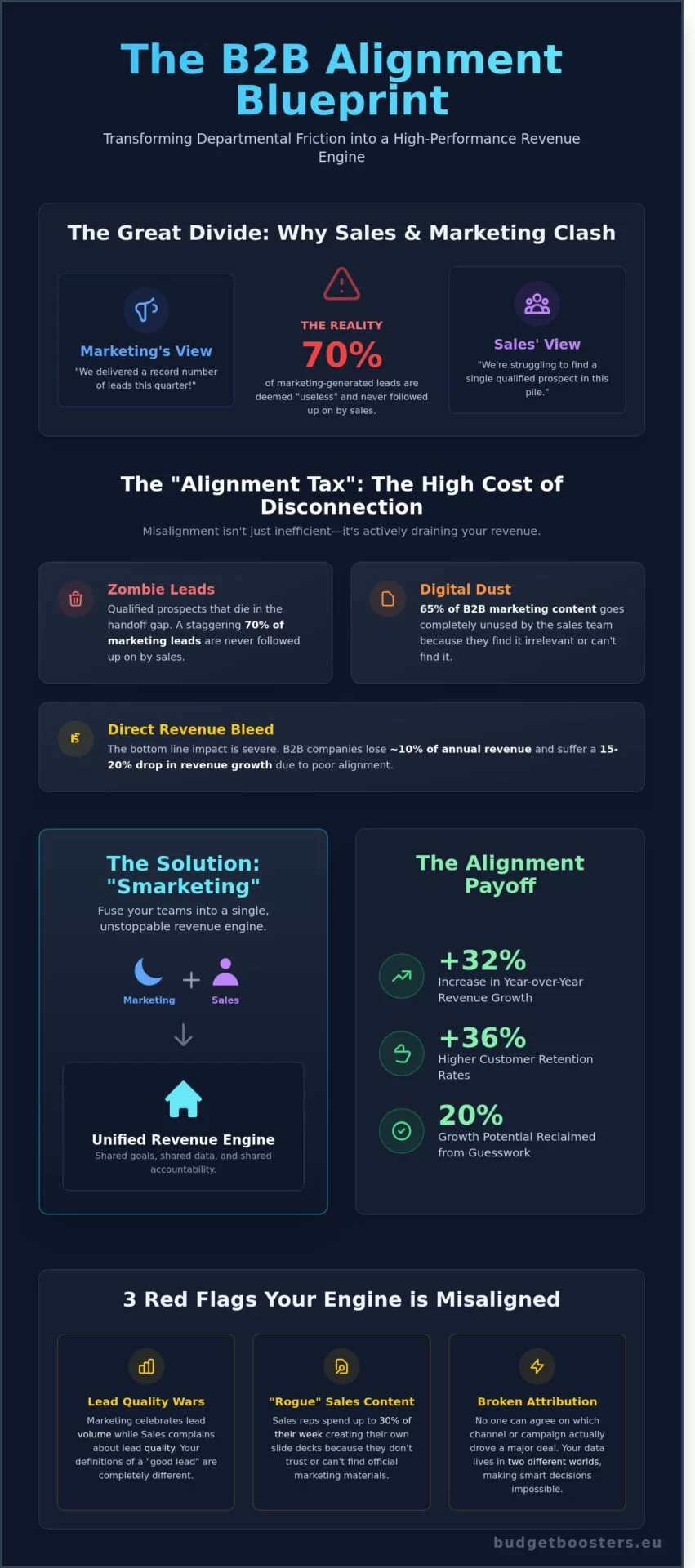
Small teams have a massive natural advantage here. You don’t have the 10 layers of bureaucracy found in a Fortune 500 company. You can move fast. You can pivot in an afternoon. Achieving this vision requires an emotional shift. You have to move from a culture of blame to one of shared accountability. Stop asking "Who messed up?" and start asking "How do we fix the flow?" This shift creates a better experience for your prospective customers. They won’t feel a "hand-off" between departments. Instead, they’ll experience a consistent, helpful journey. Data from 2023 shows that companies with aligned teams see 36% higher customer retention rates.
Signs Your Revenue Engine is Misaligned
Is your engine stalling? Check for these three red flags. First, look at your lead reports. Marketing might celebrate a 45% increase in lead volume, but sales complains that those leads are "trash." This gap proves your definitions aren’t aligned. Second, watch your sales reps’ behavior. If they’re spending 30% of their week creating "rogue" slide decks because they don’t trust the official marketing materials, you’re wasting time and money. Finally, look at your last meeting. If no one could agree on which channel drove the $25,000 deal closed on June 12th, your data is broken. Misalignment isn’t just annoying. It costs B2B companies roughly 10% of their annual revenue according to 2024 industry benchmarks. It’s time to turbocharge your growth by fixing these cracks.
The High Cost of Disconnected Teams
You might think your team is too small to worry about formal structures. This is a trap. Even in a lean B2B setup, the "Alignment Tax" is real and it’s draining your bank account. When your departments operate in silos, you aren’t just losing efficiency; you’re losing the freedom to scale. This friction often leads to a toxic "blame game" culture. Marketing claims Sales is lazy, while Sales insists Marketing sends junk. This cultural rift was famously diagnosed in a classic Harvard Business Review article, which highlights how these two groups often view each other as a necessary evil rather than partners. For an SMB, this friction results in a 15% to 20% drop in annual revenue growth.
Misalignment creates a fractured buyer journey. B2B prospects now complete nearly 70% of their research before ever speaking to a human. If your marketing message promises one thing and your sales pitch delivers another, the prospect feels the disconnect immediately. They don’t see two departments; they see one confused brand. This confusion triggers churn before the contract is even signed. True sales and marketing alignment isn’t a corporate luxury; it’s the foundation of your survival.
Wasted Marketing ROI and "Zombie Leads"
The numbers are staggering. Research from SiriusDecisions shows that 70% of marketing-generated leads are never followed up on by sales. You’re paying for clicks, ads, and events, only to let those opportunities rot in a CRM. This waste extends to your creative output too. Roughly 65% of B2B content created by marketing goes unused because sales finds it irrelevant or doesn’t know it exists. Every whitepaper that gathers digital dust is money taken directly from your growth budget.
Zombie Leads are qualified prospects that die in the handoff gap.
The Strategic Vacuum: Why CEOs Get Frustrated
Scaling a Go-to-Market strategy is impossible when your data lives in two different worlds. If Marketing uses one set of metrics and Sales uses another, the CEO can’t make a single data-driven decision. This lack of transparency forces many founders to stay trapped in "Founder-led" sales long after they should have stepped back. They spend their time fixing marketing gaps instead of building the company. You can’t reach the next level of success if you’re constantly playing referee between your teams. Taking control of your growth trajectory starts with mastering your resource allocation today. When you achieve sales and marketing alignment, your data becomes a map rather than a maze, allowing you to invest with total confidence.
The 5 Pillars of a Unified B2B Revenue Engine
Growth doesn’t happen by accident. It’s the result of teams moving in the same direction. For B2B SMBs, you don’t need complex enterprise frameworks. You need a system that’s lean, fast, and effective. These five pillars represent the core of sales and marketing alignment. They’re also the foundation of a marketing diagnostic audit, which helps you spot exactly where your revenue engine is leaking cash. When these pillars stand strong, AI can act as the ultimate bridge. It automates the data flow between them, ensuring no lead falls through the cracks.
1. A Single Ideal Customer Profile (ICP)
Who is your perfect client today? It’s likely not the same person you targeted three years ago. Markets shift. Your ICP must be a living document that both teams own. Marketing might see a "target audience" as anyone in manufacturing, but Sales knows that only mid-sized firms with aging equipment actually sign contracts. You must focus on the high-intent buyer, not just someone browsing for info. Use regular feedback from your sales calls to sharpen marketing’s targeting. If Sales says the last ten leads were too small, Marketing needs to pivot their ad spend immediately.
2. Common Definitions for MQLs and SQLs
The "Handshake" is where most deals die. You need a clear, shared checklist for when a lead moves from Marketing to Sales. A "Marketing Qualified Lead" (MQL) doesn’t mean they’re ready to buy; it just means they’ve shown interest. You must agree on the specific actions that trigger a handoff. Research from Western Kentucky University involving 821 respondents proves that this specific type of alignment leads to higher growth in qualified leads and better customer retention. Don’t leave it to guesswork. Define the criteria, stick to them, and watch your conversion rates climb.
3. Shared KPIs and Revenue Accountability
It’s time to stop measuring Marketing by "Lead Count" alone. That’s a vanity metric if those leads don’t close. Shift your focus to pipeline contribution. How much potential revenue did Marketing generate this month? When you reward both teams for a closed deal, the silos disappear. This requires a single source of truth. Your CRM must be the master record for all data. If it isn’t in the CRM, it doesn’t exist. This transparency builds trust and keeps everyone focused on the only goal that matters: sustainable revenue growth.
The final two pillars involve AI-driven lead scoring and consistent feedback loops. AI tools can now analyze thousands of data points to predict which prospects are most likely to close, acting as a neutral judge between teams. Combine this with a simple, 15-minute weekly sync. You don’t need a three-hour meeting; you just need to ensure sales and marketing alignment remains a daily priority rather than a quarterly goal. You’ve got the tools and the talent. Now, it’s just about connecting the dots.
Practical Steps to Align Your Teams Today
Stop guessing and start measuring. Most SMBs lose revenue because their departments speak different languages. You can change that right now. Real growth happens when you stop treating sales and marketing as separate islands. It’s time to build a bridge based on data and shared goals. Sales and marketing alignment isn’t a luxury. It’s your competitive advantage.
Begin by auditing your buyer journey. Research from MarketingSherpa shows that 79% of marketing leads never convert into sales. This happens because of "cracks" in the funnel. Are your leads waiting 24 hours for a response? Do they receive marketing emails that contradict what a sales rep said? Map every touchpoint. If a lead drops off after the first demo, find out why. Fixing these small gaps can increase your conversion rate by 15% within the first quarter.
-
Establish a "Smarketing" rhythm: Hold a 20-minute weekly sync. This isn’t a long strategy session. Focus on lead quality and immediate roadblocks.
-
Integrate your tech stack: Your CRM must be the single source of truth. Ensure your marketing automation tools feed data directly into sales dashboards.
-
Implement closed-loop feedback: Sales should report on lead quality every Friday. This data allows marketing to adjust targeting in real-time.
Conducting a Marketing Diagnostic
Numbers provide the clarity you need to move forward. You can’t fix what you haven’t measured. Start by identifying the "Low-Hanging Fruit." For instance, a 2023 study found that companies responding to leads within five minutes are 100 times more likely to connect. Is your team hitting that mark? If your internal departments are too close to the friction, hire an external auditor. They provide an unbiased perspective on team tension that you might miss. This diagnostic sets the stage for sales and marketing alignment by removing personal biases from the equation.
Streamlining Content for Sales Enablement
Sales reps often hear the same five objections every single day. Don’t let that knowledge go to waste. Use AI for content creation to quickly turn those objections into marketing FAQs or bite-sized LinkedIn posts. This ensures your messaging stays consistent. Every piece of content must serve a specific sales purpose. Whether it’s a case study or a whitepaper, it should help a rep close a deal. You can use AI content creation to keep your library updated without draining your team’s energy. This system ensures your reps always have the right tool for the right prospect at the right time.
Consistency creates trust. When your marketing materials mirror the conversations your sales team is having, your brand authority skyrockets. A structured B2B content system can help you maintain this consistency across all touchpoints, ensuring that every piece of content supports your sales process. Ready to take control of your growth? Check out our growth resources here.
How a Fractional CMO Bridges the Alignment Gap
You’ve likely felt the friction between your teams. Marketing feels their leads are ignored; Sales feels those same leads are a waste of time. This disconnect isn’t just annoying; it’s expensive. A Fractional CMO steps in as a revenue architect to fix this. They don’t just manage social media or run ads. They design the entire engine that powers your growth. By bringing corporate-level strategy to your SMB at a fraction of the cost, they build the roadmap you’ve been missing. This allows you, the CEO, to stop refereeing internal disputes and start focusing on your long-term vision again. It’s about moving from chaos to a structured, high-performance culture where everyone wins.
The Objective Outsider Advantage
Internal hires often struggle to challenge the status quo. They’re part of the existing culture, which makes it hard to dismantle silos that have existed for years. A fractional leader arrives with an objective perspective and "best practices" harvested from a variety of successful B2B environments. They’ve seen what works in 2024 and what’s already obsolete. Data shows that companies with strong sales and marketing alignment see 27% faster profit growth. The Fractional CMO focuses entirely on execution. They identify the bottlenecks, call out the inefficiencies, and turn your alignment plan into a series of measurable revenue milestones. They aren’t there to play politics; they’re there to deliver results.
Your Roadmap to Predictable Growth
Success doesn’t happen by accident. In the first 90 days of an engagement, a Fractional CMO establishes a common language between departments. They define exactly what a "qualified lead" looks like so there’s no more finger-pointing. This clarity directly impacts your bottom line. When your messaging matches the sales conversation, your Content ROI increases because every blog post and case study serves a specific stage of the buyer’s journey. Implementing a comprehensive B2B content system for strategic marketing alignment ensures that both teams work from the same playbook, creating a seamless experience for prospects. To further accelerate this process, leveraging AI for content creation allows your team to produce consistent, on-brand materials at scale without stretching your resources thin.
-
Standardized Lead Scoring: No more guessing which prospects are ready to buy.
-
Unified Data: One single source of truth for both teams to track progress.
-
Higher Profit Margins: Projections for 2025 suggest that aligned B2B firms reduce customer acquisition costs by up to 15%.
You deserve a business that runs like a well-oiled machine. It’s time to stop leaving your growth to chance and start building a predictable future. You have the vision; now you just need the architect to make it a reality. Book your marketing audit to start the alignment journey.
Ignite Your Revenue Growth Today
You’ve seen the data. Companies with strong sales and marketing alignment achieve 20% higher annual growth rates according to Aberdeen Group research. It’s not just a buzzword; it’s your competitive advantage. Misalignment costs B2B firms roughly 10% of their annual revenue according to IDC (International Data Corporation). You can stop that leak right now. Start by unifying your data and focusing on shared revenue goals rather than vanity metrics. It’s about creating a clear, actionable roadmap that empowers every team member to win.
You don’t have to figure this out by yourself. Bringing in senior B2B marketing leadership provides the professional focus your business needs to scale. You’ll get a data-driven growth roadmap that prioritizes actual revenue. It’s time to give your teams the clarity they deserve and turn your marketing into a predictable growth engine. Your path to personal and professional freedom starts with a single, confident step toward better systems.
Eliminate the guesswork and align your teams with a Fractional CMO
You’ve got the vision. We’ve got the tools to help you reach it. Let’s make this your most successful year yet.
Frequently Asked Questions
How long does it take to see results from sales and marketing alignment?
You can expect to see the first measurable results within 3 to 6 months of starting your journey. Companies that prioritize sales and marketing alignment often see a 20% increase in annual revenue growth according to recent industry benchmarks. The first 90 days usually focus on cleaning data and syncing goals. After that, your conversion rates will start to climb. It’s a marathon, not a sprint, but the payoff is massive for your bottom line.
What is the most common reason sales and marketing teams fail to align?
The most common reason for failure is the lack of shared goals and KPIs. Research indicates that 60% of B2B organizations struggle because marketing focuses on lead volume while sales only cares about closed deals. If you aren’t measuring the same numbers, you’re running in different directions. Break down these silos by creating a single revenue target. This simple shift turns two separate teams into one unstoppable force focused on growth.
Do we need a CRM to achieve alignment?
Yes, a CRM is the essential backbone of any successful sales and marketing alignment strategy. Data shows that 74% of businesses improve their customer relationships by using a central system to track interactions. Without a shared dashboard, your data stays hidden in spreadsheets and buried in emails. Think of your CRM as the shared map for your growth journey. It ensures everyone sees the same reality and makes decisions based on facts, not hunches.
How often should sales and marketing teams meet?
You should schedule a joint meeting at least once a week for 30 minutes. High performing teams are 80% more likely to have a formal weekly sync to review the lead pipeline and feedback loops. Use this time to discuss what’s working and what needs a quick pivot. Supplement these with monthly deep dives to adjust your overall strategy. Frequent, short bursts of communication keep everyone energized and focused on the same target.
What is the difference between lead generation and demand generation in alignment?
Lead generation focuses on capturing specific contact information, while demand generation builds long term brand awareness and interest. Statistics show that 70% of the B2B buyer journey is completed before a prospect even talks to a salesperson. Demand gen warms up the market so your sales team doesn’t have to start from zero. In a unified system, marketing creates the appetite and sales provides the meal. Both are vital for sustainable growth.
Can a small company with only one marketer and one salesperson still benefit from alignment?
Absolutely, small teams of just two people often see the fastest improvements from staying in sync. SMBs that align these functions are 67% better at closing deals compared to those that work in isolation. Since there are only two of you, communication is faster and pivots are much easier. You don’t need complex corporate structures to win. Just sit down, sync your calendars, and start chasing the same revenue goals together today.
How does AI help in aligning sales and marketing teams?
AI helps by automating lead scoring and predicting which prospects are most likely to buy right now. Current data suggests that AI can automate 40% of the manual tasks that usually cause friction between departments. This technology removes human bias from the lead handoff process. It gives both teams a clear, data backed reason to prioritize specific accounts. You’ll save hours of time and focus your energy where it actually generates cash for your business.

Article by
Aurimas Guoga
Aurimas Guoga is a fractional CMO and founder of Budget Boosters, helping B2B companies turn fragmented marketing into a predictable growth engine. With over a decade of experience leading marketing strategy, he works with business leaders to improve ROI, build scalable systems, and drive measurable revenue growth. Aurimas is also the author of The CMO Edge, a guide for companies looking to gain a competitive advantage through senior marketing leadership.