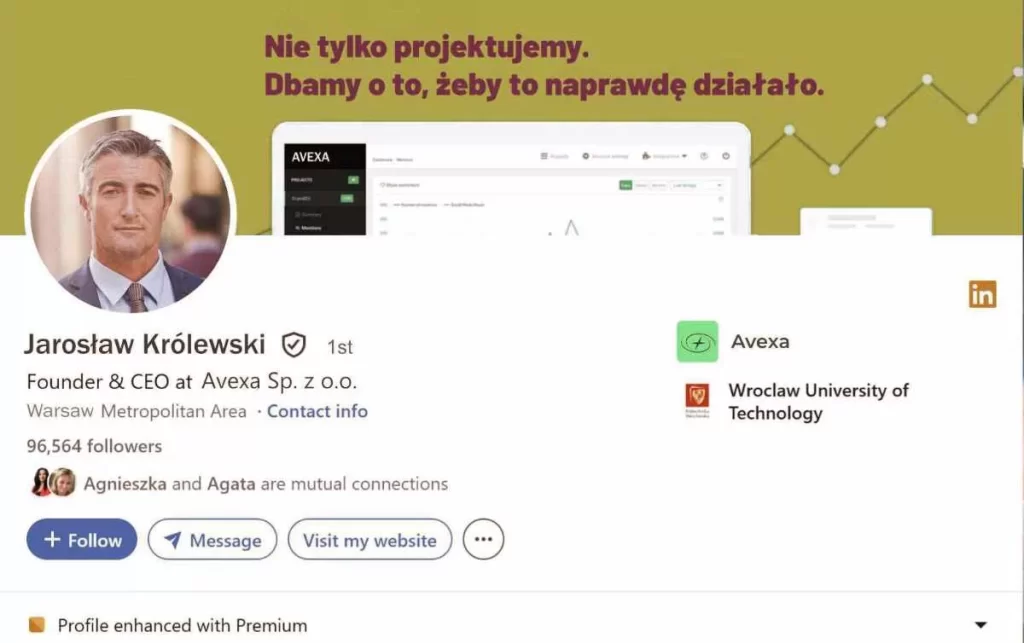
Case Study: the task: enhance the LinkedIn profile of Jarosław Królewski, CEO of Avexa, a mid-sized engineering services company based in Warsaw, Poland. My job was to turn (help him to, rather) his LinkedIn into a source of influence and sales.

Business Challenge Summary
Most CEOs are told the same thing about LinkedIn:Post more.
Comment more.
Stay consistent.
Sounds reasonable.
And yet — most profiles never turn into a real business asset.
Recently, I was given a task:
enhance the LinkedIn profile of Jarosław Królewski, CEO of Avexa, a mid-sized engineering services company based in Warsaw, Poland. My job was to turn (help him to, rather) his LinkedIn into a source of influence and sales.
At the start:
- ~2,000 followers
- minimal engagement
- no inbound pipeline
The Results After 90 days::
- 8,700 followers
- reach: 1,200 → 18,000
- 12–18 inbound inquiries/month
After 12 months:
- 90,000+ followers
- 110,000+ average post reach
- multiple deals (€30K–€80K)
youtubers advise:
Most companies approach LinkedIn in a very similar way. They post occasionally. They comment when they have time. Some eventually experiment with paid ads. The intention is good, but the result is often the same — limited visibility, inconsistent engagement, and little to no impact on revenue.
This is not because people are doing something wrong. It is because they are following conventional marketing advice, which focuses on activity rather than outcomes.
A typical marketing specialist or Youtube influencer would recommend:
- “Post more frequently”
- “Engage with your audience”
- “Stay consistent”
- “Try different formats”
- “Boost posts if needed”
All of this sounds reasonable. And yet, most companies remain invisible. At first glance, this advice seems entirely logical. It worked for many of the people who share it today. But there is a problem.
Much of this guidance comes from LinkedIn personalities who built their visibility several years ago, when the platform operated differently and competition was significantly lower. At that time, consistency alone could drive reach. Posting more often was enough to stand out.
Today, the landscape has changed. Success rarely follows well-trodden paths. What worked then does not necessarily work now — and almost never works in exactly the same way for someone else.
Every company operates in a different context. Your audience is not the same as theirs. Their followers have been shaped by years of exposure to similar content, often influenced by the same widely shared advice. Your audience, on the other hand, has different expectations, different problems, and a different level of awareness.
This is where most companies get stuck.
They try to replicate visible tactics without understanding the underlying dynamics. The result is activity without impact.
““LinkedIn is not just a social platform. It is a distribution channel where buyers evaluate companies and leaders before making contact..”
A CMO approach:
A CMO approaches this differently. Instead of copying what appears to work, the focus shifts to understanding your specific situation — your market, your audience, and your positioning — and building a path that is uniquely yours.
Because in the end, growth does not come from following templates. It comes from finding the right system for your business.
The Situation: A CEO With Visibility but No Growth
I was brought in to work with Jarosław Królewski, CEO of Avexa, a mid-sized B2B company in Warsaw, Poland (engineering services, approx. €3.5M annual revenue).
His LinkedIn profile looked active at first glance, but the numbers told a different story:
- ~2,000 followers
- 1–2 posts per month
- low engagement
- no consistent inbound leads
LinkedIn was present, but it was not working.
The task was simple on paper: improve visibility.
In reality, the goal was bigger — turn LinkedIn into a reliable business channel.
I started with a simple set of questions.
First, how does this channel actually work, and how can it be turned into a system that produces results?
Where is Mr. Królewski’s target audience on LinkedIn, and what truly drives their attention? What kind of content do they actually want to engage with?
And finally, what could be his unique angle — the perspective that would make him stand out and attract? What distinct value could he bring to his dedicated audience?
Step 1: Changing the Mindset
LinkedIn is not just a social platform. It is a distribution channel where buyers evaluate companies and leaders before making contact.
At the same time, it is important to understand how the LinkedIn algorithm works.
LinkedIn does not distribute content evenly. It amplifies posts that generate early engagement, keeps people on the platform, and spark meaningful interaction.
In practical terms, this means:
- content that gets comments is shown to more people
- conversations extend reach far beyond your existing network
- consistency signals relevance and increases visibility over time
This is why growth on LinkedIn is not random.
It is shaped by how well your content aligns with the way the platform distributes attention.
Step 2: 72 Hours of Research
Before publishing anything, we first needed to understand where Mr. Królewski fits within the ecosystem.
Growth does not start with content. It starts with understanding who you are speaking to and how conversations already happen in that space.
A CMO does not act before building this foundation.
So instead of posting, I spent 72 hours observing, discussing the findings with my client..
We studied other voices in the same field — founders, executives, and industry leaders — and focused not only on what they posted, but how their audiences responded.
We looked at:
- what generated discussion
- how ideas were presented
- what resonated, and what was ignored
This was not about copying, but about understanding the environment.
Because on LinkedIn, visibility does not come from speaking more —
but from speaking in a way the right audience recognizes.

Step 3: Profile Optimization
We transformed the profile into a clear value proposition.
Instead of presenting a list of roles and responsibilities, the profile had to answer one simple question: why should someone pay attention?
We structured it using four elements:
– Problem — clearly stating the challenge the audience is facing.
This creates immediate relevance and signals that you understand their situation.
– Solution — explaining how that problem is addressed.
Not in technical detail, but in a way that makes the outcome easy to grasp.
– Proof — demonstrating that this approach works.
This can be experience, results, or real-world examples that build trust.
– Call to action — giving a simple next step.
Making it clear what someone should do if they want to continue the conversation.
This turned the profile from a static description into a working entry point.
Because when attention comes, it needs direction.
Step 4: Content Extraction
Step 4: Content Extraction
One of the most common concerns, including from Mr. Królewski at the beginning, was simple:
– “I don’t have anything interesting to say.”
This is a familiar hesitation among experienced CEOs. And yet, it is almost always wrong.
What is often overlooked is that seasoned leaders carry a depth of experience built over years of real-world decisions, challenges, and outcomes. What feels obvious or routine to them is often highly valuable to others.
Insights formed through practice — hard-earned and shaped by real situations — frequently become breakthrough ideas for those still trying to solve similar problems.
That is why we did not focus on creating content from scratch.
We focused on extracting it.
From:
- past decisions
- real business situations
- lessons learned over time
In this sense, experienced leaders are not short of content.
They are, in fact, walking repositories of it.
The task is simply to bring that knowledge into a form others can see and use.
“Experienced leaders are not short of content. They are, in fact, walking repositories of it..”
Step 5: Content System
We used four types of content, each serving a different purpose in the system:
– Growth — content designed to reach new people.
Curious broader insights, strong opinions, or industry observations that attract attention beyond the existing network.
– Authority — content that builds trust.
Frameworks, case examples, and practical thinking that show how problems are actually solved. This is where my client shared his invaluable insights gained through hard graft
– Conversion — content that moves people to act.
Clear offers, invitations to connect, or simple next steps that turn attention into business conversations. This is the type of content that ends to a CTA – a clear call-to-action
– Personal — content that creates connection.
These depict a human behind the work profile. Personal stories, intriguing life experiences, and reflections that make the person behind the profile relatable and credible. For example, this is where you share that you love corgis and have two at home.
Step 6: Leveraging Existing Audiences
We focused on high-quality commenting on other relatable profiles to gain visibility.
At the early stage, growth did not come from posting alone.
It came from understanding a simple dynamic: on LinkedIn, attention is already concentrated around active profiles. Instead of trying to build visibility from zero, we positioned ourselves where that attention already existed.
We focused on high-quality commenting on relevant profiles to gain visibility.
This was not random activity. It was a deliberate approach.
We identified voices in the same space — founders, executives, and industry experts whose audiences overlapped with the ones Avexa wanted to reach. These were not necessarily the largest accounts, but the ones with active, engaged communities.
Then Mr Królewski showed up consistently in their comment sections.
Results After 90 Days:
- followers: 2,000 → 8,700;
reach: ~1,200 → 18,000;
inbound inquiries: 12–18/month;
deals closed: ~€22,000.
Step 7: Consistency
We maintained at least two posts per week and continued engagement.
By this stage, the initial results were already visible. But the real shift came next.
We began to treat LinkedIn not as a series of posts, but as an ongoing presence.
Like any social platform, LinkedIn rewards consistency. Once you have built an audience, they expect you to show up. This is what creates momentum — visibility compounds, and trust grows over time.
This is also where many CEOs fall short.
As their focus returns to core business responsibilities, LinkedIn becomes secondary. Posting turns irregular, gaps appear, and momentum fades.
We addressed this with a simple, sustainable rhythm:
- at least two posts per week
- no long interruptions
Because the biggest gains come not from bursts of activity, but from consistent cadence.
My role shifted accordingly — from execution to oversight, ensuring the system continued to work.
This is how a CMO approaches growth: not as a campaign, but as a system.
“Like any social platform, LinkedIn rewards consistency. Once you have built an audience, they expect you to show up. This is what creates momentum — visibility compounds, and trust grows over time...”
Results After 12 Months:
90,000+ followers;
110,000+ average post reach;
multiple deals (€30K–€80K)
Final Thoughts
Some companies use LinkedIn.
They post from time to time, share updates, and remain present — but largely unnoticed.
Others approach it differently. They turn LinkedIn into a predictable engine of growth — a channel that consistently generates visibility, builds trust, and creates business opportunities.
The difference is not effort. It is not even talent.
It is structure.
It is the ability to understand how the channel works, to build a system around it, and to sustain it over time.
That is the difference a CMO brings.
About the Author
Aurimas Guoga is a fractional Chief Marketing Officer and founder of Budget Boosters, a regional marketing directors agency.
With over a decade of experience leading marketing in a premium B2B services company, he focuses on replacing fragmented activity with clear systems that connect marketing to revenue.
Aurimas works with business owners and leadership teams to:
- identify what truly drives growth
- build focused marketing plans
- align teams and partners
- ensure decisions are based on data, not guesswork
His core belief is simple: companies grow faster when marketing is managed as a system, not just a set of activities.
He works as a part-time CMO, bringing structure, clarity, and measurable results without the need for a full-time hire.
Aurimas is also the author of books on CMO and marketing leadership. More about his work and publications can be found on the Budget Boosters website.
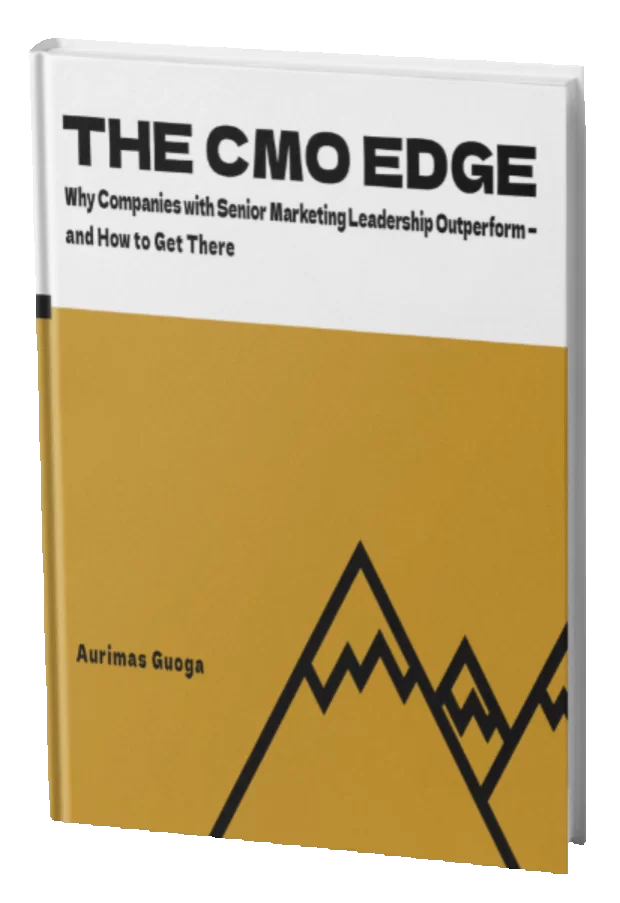
Subscribe to the Budget Boosters newsletter and receive a free copy of:
“The CMO Edge. Why Companies with Senior Marketing Leadership Outperform — and How to Get There.”
Regular price: €29