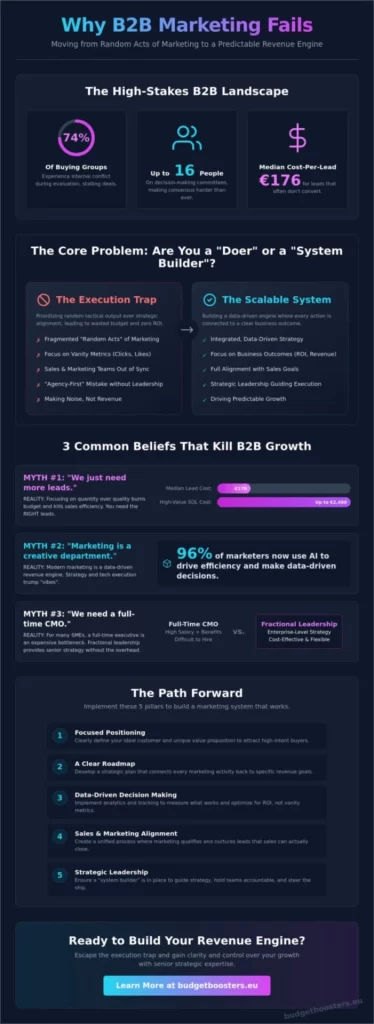
Why are 74% of buying groups currently experiencing internal conflict during their evaluation process? With decision-making committees expanding to 16 people as of May 2026, the old way of simply making noise doesn’t cut it anymore. You’ve likely felt the sting of a wasted budget and wondered exactly why b2b marketing fails to deliver a steady stream of revenue. It’s frustrating to see a median cost-per-lead hit €176 while your sales and marketing teams remain out of sync.
You deserve a system that provides clarity and control over your growth. We’re going to show you how to move away from fragmented execution and build a scalable marketing engine that supports your sales goals. You’ll learn the structural reasons for stagnation and how to achieve a clear ROI on every € invested. We’ll look at how 96% of marketers are now using AI to drive efficiency and how you can transform your strategy into a predictable lead generation machine that finally brings you the freedom to scale.
Key Takeaways
- Escape the “execution trap” by shifting your focus from random tactical acts to a data-driven system that prioritizes lead quality.
- Identify the structural reasons why b2b marketing fails and how to transition from making noise to driving predictable revenue.
- Distinguish between a “doer” and a “system builder” to ensure your marketing budget supports your sales objectives.
- Implement five essential pillars, including focused positioning and a clear roadmap, to create a scalable engine for your business.
- Explore how fractional leadership provides Baltic and Polish SMEs with senior strategic expertise to streamline growth and improve ROI.
The Execution Trap: Why Random Acts of Marketing Never Scale
Many companies fall into a cycle of “doing” rather than “building.” You hire a junior specialist to manage social media or run ads, hoping for a breakthrough. Instead, you get a feed full of posts that nobody reads and leads that never close. This is the Execution Trap. It happens when you prioritize tactical output over strategic alignment. It’s the primary reason why b2b marketing fails in complex sales environments. You’re busy, but you aren’t moving the needle.
When you lack a system, every marketing effort is a “random act.” You spend your budget on a website refresh or a few LinkedIn ads, but these pieces don’t talk to each other. In 2026, organizations allocate an average of 8.7% of their total budget to marketing. Without a structure, that money simply evaporates. Even for precise industrial specialists like CNC Cut to Size, a lack of strategic alignment leads to diluted brand positioning and a sales team that doesn’t trust the incoming leads. It’s frustrating to watch your budget disappear without seeing a clear path to growth.
Tactics Without Strategy is the Noise Before Defeat
Jumping straight into SEO or LinkedIn ads without a foundation often results in a €0 ROI. You might see your competitors doing it, but copying their tactics is dangerous. You’re seeing their output, not the underlying system that makes it work. To succeed, you need a deep understanding of Business-to-business (B2B) marketing principles. Without a clear roadmap, you’re just making noise. This lack of direction kills your momentum and wastes your most precious resource: time. Real growth requires a system that connects every click to a business outcome.
The High Cost of the ‘Agency-First’ Mistake
Hiring an agency before you have internal leadership is a common mistake. Agencies are great at execution, but they need a “system builder” to hold them accountable. If no one is steering the ship, you’ll find yourself drowning in vanity metrics like clicks and likes. These numbers look good in a slide deck, but they don’t pay the bills. The Agency Accountability Gap is the disconnect between creative output and your actual business objectives. Our Fractional CMO Landscape Research 2026 shows that firms in Poland and the Baltics are now moving away from this fragmented model toward senior, part-time leadership. It’s about moving from “making content” to “building a revenue engine.” You deserve a partner who focuses on your bottom line, not just your follower count.
Myth-Busting: 3 Common Beliefs That Kill Business-to-Business Growth
Beliefs drive behavior. If your growth has stalled, it’s likely because your team is operating under outdated assumptions. Understanding the specific challenges in B2B marketing implementation is the first step toward building a system that actually works. We need to dismantle the myths that keep your revenue flat and your team frustrated. Control over your growth starts with clarity.
Many CEOs believe that “more leads” is the universal cure for a slow sales cycle. This is a primary reason why b2b marketing fails to scale effectively. When you focus on quantity, you often end up with a funnel full of low-intent noise. In 2026, the median cost-per-lead for business marketing firms is €176. If those leads don’t convert, you’re just burning your budget. High-value software services can see sales-qualified lead costs as high as €2,480. You don’t need a bigger pile of names; you need a system that attracts the right 16 decision-makers in the buying committee.
Another dangerous myth is that marketing is a “creative department” tasked with making things look pretty. It’s actually a data-driven engine. With 96% of marketers now using AI for efficiency, the focus has shifted to strategic governance and technical execution. This shift toward systems is exactly why b2b marketing fails when companies only focus on “vibes” rather than data. If you treat marketing as an aesthetic exercise, you’ll never see a predictable ROI.
Finally, don’t fall for the idea that a full-time CMO is the only path to senior leadership. For many growth-stage firms in the Baltics and Poland, this is an expensive bottleneck. Enterprise-level strategy is no longer reserved for the giants. You can access “system builder” expertise through fractional leadership without the massive executive salary. It’s a smarter way to gain the freedom to focus on your core business while your marketing engine runs on autopilot.
Lead Generation vs. Demand Generation
Filling your CRM with low-quality leads kills sales efficiency. Your sales team spends hours chasing people who aren’t ready to buy. Instead, focus on B2B demand generation. This approach builds long-term brand preference so buyers come to you. It’s about educating the 89% of buyers who research online before ever talking to a rep. You want to be the obvious choice before the first call even happens.
The Fallacy of the ‘All-in-One’ Junior Hire
Expecting a single junior hire to handle strategy, design, and AI analytics is a recipe for stagnation. In 2026, business marketing is too complex for a “jack of all trades.” You need a structural evolution, not just an extra pair of hands. Read our guide on Hiring Your First Marketing Person to see how to build a team that actually scales. Moving from a single doer to a coordinated system is the ultimate level-up for your company.
Ready to stop guessing and start growing? Join the Budget Boosters Newsletter for the latest fractional CMO trends and practical frameworks. You’ll get our ebook, The CMO Edge (a €29 value), for free. It’s your guide to making senior-level decisions without the full-time cost.
The Leadership Gap: The Silent ROI Killer
You might have a team of talented people, but if they’re just “doers,” your growth will eventually hit a ceiling. This is the leadership gap. It’s the silent killer of your ROI. A Marketing Manager focuses on getting the next post out or the next email sent. A CMO focuses on the system that makes those actions profitable. This lack of senior oversight is exactly why b2b marketing fails to move from a cost center to a revenue driver. You need a builder, not just a manager, and agencies like The Palm Group specialize in building these revenue-optimized communication systems.
Research from Harvard Business School highlights how B2B leaders often misunderstand marketing as just a creative support function rather than a strategic lever. This misunderstanding leads to siloed departments. Sales and marketing stop talking and start operating in different worlds with conflicting goals. You need a “System Builder” to bridge that gap. Marketing governance is the bridge. It turns random activities into a predictable engine for growth that you can actually trust.
Why Strategy is a Part-Time Need but a Full-Time Requirement
Most SMEs in Poland and the Baltics don’t need a full-time executive at a €12,000 monthly retainer. However, they desperately need that level of strategic thinking every single day to avoid stagnation. Fractional leadership provides this balance. You get the corporate-level expertise needed for building a high-performance marketing team structure at a fraction of the cost. In 2026, fractional rates typically range from €6,400 to €20,000 per month. It’s a smarter way to gain the brainpower required for scale without the heavy executive overhead.
Aligning Marketing with Business Objectives
Your marketing should never be an island. It must align perfectly with your actual business goals. A Marketing Audit is the best way to see where your current leadership is falling short and where your budget is leaking. Strategic Governance is the process of ensuring every marketing euro spent aligns with the CEO’s 3-year vision. When you have this alignment, marketing stops being a black hole for your cash. It becomes a transparent, measurable driver of your company’s future value. You’ll finally see how every campaign contributes to the bottom line.
5 Pillars of a Marketing System That Actually Works
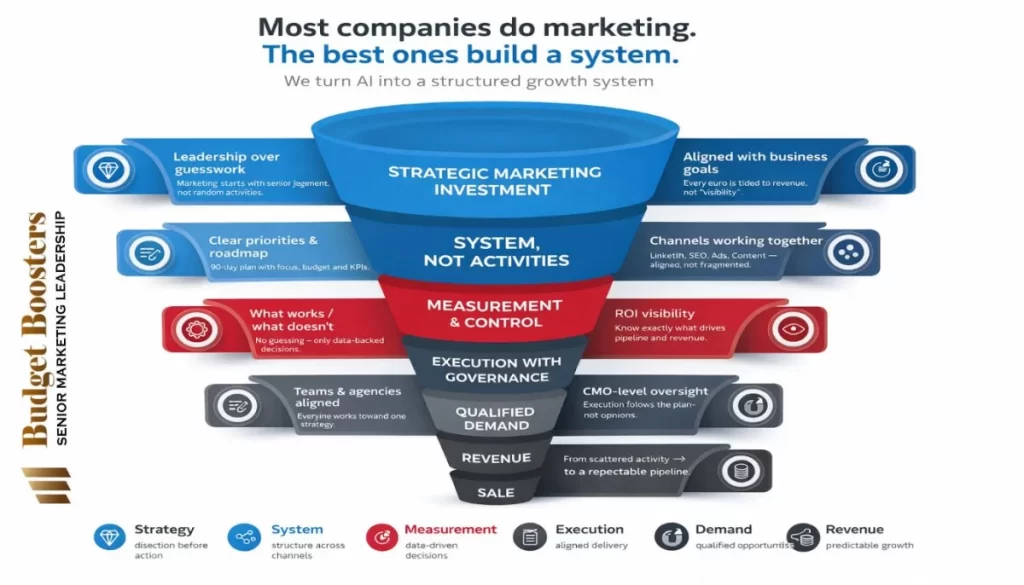
Building a high-performance engine isn’t about luck. It’s about structure. When you move from random acts to a system, you gain the freedom to scale. This transition is vital because a lack of a cohesive framework is exactly why b2b marketing fails in most growth-stage companies. Let’s look at the five pillars that turn marketing from a guessing game into a predictable revenue driver.
Data-Driven Roadmap: You can’t fix what you don’t measure. Stop guessing which channels work and start using real-time data to guide your € spend.
Focused Positioning: In 2026, the average buying committee has 16 people. If you try to please everyone, you’ll reach no one. Sharp positioning makes you the only logical choice for your specific niche.
Content Systems: Consistency is the fuel of your engine. You need 7 practical ways to streamline content creation with AI to keep the momentum without burning out your team.
Sales Alignment: Marketing’s job is to make sales easier. If your content doesn’t help close deals, it’s just noise.
Accountability: Regular audits ensure your system stays lean. High-performing teams review performance weekly, not just once a year.
Building the Foundation: Strategy and Data
Execution and Efficiency: The Content System
You don’t need more content; you need a better process. Implementing a Content System allows you to maintain a high-quality presence in the Baltics and Poland without doubling your headcount. By using AI, you can reduce the cost of production by 45% while increasing the strategic value of every piece. This efficiency is crucial for business marketing success in 2026. When your content supports the sales team by answering the specific questions of those 16 decision-makers, you turn your marketing into a high-octane revenue engine. It’s time to stop making noise and start building a system that delivers.
Ready to see where your system is leaking? Book a Marketing Diagnostic & Audit today to identify your growth bottlenecks and start your journey toward predictable revenue.
The Shift Toward Fractional Leadership in 2026
Businesses across the Baltics and Poland are reaching a turning point in how they manage growth. You’ve likely seen the limits of hiring junior staff to handle complex revenue goals. Our Fractional CMO Landscape Research 2026 reveals a major regional shift toward senior governance. Companies are moving away from fragmented execution because they’re tired of marketing feeling like a black hole for their cash. This lack of strategic oversight is the core reason why b2b marketing fails to deliver a predictable ROI. A fractional leader steps in as a system builder to ensure every action serves your long-term vision.
This model effectively kills the Execution Trap we identified earlier. Instead of a series of random acts, you get a coordinated strategy that aligns with your sales team. In 2026, 91% of business marketing leaders utilize content systems, but only those with senior guidance see a true impact on the bottom line. It’s about moving from “doing more” to “building better.” You deserve a system that works as hard as you do.
Why the Baltics and Poland are Embracing Fractional Roles
Why are firms in Warsaw, Tallinn, Riga and Vilnius making this move? Senior talent is scarce in our region. Hiring a full-time executive is a massive financial commitment that many growth-stage firms aren’t ready for. By “renting” a CMO brain, you bypass the recruitment struggle. In 2026, fractional rates typically range from €6,400 to €20,000 per month. This provides you with corporate-level expertise at a fraction of the cost of a full-time hire. These leaders integrate strategy, data, and execution into a single system, giving you the freedom to focus on your core business.
Next Steps for Frustrated CEOs
If you’re tired of stagnant growth, it’s time for a change. Don’t just hire another agency or a junior specialist. Start with a Marketing Audit to diagnose exactly where your current system is failing. This clarity is the first step toward the personal freedom and professional balance you’ve been working for. You can move from a state of constant firefighting to a position of magisterial control over your revenue.
Stay ahead of the curve by joining our community. Our newsletter focuses on fractional CMO trends and demand generation frameworks specifically for our region. Download ‘The CMO Edge’ (a €29 value) for free by subscribing to our newsletter. It’s your roadmap to building a system that finally delivers the results you deserve.
Build Your Scalable Revenue Engine Today
You now have the roadmap to move beyond the “Execution Trap” and stop the cycle of random acts. We’ve explored how a lack of strategic governance is the structural reason why b2b marketing fails to deliver predictable growth. By focusing on the five pillars of a marketing system and bridging the leadership gap, you can transform your efforts from a cost center into a powerful revenue driver. It’s about shifting from fragmented tactics to a senior-led system that actually supports your sales team in closing those 16-person buying committees.
Frequently Asked Questions
Why does my business-to-business marketing feel like a waste of money?
It feels like a waste because you’re likely trapped in a cycle of random tactical acts rather than a governed system. Without a strategic roadmap, your budget evaporates into fragmented activities that don’t communicate with each other. This lack of structural alignment is a primary reason why b2b marketing fails to produce a measurable ROI. You need to move away from simply making noise and start building a revenue engine that supports your sales goals.
Can a junior marketing person effectively lead our strategy?
No, a junior hire lacks the senior-level experience required to build and govern a complex revenue system. While they’re often great at tactical execution, expecting them to handle high-level strategy, design, and AI analytics is unrealistic. In 2026, business marketing requires a “System Builder” who can align every campaign with your business objectives. You need a leader who knows how to manage agencies and hold them accountable for actual revenue, not just vanity metrics.
What is the most common reason enterprise marketing strategies fail?
The most common reason is the “Leadership Gap,” where strategy is treated as a one-time event rather than a continuous requirement. When senior oversight is missing, departments become siloed and sales and marketing teams stop speaking. This disconnect is exactly why b2b marketing fails at the enterprise level, especially as buying committees have expanded to 16 people as of May 2026. Without unified strategic governance, your efforts become a hodgepodge of disconnected tactics that confuse your prospects.
How much should a mid-sized company spend on marketing leadership?
Mid-sized companies in the Baltics and Poland should allocate budget based on the complexity of their growth goals, often choosing fractional leadership to save on costs. In 2026, fractional CMO rates typically range from €6,400 to €20,000 per month. This allows you to access corporate-level expertise without the heavy annual salary of a full-time director. It’s a strategic investment that ensures your marketing budget actually drives predictable growth and long-term stability.
What is the difference between an agency and a fractional CMO?
A traditional marketing agency is primarily an external execution partner focused on delivering specific services such as advertising, SEO, content creation, social media, or campaign management, usually within a limited scope defined by a contract. A fractional CMO (part-time senior marketing director), by contrast, operates as strategic leadership inside the business: aligning marketing with company goals, setting priorities, building the marketing system, managing budgets and KPIs, coordinating agencies and internal teams, improving accountability, and helping the company make better long-term growth decisions. In simple terms, agencies typically execute activities, while a fractional CMO decides what should be done, why it should be done, how success will be measured, and how all moving parts should work together to generate predictable growth.
How do I know if my marketing team is actually performing?
Performance is measured by revenue-driven data and sales alignment, not by vanity metrics like likes or clicks. You should see a clear ROI on every € spent and a steady pipeline of high-quality leads that your sales team can actually close. If your team is spending 30% of their time chasing “junk” leads, your system is failing. A high-performing team uses a data-driven roadmap and performs regular audits to ensure accountability and efficiency.
What are the first steps to fixing a failing marketing system?
The first step is a comprehensive Marketing Diagnostic & Audit to identify exactly where your current system is leaking cash. You must stop guessing and start measuring your attribution through a properly set-up CRM. Once you’ve identified the failure points, create a 90-day growth roadmap focused on quick wins and long-term stability. This foundation allows you to move away from random acts and toward a scalable system that finally delivers the results you deserve.
Is AI making marketing easier or just more crowded in 2026?
AI is making execution more efficient, but it’s also making the digital space more crowded, requiring sharper positioning to stand out. With 96% of marketers now using AI for efficiency, the barrier to entry for content is lower than ever. However, AI can only amplify a good strategy; it can’t fix a bad one. Success in 2026 depends on using AI to streamline your content system while maintaining human-led strategic governance to stay relevant.

Article by
Aurimas Guoga
Aurimas Guoga is a fractional CMO and founder of Budget Boosters, helping B2B companies turn fragmented marketing into a predictable growth engine. With over a decade of experience leading marketing strategy, he works with business leaders to improve ROI, build scalable systems, and drive measurable revenue growth. Aurimas is also the author of The CMO Edge, a guide for companies looking to gain a competitive advantage through senior marketing leadership.