
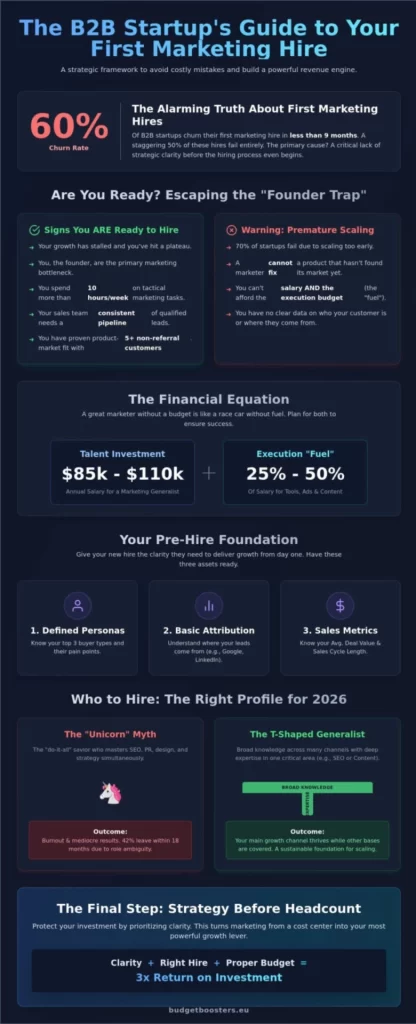
Did you know that 60% of business-to-business startups churn through their first marketing hire in less than nine months? It’s a staggering waste of capital that usually stems from a lack of strategic clarity. You’ve likely felt the frustration of treating marketing like a black box, or perhaps you’ve already been burned by hiring a “social media kid” who didn’t understand your bottom line. Success in hiring first marketing person shouldn’t feel like a gamble; it should feel like the moment your business finally scales and finds its rhythm.
You deserve a partner who turns technical noise into a clear revenue engine. We’re going to fix the confusion around SEO, PPC, and strategy together. This guide provides a proven framework to build a job description that works and helps you choose between a full-time employee or fractional leadership. You’ll gain a clear roadmap to measure success and the confidence that your next hire will deliver a 3x return on investment. Let’s turn that marketing spend into your most powerful growth lever.
Key Takeaways
Recognize the “Founder Trap” and identify the exact indicators that your business is ready to transition from DIY efforts to professional scaling.
Learn why hiring your first marketing person as a T-shaped generalist is the most effective way to build a foundation without falling for the “unicorn” myth.
Compare the ROI of traditional full-time executives against fractional CMO models to find the most cost-effective leadership for your 2026 growth.
Follow a proven roadmap to conduct a marketing audit and craft job descriptions focused on revenue outcomes rather than just a list of tasks.
Protect your investment by prioritizing strategy before headcount to avoid the common pitfalls that lead to 50% of first marketing hires failing.
Table of Contents
When is the Right Time for Hiring Your First Marketing Person?
You’ve built a product that works. You’ve closed the first ten or twenty clients yourself through sheer grit and networking. It’s an incredible achievement. But lately, you might feel like you’re running on a treadmill that’s moving just a bit too fast. If your growth has stalled because you don’t have time to post on LinkedIn or follow up on inbound interest, you’ve hit the “Founder Trap.” This happens when the CEO becomes the bottleneck for every piece of outward communication.
Recognizing this moment is vital for your freedom. You aren’t just looking for someone to “do social media.” You’re looking to transition from accidental growth to a repeatable system. However, 70% of startups fail due to premature scaling, according to data from the Startup Genome project. Hiring a marketer cannot fix a product that hasn’t found its place yet. You’re ready when your product-market fit is proven by at least five non-referral customers and your sales team needs a consistent pipeline to stay busy.
Financial readiness is the final hurdle. Don’t just budget for a salary. If you hire a specialist at an $85,000 to $110,000 annual rate, you must also provide the “fuel” for their engine. Expect to spend an additional 25% to 50% of that salary on ad spend, CRM tools, and content production. Without a working budget, your new hire will spend their first six months building a car they can’t afford to drive. High-level Marketing management fundamentals dictate that resources must be allocated to both talent and execution to see a real return on investment.
The “Founder-Led” Marketing Plateau
Many CEOs struggle to let go of the brand voice. You worry that nobody else can explain the “why” behind your company as well as you can. This fear keeps you stuck doing $20-an-hour tasks instead of $1,000-an-hour strategy. If you spend more than 10 hours a week on tactical marketing, you’re losing money. It’s time to move from “founder-led” chaos to intentional demand generation that runs while you sleep.
Minimum Requirements Before Your First Hire
Before hiring your first marketing person, you need a solid foundation so they don’t waste the first 90 days guessing. Ensure you have these three things ready:
Defined Personas: You should know exactly who your top 3 buyer types are and what keeps them up at night.
Basic Attribution: You need to know if your last five leads came from Google, LinkedIn, or a podcast.
Sales Metrics: Know your average deal value (e.g., $15,000) and your sales cycle length (e.g., 4 months) so the marketer can calculate their required lead volume.
Success in hiring your first marketing person depends on clarity. When you provide the data, they provide the growth. It’s a partnership that unlocks your next level of professional freedom.
Defining the Role: Generalist, Specialist, or Leader?
Stop searching for the marketing unicorn. It doesn’t exist. You can’t expect one human to master SEO, high-level PR, graphic design, and complex growth strategy simultaneously. When hiring first marketing person, many CEOs fall into the trap of wanting a “do-it-all” savior. This path leads to burnout and mediocre results. Data from 2024 suggests that 42% of first marketing hires at B2B startups leave within 18 months due to role ambiguity. You need clarity, not a mythical creature.
The T-Shaped marketer is your best bet for 2026. These professionals possess a broad understanding of all marketing facets but specialize deeply in one specific area. If your primary growth engine is organic search, find a generalist with a deep SEO background. If you rely on outbound, find a content specialist. This approach ensures your main channel thrives while other basics stay covered. Don’t get stuck in the social media trap. B2B growth requires more than just daily LinkedIn posts; it requires a strategy that turns clicks into cash flow. Many marketing leaders accelerate this learning curve by tapping into marketing peer group benefits to validate channel strategies and avoid costly trial-and-error before committing to a hire.
As you scale, you might find yourself choosing between a fractional CMO and a full-time marketing director to guide your new hire. This decision depends on whether you need a high-level architect or someone to manage the daily grind. Building a solid foundation now means more freedom for you later. You’re not just buying labor; you’re investing in your company’s future pace. It’s about creating a system that works even when you aren’t watching.
The Junior Generalist (The Doer)
This person is your execution engine. They’re affordable and high-energy. They’ll handle your email newsletters, basic social updates, and website tweaks. However, they lack the 10,000-hour experience to set a long-term vision. You’ll need to spend about 5-10 hours a week managing them directly. This is the right move if your strategy is already set and you just need more hands on deck. If you want to boost your marketing efficiency, start by documenting your processes before they arrive.
The Marketing Manager (The Coordinator)
A manager does more than execute; they coordinate. They can vet freelancers or manage a small agency effectively. They’re often a “jack of all trades” who knows enough to be dangerous in five different areas. When hiring first marketing person at this level, look for candidates who ask about your Customer Acquisition Cost (CAC) and Lifetime Value (LTV). If they focus on these metrics rather than just “likes,” they have the potential to grow into a Director level role as your revenue climbs. As your team expands beyond a single hire, understanding the right b2b marketing team structure becomes essential to sustaining that growth without costly turnover.
Full-Time vs. Fractional CMO: Choosing the Right Model in 2026
You’ve built a solid product and found your early fans. Now you’re ready to scale. Many CEOs think the next logical step is hiring a €110,000-a-year VP of Marketing. In 2026, this move often leads to a “strategy without execution” trap. High-level executives want to lead teams, not write your email sequences or manage your LinkedIn ads. This mismatch is why 60% of first-time marketing leadership hires fail within the first 18 months.
The math has changed. A full-time executive costs you roughly €160,000 annually when you factor in benefits, taxes, and equity. Contrast this with a fractional leadership retainer that typically ranges from €2,000 to €5,000 per month. By choosing a fractional model, you save over €90,000 in overhead. You gain the freedom to invest that capital into actual lead generation and AI-driven content tools. It’s about being smart with your cash flow while accessing veteran expertise.
The Case for Fractional Leadership First
Don’t hire a pair of hands until you have a brain to guide them. A fractional CMO focuses on building your B2B marketing strategy before you add a single person to your payroll. They create the roadmap, define your KPIs, and set up your tech stack. This foundation ensures that when you’re hiring first marketing person at a junior level, that individual has a clear plan to follow.
Expert Vetting: Your fractional leader interviews and tests candidates. They know how to spot a “growth hacker” who actually understands data versus one who just uses buzzwords.
Risk Mitigation: Industry data from 2025 shows that having a senior expert oversee the recruitment process reduces the risk of a “bad hire” by 70%.
Mentorship: They coach your junior hire, turning a $60k employee into a powerhouse producer.
When to Commit to a Full-Time Executive
There is a right time to bring on a permanent leader. Usually, this happens when your company hits the €8M ARR milestone or your marketing team grows beyond four members. At this stage, the complexity of managing people and cross-departmental politics requires 40+ hours per week. You need someone in the building every day to protect your brand culture.
Transitioning from fractional to permanent shouldn’t be a sudden shock. Use a 90-day handover plan. During the first 30 days, the new executive shadows the fractional CMO. In the next 30, they co-lead. By day 90, the fractional expert steps back into a light advisory role. This ensures hiring first marketing person at the executive level doesn’t break the momentum you’ve worked so hard to build. You’re not just filling a seat; you’re securing your company’s future freedom.
The Step-by-Step Roadmap to Your First Marketing Hire
Stop guessing and start building. Hiring your first marketing person isn’t about filling a seat; it’s about installing a high-performance engine into your business machine. Most CEOs rush this process, which leads to the 40% turnover rate seen in first-time marketing roles within the first six months. You can avoid this by following a structured, data-driven path that prioritizes business growth over flashy resumes.
The Marketing Audit: Your Pre-Hire Essential
Before you post a single job ad, look at your current landscape. You must understand your marketing diagnostic audit results first. This clarity prevents you from hiring for the wrong stage of growth. Are you looking for a “builder” to create your foundational lead-gen processes? Or do you need a “scaler” to increase the volume of a system that already works? 65% of B2B startups fail here because they hire a tactical “button clicker” when they actually need a strategic architect. Identify three “low hanging fruit” wins, such as fixing a 1.5% conversion rate on your demo page, for the new hire to tackle immediately.
Step 1: Conduct a marketing audit. Identify where the “brain” is missing in your current strategy.
Step 2: Write an outcome-based job description. Forget a list of responsibilities. Focus on results like “increase SQLs by 20% within six months.”
Step 3: The Work Sample test. Never hire based on a resume alone. Give them a real business problem. Ask them to analyze your last 30 days of LinkedIn data and suggest three pivots.
Step 4: Set 30-60-90 day KPIs. Accountability starts on day one, not day ninety.
Interviewing for “Marketing Grit”
You need a thinker, not just a doer. Ask questions that separate those who understand business from those who only understand tools. A red flag is any candidate who talks about “brand awareness” or “impressions” without mentioning revenue or customer acquisition costs. In 2026, marketing is a profit center, not a cost center.
Test for AI proficiency. Ask exactly how they use tools like Claude or Midjourney to amplify their output. A modern hire should use AI to handle the work of a three-person team. If they aren’t using automation to move faster, they’ll become a bottleneck as you scale. Look for candidates who show obsession with the “why” behind the data. They should be able to explain how a 10% increase in top-of-funnel traffic specifically impacts your bottom line by the end of the fiscal year.
Ready to turn your marketing into a predictable revenue stream? Boost your marketing strategy today and take full control of your business growth.

Avoiding the “Expensive Mistake”: Strategy Before Headcount
Statistics show that 50% of first marketing hires are terminated or quit within their first 12 months. This failure rarely happens because the candidate lacked talent. It happens because the CEO hired a “doer” before defining the “direction.” If you hire someone to “just do social media” without a documented strategy, you aren’t hiring a growth engine; you’re hiring an expensive experiment. You need a system, not just a person.
The true cost of hiring first marketing person roles goes far beyond the base salary. You must account for the “management tax,” which typically consumes 20% of a CEO’s weekly schedule during the first six months. Add the essential tech stack costs like a CRM, LinkedIn Sales Navigator, or automation tools, and your €60,000 hire quickly becomes a €100,000 investment. Without a clear roadmap, most of that capital is wasted on trial and error. Smart CEOs increasingly turn to collective intelligence through marketing peer groups to stress-test their strategy before committing to headcount, replacing costly guesswork with battle-tested frameworks from non-competing peers.
Budget Boosters helps you bridge the gap between founder-led sales and a scalable team. We ensure your business is “marketing-ready” so your new hire doesn’t spend their first 90 days staring at a blank screen. We provide the structure that turns a risky hire into a strategic win.
Empowering Your First Hire for Success
Your first hire needs more than a laptop and a desk. They need a realistic ad budget of at least €2,000 to €5,000 per month to test channels and gather data. Without this, they’re flying blind. You must also provide a direct line to your desk. In the beginning, you are the primary source of product knowledge and customer pain points. If you can’t commit to weekly 1-on-1s, use a fractional CMO to mentor them and provide the high-level oversight you don’t have time for.
Your Next Steps to Strategic Growth
Stop guessing and start auditing. Data is your best recruiter. Before hiring first marketing person candidates, you need to know your current Customer Acquisition Cost (CAC) and which channels actually drive revenue. We bring corporate-level expertise to SMBs, removing the fluff and focusing on the numbers that matter for your 2026 growth targets.
Are you ready to scale, or do you just need a roadmap? Don’t let your first hire be a costly mistake. Let’s build your foundation together. Book your B2B Marketing Audit today and take control of your growth trajectory.
The Strategy Check: Do you have a documented 90-day plan?
The Tool Check: Is your CRM ready to track leads?
The Mentor Check: Who will guide them when they hit a wall?
Turn Your Growth Vision Into a 2026 Reality
Building a marketing engine from scratch is one of the most significant milestones you’ll hit this year. You now know that success depends on establishing a strategy before increasing your headcount. Avoid the common trap where 65% of B2B startups fail to see marketing ROI because they hired a tactical executor without a strategic plan. Whether you choose a full-time generalist or a flexible Fractional CMO, your goal remains the same: creating sustainable, predictable revenue. You’ve built the foundation; now you just need the roadmap to execute it without wasting capital.
At Budget Boosters, our fCMOs delivered corporate-level marketing leadership to over 45 SMBs across the Baltics and Poland. We focus on data-driven growth roadmaps that provide 100% transparency on every Euro spent. Your journey toward hiring first marketing person doesn’t have to be a gamble. You can access elite expertise at prices that actually make sense for your current scale. It’s time to take control of your brand’s future and stop guessing which channels will perform.
Eliminate the guesswork—get a professional Marketing Audit before you hire.
You’ve built something incredible through hard work and grit. Now, let’s give your business the spotlight it deserves. You’re ready for this next level, and we’re excited to see you thrive.

Frequently Asked Questions
How much should I pay my first marketing hire in 2026?
Expect to pay between €45,000 and €90,000 per year for a competent mid-level professional in 2026. This range reflects the 4.2% annual wage growth seen in the B2B tech sector over the last two years. You’re investing in a growth engine, so consider adding a 10% performance bonus tied to specific revenue milestones. It’s a fair price for the freedom you’ll gain to focus on CEO-level tasks.
Should my first marketing hire be a specialist in SEO or a generalist?
Hire a generalist who can handle multiple channels like email, content, and basic ads. You need a “T-shaped” marketer who understands the big picture but has deep knowledge in at least one area. A specialist might master one niche, but they’ll leave 80% of your funnel empty. Start broad to find what works, then hire specialists later to scale those specific wins.
What is the difference between a Marketing Manager and a Fractional CMO?
A Marketing Manager executes daily tasks for 40 hours a week, while a Fractional CMO provides high-level strategy for roughly 10 to 15 hours a month. Managers typically cost €80,000 annually and focus on doing the work. Fractional CMOs often charge a €4,000 monthly retainer to tell you what work needs doing. Choose the manager if you have a clear plan but no hands to build it.
How do I measure the ROI of my first marketing person?
Measure success through sales pipeline contribution and your customer acquisition cost. Your first marketing person should influence at least 25% of new leads within their first six months. Track how much revenue originates from marketing-sourced deals in your CRM. Don’t get distracted by likes or shares; focus on the €50,000 contracts that actually move the needle for your business.
Do I need to hire a marketing agency or a person first?
Hire a person first to build your internal brand soul and long-term strategy. Agencies are excellent for scaling specific tasks, but they don’t live in your office or understand your customers’ daily pains. An internal hire spends 2,000 hours a year obsessing over your growth. Use agencies later for specialized projects like high-end video production or complex technical web development.
What skills are essential for a marketing hire in the age of AI?
Your hire must master AI prompt engineering and automated data synthesis. By 2026, 70% of business content starts with an AI draft, so they need to be a conductor of technology. They should use tools like OpenAI or Jasper to triple their creative output. Look for someone who uses AI to handle the grunt work so they can spend more time on human-to-human strategy.
Can a junior marketer create a full marketing strategy?
A junior marketer cannot create a comprehensive strategy alone. They lack the 5 to 7 years of experience required to navigate complex multi-stakeholder buying cycles. You’ll likely end up with a list of disconnected tactics instead of a cohesive growth plan. If you hire a junior, you must be prepared to act as the lead strategist yourself or hire an external mentor.
How long does it take for a first marketing hire to show results?
It takes 90 to 180 days to see measurable revenue impact after hiring your first marketing person. The first 30 days are dedicated to audits and setting up your tracking systems. By day 60, you’ll see an increase in lead flow and engagement. By day 180, those leads should be converting into closed deals. Stay patient and trust the process as your new engine warms up.
Article by
Aurimas Guoga