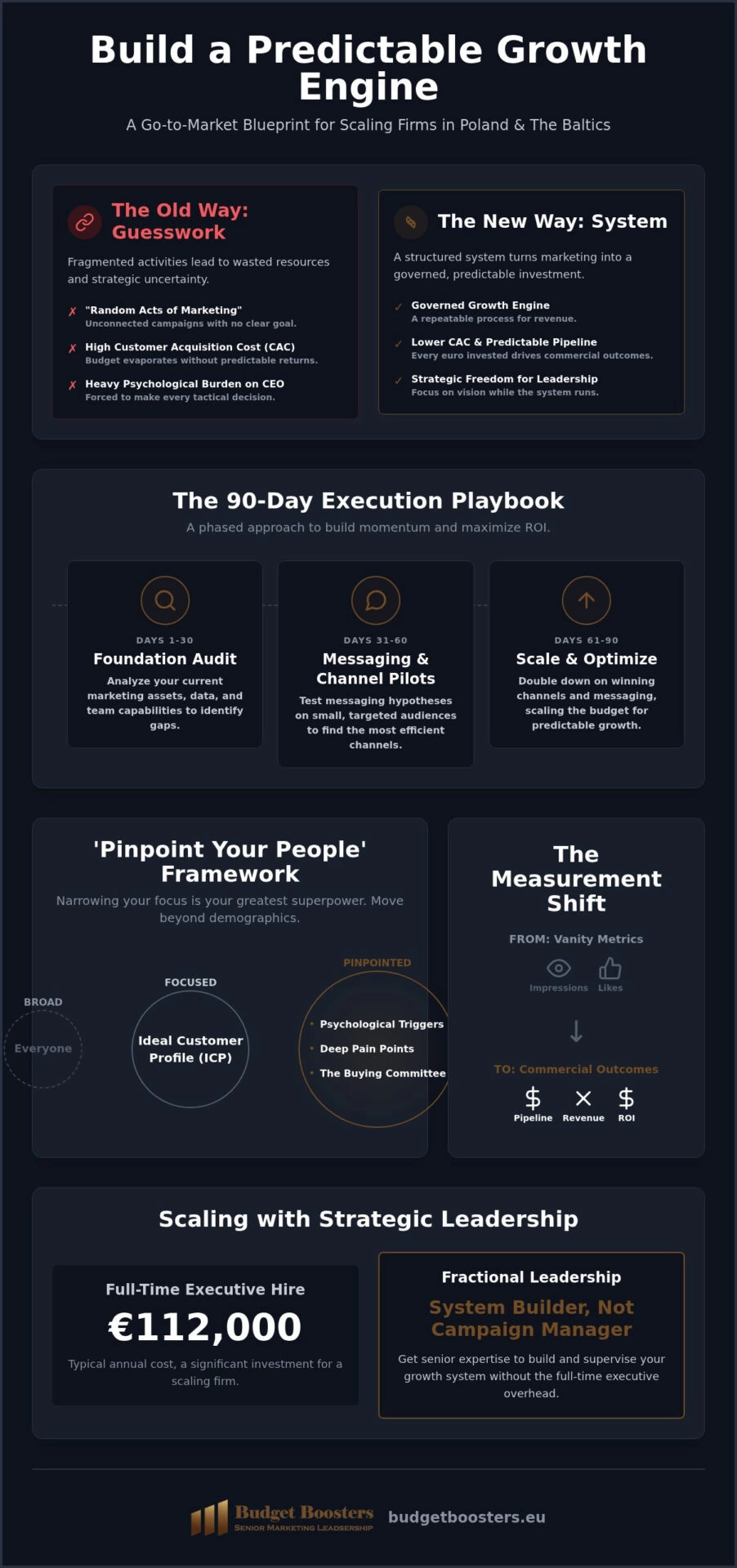
What if the reason your last product launch felt like a high-stakes gamble wasn’t a lack of talent, but the absence of a repeatable system? It’s a common struggle for scaling firms across Poland and the Baltics. You’re likely tired of funding fragmented, activity-driven marketing that leaves you guessing about the actual ROI. Making every single tactical decision yourself creates a heavy psychological burden. It’s frustrating when you know your product deserves better than “random acts of marketing.”
You’re ready for a change, and that’s exactly what we’re going to build. This guide reveals how to implement a data-driven B2B go-to-market strategy that ensures successful launches and predictable revenue growth. We’ll move past the era of strategic uncertainty. You’ll discover a roadmap to lower your CAC and increase lead volume by treating marketing as a governed investment. This isn’t about the pressure of hiring a full-time executive for €140,000. It’s about building a system that works. Let’s explore how to build a world-class growth engine that gives you back your freedom and control.
Key Takeaways
- Transition from scattered marketing activities to a structured Marketing Operating System that treats growth as a governed investment rather than an unpredictable cost center.
- Master a B2B go-to-market strategy by using the ‘Pinpoint Your People’ framework to align your messaging with the deep psychological triggers of your ideal customers.
- Follow a proven 90-day execution playbook to audit your foundation, test messaging pilots, and identify the most efficient channels for your specific product launch.
- Shift your focus from vanity metrics like clicks and likes to commercial outcomes to ensure every €1 invested drives predictable pipeline and revenue growth.
- Discover how fractional leadership provides the senior expertise needed to build and supervise these systems for scaling firms across Poland and the Baltics.
Understanding the GTM Blueprint: Why Guesswork is the Enemy of Growth
Growth isn’t a matter of luck or a series of happy accidents. It’s the result of a disciplined system. A solid go-to-market strategy is more than just a marketing campaign; it is a cross-functional blueprint that aligns your sales, product, and marketing teams toward a single commercial goal. A go-to-market strategy is the vital bridge between product development and revenue traction.
Fragmented, “activity-driven” marketing is the fastest way to drive up your Customer Acquisition Cost (CAC). When your team jumps from one trend to another without a central plan, your budget evaporates and your message gets lost. You need a structure that prioritizes results over noise. The Marketing Operating System serves as your framework for financial discipline, turning marketing from a cost center into a governed investment that replaces expensive guesswork with a repeatable engine for growth.
To better understand this concept, watch this helpful video:
Go-to-Market vs. General Marketing Strategy
Many leaders confuse these two concepts. Your general strategy is the foundation; it defines your brand’s long-term identity and positioning. However, your B2B go-to-market strategy is the momentum. It is a time-boxed execution plan designed for a specific market entry or product launch. For scaling firms in Poland and the Baltics, market-entry sequencing is everything. You don’t just “enter a market.” You win one specific segment, build authority, and then use that momentum to expand into the next.
The Cost of Strategic Uncertainty
Carrying the weight of every marketing decision is exhausting for a CEO. This strategic uncertainty creates a massive psychological burden that slows down your entire organization. When you lack senior oversight, you end up with “random acts of marketing” that burn through cash without building long-term assets. It’s time to shift from being a campaign manager to a system builder. You can explore how this fits into a broader growth roadmap in our guide on the modern business-to-business marketing strategy. Building a predictable system isn’t just about revenue; it’s about gaining the freedom to focus on your vision while the growth engine runs on its own.
Identifying the Right Audience: The Ideal Customer Profile (ICP) Framework
Trying to sell to everyone is a recipe for exhaustion. In the competitive landscapes of Poland and the Baltics, narrowing your focus isn’t a limitation; it’s your greatest superpower. Our ‘Pinpoint Your People’ framework helps you move beyond basic demographics. You need to understand what keeps your prospects awake at night. What are their psychological triggers? Are they driven by a fear of falling behind competitors or the excitement of personal freedom through better systems?
When you focus on a specific segment, your revenue growth actually accelerates. You stop wasting resources on leads that don’t close. Instead, you build deep authority within a niche. This is a core component of a comprehensive B2B go-to-market guide that prioritizes efficiency over volume. You must also identify the ‘Buying Committee.’ In professional services, the person signing the check is rarely the only one you need to convince. You’re speaking to the CEO, the CFO, and the technical supervisors who all have different definitions of success.
Developing Messaging Hypotheses
Your messaging must hit home immediately. In the tech and logistics sectors, generic promises fail. You need hypotheses that address specific regional pain points. Effective competitive differentiation means showing exactly how you solve a problem better than the local or global giants. If you want to see how senior leadership handles this level of strategy, you might find The CMO Edge helpful for understanding the impact of high-level marketing oversight.
Validating the Market in Poland and the Baltics
Cultural nuances matter. A Polish business leader might value scale and proven reliability, while an Estonian executive often prioritizes digital agility and lean processes. Don’t guess. Use data to confirm your ICP is large enough to hit your growth targets. This validation phase requires tight alignment with your sales team. They are on the front lines and know which messages actually open doors. Are you ready to stop guessing and start scaling? Check out our Fractional CMO Landscape Research 2026 to see how regional firms are refining their audience focus.
The 90-Day Execution Playbook: Sequencing Channels for Maximum ROI
Execution is where most plans fail. You don’t need a three year strategy that gathers dust on a shelf. You need a 90 day sprint that builds a permanent growth engine. This timeframe is short enough to maintain high energy but long enough to see real data. It’s about momentum. By breaking your B2B go-to-market strategy into three distinct phases, you replace chaos with a rhythmic, predictable system.
- Days 0–30: The Foundation. We start with a deep audit of your current assets. This is where we define your ICP with surgical precision and build the strategic bedrock. No ads are running yet. We’re sharpening the axe.
- Days 31–60: The Pilot Phase. Now we test. We run messaging pilots and channel tests to find true product-market fit. We don’t guess; we listen to what the market in Poland and the Baltics tells us through real interactions.
- Days 61–90: The Scaling Phase. We identify the winning channels and double down. This is where we install a repeatable cadence that your team can follow long after the initial launch.
To stay ahead of these shifts, join our community. Subscribe to the Budget Boosters Newsletter for the latest fractional CMO trends across the Baltics and Poland. You’ll also receive our free ebook, The CMO Edge. Why Companies with Senior Marketing Leadership Outperform (a €29 value), to help you master senior-level marketing leadership.
Sequencing Channels by Intent and Payback
Don’t try to be everywhere at once. Start with high-intent channels where people are actively searching for solutions. Search advertising often provides a faster payback than broad social awareness campaigns. We typically recommend allocating 5% to 10% of your gross revenue to marketing. This budget should be focused on the channels that move the needle first. For a detailed breakdown of how to structure this, use the ultimate go-to-market strategy template.
AI-Enhanced Content Multiplication
Scaling firms often struggle with content production. You don’t need a massive team to stay visible. By using the ‘Universal Content Converter’ concept, you can turn a single high-quality whitepaper into 20 LinkedIn posts or several newsletters. AI workflows can cut your production time by up to 65% while keeping your unique brand voice intact. This efficiency is vital for maintaining a strong presence in regional markets without exploding your costs. Discover more in our guide on 7 practical ways to streamline content creation with AI.
Governance and Measurement: Turning Marketing into a Predictable Investment
Control isn’t a burden. It’s the path to personal freedom. When you stop chasing vanity metrics like “likes” or “clicks,” you start building a real growth engine. Your marketing shouldn’t be a black hole for cash. It should be a governed investment with clear commercial outcomes. By focusing on pipeline and revenue, you transform your B2B go-to-market strategy from a series of guesses into a predictable system.
The ‘Measurement Discipline’ is a vital piece of the Marketing Operating System. It’s about knowing exactly how much you spend to acquire a customer and how that spend impacts your gross margins. Tracking your Customer Acquisition Cost (CAC) allows you to make decisions based on financial reality, not gut feelings. We recommend a weekly cadence to review this data. This rhythm allows you to adjust tactics in real-time before small leaks become big problems. Ready to see where your budget is actually going? Start with a Marketing Diagnostic & Audit to find your hidden growth levers.
The Feedback Loop: Messaging and Pricing Tests
Your messaging shouldn’t be static. It needs to evolve based on real conversations your sales team is having. Weekly feedback loops ensure your marketing stays sharp and relevant. We also use ‘Pipeline Acceleration’ tests to find ways to shorten your sales cycle. This keeps your cash flow healthy and your team motivated. If you’re unsure where to start with the numbers, learn how to calculate Customer Acquisition Cost (CAC) to ground your strategy in hard data.
Revenue Attribution for Non-Enterprise Firms
You don’t need complex enterprise software to track what’s working. In Poland and the Baltics, simple attribution methods often yield the best results. Focus on revenue and demand generation instead of just counting leads. It’s about the quality of the deals, not the volume of the forms filled. Look at Polmet Solutions. By installing these governance structures, their revenue grew from €6.1M to €7.4M. They saw a ≈22% increase in marketing efficiency and a ≈18% decrease in CAC. This is the power of a governed system. It provides the clarity you need to scale with confidence.
Scaling with Strategic Leadership: The Role of a Fractional CMO
You shouldn’t have to be the default marketing manager. Your vision is too big for you to be stuck in tactical execution. This leadership gap is where growth often stalls for scaling firms. If your revenue is between €1M and €15M, you’ve likely reached a point where you need senior expertise but don’t yet require a full-time executive. This is where a Fractional CMO changes the game. They don’t just manage campaigns. They act as an architect who builds your growth system and then supervises its execution. This ensures your B2B go-to-market strategy isn’t just a document on a shelf, but a living engine that drives traction.
The beauty of this model is the focus on governance and accountability. You get a technical supervisor who understands how to align marketing with your sales goals. To see how this shift is happening in real-time, download the Fractional CMO Landscape Research 2026. It highlights how firms across Poland and the Baltics are moving toward senior, part-time leadership to stay agile and efficient.
Fractional vs. Full-time: The Decision Framework
Choosing the right leadership model depends on your growth stage. Use this simple framework to decide. An Interim CMO is perfect for transitions or filling a temporary gap. A Fractional CMO is the ideal choice for stable, predictable growth when you need a system builder. Save a full-time hire for when your complexity exceeds €20M. The cost-benefit is clear. You can access senior leadership for approximately €48,000 to €96,000 per year, compared to the €200,000 or more required for a full-time executive. If you want to dive deeper into this choice, read our guide on marketing leadership for SMBs.
Building a Predictable Growth Engine in the Baltics
Regional nuance matters. Finding a partner who understands the specific business cultures of Lithuania, Latvia, and Estonia is vital for success. You need a leader who is embedded in your leadership cadence, not an outside consultant who just drops a report and leaves. This integration allows for real-time adjustments and true partnership. It’s about taking control of your future and turning marketing into a source of personal freedom and business stability. Are you ready to stop the guesswork? Explore our Go-to-Market & Product Launch services and let’s build your growth engine together.
Step into Your Future: Building a System for Freedom
Your journey toward a predictable growth engine starts with a single choice: deciding to replace chaos with a system. We’ve explored how a refined B2B go-to-market strategy turns fragmented activities into a governed investment. By narrowing your focus to a precise Ideal Customer Profile and following a disciplined 90 day playbook, you gain the control needed to scale with confidence.
The results speak for themselves. Look at Polmet Solutions, where revenue grew from €6.1M to €7.4M while CAC was reduced by ≈18% in just 12 months. With AI workflows cutting content production time by up to 65%, your team can achieve more without the burnout. You don’t need to carry the strategic burden alone. Fractional leadership provides the senior expertise to build and supervise these systems at a fraction of the cost of a full time executive.
It’s time to stop guessing and start growing. You have the roadmap; now it’s time to take the first step toward your personal freedom and business stability. Build your predictable growth engine with a Fractional CMO. Your future is waiting. Let’s make it extraordinary.
Frequently Asked Questions
What is a go-to-market strategy for companies in the professional services sector?
It is a cross-functional blueprint that aligns your sales, product, and marketing teams to launch a service or enter a new market. It goes beyond general branding to focus on specific market entry sequencing. For professional services, it defines how you will reach the buying committee and prove your authority. It is the vital bridge between having a great service and actually gaining revenue traction in a competitive landscape.
How much does a go-to-market strategy engagement cost for an SME?
While costs vary based on scope, a fractional CMO engagement typically ranges from €60,000 to €120,000 per year. This is significantly more efficient than a full-time executive, which can cost over €250,000. For specific projects, scaling firms often allocate 5% to 10% of their revenue to their marketing budget. This ensures you have the senior oversight needed to build a system without the overhead of a full-time hire.
Can a fractional CMO help with a product launch in Poland and the Baltics?
Yes, a fractional CMO specializes in building the systems required for successful regional launches. They understand the cultural nuances between Estonian, Latvian, Lithuanian, and Polish business leaders. By embedding themselves in your leadership cadence, they ensure your B2B go-to-market strategy is tailored to the local market. This approach helps you avoid generic global tactics that often fail to resonate with regional buying committees and technical supervisors.
How do I measure the ROI of my go-to-market plan?
You should move away from vanity metrics like likes and focus on commercial outcomes. Key indicators include qualified lead volume, pipeline value, and revenue growth. We also track Customer Acquisition Cost (CAC) and its impact on your gross margins. For example, Polmet Solutions saw a ≈22% increase in marketing efficiency after implementing a structured system. Real ROI is measured by how effectively your marketing budget turns into predictable revenue.
What is the difference between a GTM plan and a sales playbook?
A GTM plan is the high-level architectural blueprint for the entire organization. It covers segment prioritization, messaging hypotheses, and channel sequencing. A sales playbook is a tactical tool specifically for the sales team. It contains scripts, objection handling, and closing techniques. While the GTM plan sets the direction, the sales playbook focuses on the individual conversations required to win the deals defined by that broader strategy.
How long does it take to see results from a new go-to-market system?
We use a 90 day execution playbook to ensure you see measurable progress quickly. The first 30 days focus on the foundation and audit. Days 31 to 60 involve testing channel pilots and messaging. By the final 30 days, we are scaling winning channels and installing a repeatable cadence. While long-term brand authority takes time, you can expect to see shifts in lead quality and pipeline clarity within the first three months.
Is AI really effective for content multiplication in a business-to-business launch?
Absolutely. AI workflows can cut your content production time by up to 65% while preserving your unique brand voice. Tools like the Universal Content Converter allow you to turn one deep-dive whitepaper into dozens of LinkedIn posts and newsletters. This efficiency is vital for scaling firms that need to maintain a high-authority presence in the Baltics and Poland without hiring a massive, expensive internal content team.
Do I need a full-time marketing director to execute a GTM strategy?
Not necessarily. Firms with revenue between €1M and €15M often find that a fractional CMO provides the perfect balance of senior expertise and cost-efficiency. You need a system builder rather than a full-time campaign manager. A fractional leader can build your Marketing Operating System and supervise its execution, giving you board-level impact without the €250,000+ price tag of a permanent executive hire.

Article by
Aurimas Guoga
Aurimas Guoga is a fractional CMO and founder of Budget Boosters, helping B2B companies turn fragmented marketing into a predictable growth engine. With over a decade of experience leading marketing strategy, he works with business leaders to improve ROI, build scalable systems, and drive measurable revenue growth. Aurimas is also the author of The CMO Edge, a guide for companies looking to gain a competitive advantage through senior marketing leadership.