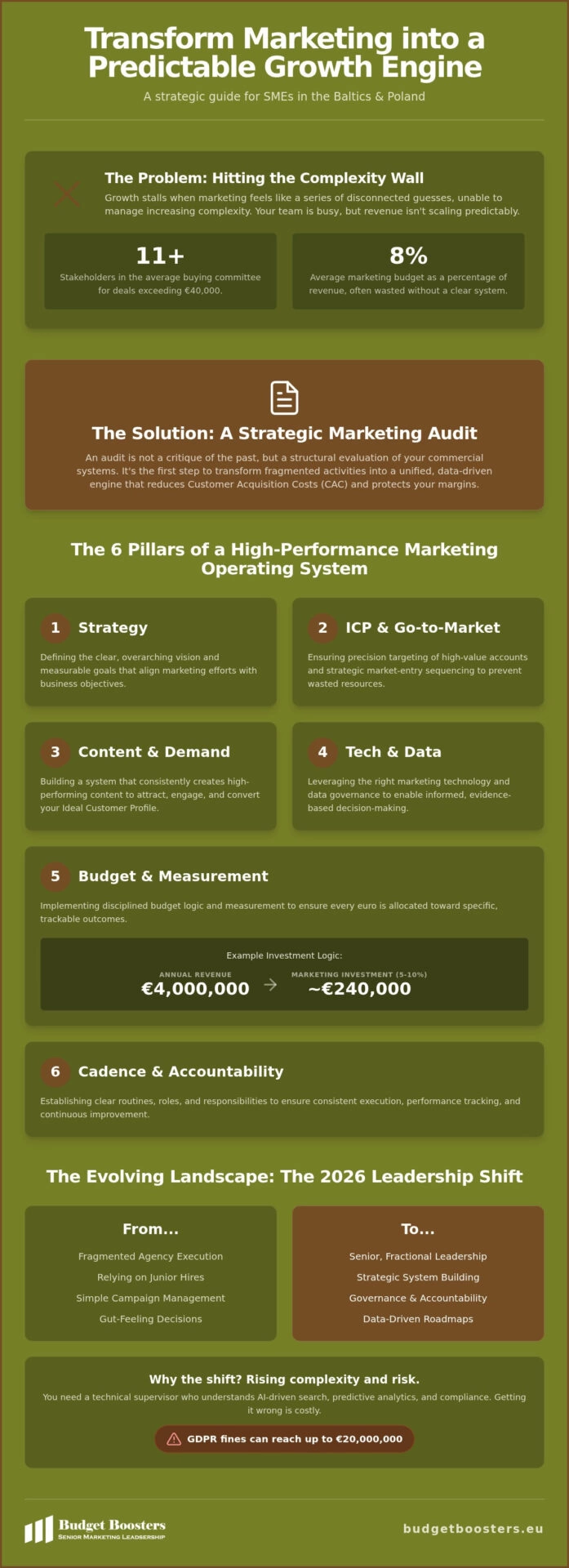
Did you know the average buying committee has grown to over 11 stakeholders for deals exceeding €40,000? That’s a massive amount of complexity to manage when your current marketing feels like a series of disconnected guesses. If you’re tired of fragmented activities that don’t seem to talk to each other, you aren’t alone. Many leaders in the Baltics and Poland feel the weight of increasing data demands and shifting AI tools. A comprehensive B2B marketing audit is the first step toward clarity. It’s not about judging past mistakes. It’s about empowering you to take control of your growth.
You deserve a system that works as hard as you do. We’ll show you how to transform those scattered tactics into a data-driven engine that reduces your customer acquisition costs. You can move from guesswork to a clear, strategic roadmap that provides personal freedom through professional control. This guide previews how to build a repeatable marketing operating system. We’ll look at why senior leadership oversight is the secret to scaling SMEs in 2026. Let’s turn your marketing into a beautiful, predictable structure that drives real revenue.
Key Takeaways
- Learn how to break through the complexity wall by shifting from scattered activities to a structured commercial system.
- Discover the 6 pillars of a Marketing Operating System that turn governance into a powerful lever for revenue growth.
- Understand how a comprehensive B2B marketing audit identifies hidden inefficiencies to help you reduce Customer Acquisition Costs and protect your margins.
- Master a 5-step framework to evaluate your current standing and transition from simply doing more to doing the right things.
- Explore how fractional leadership acts as a system builder to implement your growth roadmap without the overhead of a full-time executive.
The Strategic Necessity of a Marketing Diagnostic in 2026
Growth doesn’t happen by accident. For many SMEs in Poland and the Baltics, there comes a moment where the old ways of ‘just doing more’ stop working. You hit a complexity wall. Your team is busy and your inbox is full, but the revenue isn’t scaling predictably. This is where a strategic diagnostic becomes essential. Think of a B2B marketing audit not as a critique of your past, but as a structural evaluation of your commercial systems. It’s the moment you stop treating marketing as a cost center and start viewing it as a governed investment. By auditing your current setup, you can transform fragmented activities into a unified growth engine.
Why Guesswork is the Greatest Risk to Growth
Many CEOs find themselves acting as the default marketing manager. It’s a heavy psychological burden. You’re likely making high-stakes decisions based on gut feeling rather than hard data. This strategic uncertainty leads to wasted budgets and missed targets. When you don’t have a clear roadmap, you’re essentially gambling with your company’s future. Industry data suggests that marketing budgets for product companies now average around 8 percent of revenue. Without a system, much of that investment disappears into ‘noise’. A diagnostic is your first step toward financial discipline. It replaces the ‘spray and pray’ approach with a repeatable system that gives you back your personal freedom.
The Evolving Landscape of Leadership in the Baltics
The landscape is changing fast. In 2026, firms are moving away from relying on junior hires or generalist agencies for high-level strategy. They’re turning to senior fractional leadership instead. Why? Because the complexity of technology and data governance has skyrocketed. You’re dealing with AI-driven search, predictive analytics, and strict compliance rules. With GDPR fines potentially reaching up to €20,000,000, you can’t afford to get it wrong.
Our Fractional CMO Landscape Research 2026 shows that regional firms are now prioritizing system building over simple campaign management. You need a technical supervisor who understands how to align your commercial efforts with your sales goals. This shift isn’t just about hiring; it’s about governance. It’s about ensuring that your data, your tools, and your people are all moving in the same direction. When you have a professional diagnostic in place, you gain the clarity needed to lead with confidence.
Marketing shouldn’t feel like a collection of creative guesses. It’s a governed system. To scale effectively, you need a Marketing Operating System that integrates strategy, data, and execution into a single, high-performance engine. This proprietary framework consists of six core pillars: Strategy, ICP & Go-to-Market, Content & Demand, Tech & Data, Budget & Measurement, and Cadence & Accountability. Each component acts as a lever. When you adjust them correctly, you don’t just see more activity; you see improved gross margins and predictable revenue growth. A B2B marketing audit evaluates these pillars to ensure your commercial efforts aren’t just running, but actually driving your business forward. Control over these processes isn’t a burden. It’s your path to professional freedom.
ICP and Go-to-Market Sequencing
Precision is the foundation of efficiency. If your targeting is broad, your budget is bleeding. Auditing your Ideal Customer Profile (ICP) ensures you’re only spending resources on accounts that have the highest lifetime value. We look at Go-to-Market (GTM) sequencing to ensure you’re entering the right market segments at the right time. This prevents the “complexity wall” where you try to do everything at once and achieve nothing. You can find more about this in The Modern Business-to-Business Marketing Strategy. When your sequence is right, market entry becomes faster and less expensive.
Budget Logic and Measurement Discipline
How do you decide what to spend? Many SMEs simply pick a number that feels safe. In a high-performance system, we use a clear budget logic. Typically, growth-stage firms should invest between 5 percent and 10 percent of their revenue into marketing. For a company with €4,000,000 in revenue, a structured investment would be approximately €240,000. This isn’t just a cost. It’s an allocation toward specific outcomes. We audit your measurement cadence to ensure you have executive-level visibility on ROI. We focus on reducing Customer Acquisition Cost (CAC) while protecting your gross margins. If you can’t measure it, you can’t govern it.
Cadence and Accountability
Execution is where most strategies fail. A structured audit examines the reporting rhythm between your internal teams and external partners. Are they aligned? Is there a clear sense of accountability? We implement a structured cadence that keeps everyone focused on the growth roadmap. A fractional CMO often acts as the system builder here, ensuring that the team isn’t just busy, but productive. This rhythm creates a predictable environment where surprises are minimized and results are maximized. If you’re curious about how senior leadership can transform your governance, explore our Fractional CMO Landscape Research 2026.
Auditing for Efficiency: Reducing CAC and Improving Margins
Efficiency isn’t just a dry metric. It’s the secret to your personal freedom as a leader. When your commercial systems are tuned correctly, you stop worrying about every cent. A B2B marketing audit acts as a financial diagnostic. It identifies exactly where your budget is leaking and how to plug those holes. Take Polmet Solutions S.A. as an example. By restructuring their oversight, they achieved a 22 percent increase in marketing efficiency. Their revenue climbed from €6.1 M to €7.4 M. This wasn’t because they spent more. It’s because they spent smarter.
Strategic realignment often leads to dramatic results. We’ve seen firms achieve an 18 percent reduction in Customer Acquisition Cost (CAC) simply by cleaning up their processes. This includes improving content ROI through systematic auditing. When you stop creating content for the sake of activity and start creating it for revenue, everything changes. You’re no longer just making noise. You’re building a growth engine that protects your gross margins.
The Financial ROI of Professional Oversight
How much is guesswork costing you? A full-time marketing executive can cost your business upwards of €200,000 annually. For many SMEs, that’s a massive commitment that often isn’t necessary. In contrast, senior fractional leadership typically ranges from €48,000 to €96,000. You get the same high-level expertise without the full-time overhead. A diagnostic identifies immediate areas for these efficiency gains. It’s about getting maximum impact for every euro invested. To stay ahead of these trends in the Baltics and Poland, subscribe to the Budget Boosters Newsletter. You’ll get practical insights and our free ebook, “The CMO Edge. Why Companies with Senior Marketing Leadership Outperform – and How to Get There” (a €29 value), to help you make better decisions.
Case Study: From Fragmented to Functional
Real results speak louder than theories. During our engagement with People Element, we focused on shifting from fragmented tactics to a system-first approach. The results were clear. Qualified leads increased by 40 percent. This alignment contributed to a 25 percent annual revenue growth. We even looked at the smaller details that drive big outcomes. For instance, email open rates improved from a dismal 3 percent to a staggering 30 percent. This is what happens when you treat marketing as a governed system. You don’t just do more. You do what works. By auditing your current standing, you can stop the cycle of guesswork and start scaling with confidence.
How to Conduct a Comprehensive Marketing Audit: A Step-by-Step Framework
Scaling an SME isn’t about working harder. It’s about identifying the right commercial levers to pull. A professional B2B marketing audit provides the diagnostic clarity you need to stop guessing and start leading with data-driven confidence. We use AI-driven diagnostic tools to analyze your historical data faster, ensuring your team and technology are perfectly aligned. This process isn’t a dry checklist. It’s an exciting path to professional freedom. When you understand your system, you gain the power to change it.
Step 1 & 2: Data Integrity and Strategy Alignment
Start with the foundation. You can’t lead what you can’t see. We audit your revenue attribution and lead tracking to ensure every euro is accounted for. Are your systems correctly capturing traffic from new sources like AI search assistants? We then evaluate if your current activities align with your 2026 growth targets. Often, we find a “complexity wall” where old processes start to fail. Identifying this wall is the first step to breaking through it. It’s about moving from noise to signal.
Step 3 & 4: Channel Performance and Content Multiplication
Next, we look at where your leads are coming from. We audit your channel mix to prioritize high-intent generation. It’s time to stop chasing vanity metrics and focus on what actually moves the needle. We evaluate your production efficiency using The Content System. By auditing AI-enhanced workflows, we often find ways to cut production time by up to 65 percent. This isn’t just about saving time. It’s about creating a high-performing engine that delivers value while you sleep. Your content should be a scalable asset, not a constant drain on your energy.
Step 5: The Growth Roadmap and Financial Discipline
Finally, we synthesize everything into a prioritized execution plan. This roadmap sets measurable KPIs for the next 6 to 12 months, ensuring every action has a clear financial purpose. You move from being a campaign manager to a system builder. This transition gives you the headspace to focus on high-level strategy rather than daily fires. Ready to transform your fragmented activities into a predictable growth engine? Book your Marketing Diagnostic & Audit today to start your journey toward systematic success.
From Audit to Action: Implementing a Growth Roadmap with Fractional Leadership
A diagnostic is only as good as the action that follows it. You’ve identified the gaps and found the “complexity wall” through your B2B marketing audit. Now, how do you scale without drowning in executive costs? In the Baltics and Poland, the answer is increasingly found in senior, part-time leadership. By using your audit results to embed a fractional CMO, you gain a system builder who governs your roadmap. They don’t just manage campaigns. They build the commercial infrastructure that allows your business to breathe. This shift represents a move toward a permanent Marketing Operating System where every euro is an intentional investment. Control over these systems isn’t a burden; it’s your path to professional freedom.
The Fractional CMO Decision Framework
Are you unsure whether to hire full-time or go fractional? It’s a common question for growth-stage CEOs. An interim CMO is perfect for a short-term crisis or a specific project. A full-time placement is a heavy commitment that might not be necessary until you’ve reached a much larger scale. A fractional CMO provides the sweet spot. They reduce your strategic uncertainty by taking the “marketing manager” hat off your head. We use our “Pinpoint Your People” framework to ensure your message hits the right audience with surgical precision. This isn’t just about ads. It’s about alignment between your vision and your execution. You deserve a partner who understands the regional nuances of the Polish and Baltic markets.
Building for the Long Term
The goal is to move from reactive crisis management to predictable, repeatable growth. Your marketing should be a system that works even when you aren’t looking at it. This requires a shift in mindset. You’re no longer just looking for the next lead; you’re building a scalable engine. Our Fractional CMO Landscape Research 2026 shows that firms in our region are rapidly moving away from fragmented execution. They’re choosing senior oversight to navigate the rising complexity of data and AI. This is your chance to step up.
By implementing a governed roadmap, you aren’t just improving your marketing. You’re securing your company’s future. The transition from a one-time diagnostic to a permanent system ensures that your growth is sustainable. It’s about balance and independence. When your commercial systems are predictable, you can focus on the high-level strategy that only you can provide. Don’t let the complexity of 2026 hold you back. Use your audit as the foundation for a more sophisticated, efficient way of doing business.
Step into a Future of Predictable Growth
You’ve seen how a structured commercial system replaces guesswork with financial discipline. By conducting a thorough B2B marketing audit, you identify the exact levers needed to break through your current complexity wall. Whether it’s aligning your ICP or cutting content production time by 65 percent using AI, the path to personal freedom starts with clarity. We’ve helped firms like Polmet Solutions S.A. grow their revenue by €1.3 M through better oversight. We’ve also seen People Element lift their qualified leads by 40 percent using a system-first approach. These aren’t just numbers. They represent the power of a governed growth engine.
Aurimas Guoga, creator of The CMO Edge, designed these frameworks to help you lead with confidence. You don’t have to be a marketing expert to have expert results. You just need a roadmap that works. Book your fixed-fee Marketing Diagnostic and build your 2026 growth roadmap today. Your next level of success is waiting. Let’s build it together.
Frequently Asked Questions
What is a marketing diagnostic and how does it differ from a standard audit?
A marketing diagnostic is a structural evaluation of your commercial systems. While a standard audit often lists past mistakes or surface-level metrics, a diagnostic focuses on your future growth roadmap. It identifies the complexity wall preventing you from scaling and provides a system-first approach to governance. This process turns your efforts from a cost center into a governed investment, ensuring your strategy, data, and execution are perfectly aligned for 2026.
How long does a comprehensive marketing audit typically take for an SME?
A comprehensive B2B marketing audit typically takes between two and four weeks to complete for most SMEs. This timeframe allows for a deep dive into your data integrity, channel performance, and team accountability. We analyze your current revenue attribution and lead tracking to ensure every euro is accounted for. By the end of this period, you’ll have a prioritized execution plan and measurable KPIs for the next 6 to 12 months.
Do I need a full-time CMO to implement the audit findings?
You definitely don’t need a full-time executive to implement these changes. For companies with revenue between €1,000,000 and €15,000,000, a fractional CMO is often the smarter choice. You get senior-level oversight and a repeatable Marketing Operating System without the heavy commitment of a full-time salary. This model allows you to embed professional leadership into your cadence while keeping organizational complexity low and personal freedom high.
How can I identify my ideal audience after the audit is complete?
We use our proprietary “Pinpoint Your People” framework to identify your ideal audience with surgical precision. This happens right after the diagnostic phase. We audit your Ideal Customer Profile (ICP) to ensure you’re only spending resources on accounts with the highest lifetime value. By refining your targeting and go-to-market sequencing, you reduce waste and ensure your message resonates with the stakeholders who actually make the buying decisions.
What are the typical costs for a fractional CMO to lead this process?
Investing in senior leadership is more accessible than you might think. A fractional CMO typically costs between €48,000 and €96,000 per year. Compare this to the €200,000 or more you’d spend on a full-time placement. This model provides elite expertise at a fraction of the cost, making it ideal for growth-stage firms in Poland and the Baltics. You gain a technical supervisor who drives commercial outcomes without draining your cash flow.
How does the Content Multiplication System improve marketing efficiency?
The Content Multiplication System uses AI-enhanced workflows to act as a personal assistant for your brand. It cuts production time by up to 65 percent while preserving your unique voice. By using an Idea Bank and structured production workflows, you can turn a single piece of high-value data into multiple assets across different channels. This significantly improves your content ROI and ensures your team stays focused on strategy rather than repetitive manual tasks.
What financial results can a Baltic or Polish firm expect from a strategic audit?
Regional firms often see substantial improvements in their bottom line. For example, Polmet Solutions S.A. saw their revenue grow from €6.1 M to €7.4 M after restructuring their oversight. They also improved their gross margin by 2.3 percentage points and reduced Customer Acquisition Cost by approximately 18 percent. Other clients, like People Element, experienced a 40 percent increase in qualified leads. These results stem from replacing guesswork with a data-driven commercial engine.
How do I know if my business is ready for fractional marketing leadership?
Your business is ready for fractional leadership when you’ve outgrown tactical marketing and the CEO feels the psychological burden of being the default marketing manager. If your team is busy but revenue isn’t scaling predictably, you’ve likely hit a complexity wall. A fractional CMO steps in as a system builder to provide the governance and alignment you need. It’s the right move when you want professional control and a clear path to freedom.

Article by
Aurimas Guoga
Aurimas Guoga is a fractional CMO and founder of Budget Boosters, helping B2B companies turn fragmented marketing into a predictable growth engine. With over a decade of experience leading marketing strategy, he works with business leaders to improve ROI, build scalable systems, and drive measurable revenue growth. Aurimas is also the author of The CMO Edge, a guide for companies looking to gain a competitive advantage through senior marketing leadership.