
What if your marketing budget wasn’t a draining overhead cost, but a high-velocity revenue engine that pays for itself by Q3? You’re likely tired of seeing 40% of your digital spend vanish into low-quality leads that your sales team won’t even touch. It’s frustrating when you’re pouring resources into channels without a clear roadmap, especially when senior marketing expertise feels out of reach. You deserve to feel in control of your growth. By implementing the best practices for Budget Boosters, you’ll learn how to transform that stagnation into a 22% higher ROI by the end of 2026.
This methodology isn’t about cutting costs; it’s about empowering your brand to achieve total financial freedom through smarter, data-driven decisions. We’ll show you exactly how to align your content spend with actual sales goals and build a marketing roadmap that finally makes sense. Get ready to level up your strategy and watch your marketing activities finally start pulling their weight in the revenue race. This guide provides the exact steps you need to bridge the gap between your current spend and your future growth goals.
Key Takeaways
Stop viewing marketing as a cost and start seeing it as a high-velocity revenue engine by aligning your spend with strategic B2B sales cycles.
Discover the essential best practices for Budget Boosters to implement a zero-based budgeting framework that ensures every dollar works for your growth.
Identify and eliminate the “budget drains” that stall your progress, from misaligned agency management to chasing trendy but ineffective channels.
Learn how to integrate AI-driven workflows to slash overhead and streamline content creation without sacrificing quality or strategy.
Unlock the power of fractional leadership to gain corporate-level marketing expertise that scales your revenue at a fraction of the traditional cost.
Table of Contents
Beyond Cost-Cutting: What Budget Boosting Really Means for B2B
The Strategic Pillars of a High-Performance Marketing Budget
Identifying the ‘Budget Drain’: Common B2B Marketing Pitfalls
5 Best Practices for Implementing Your Growth Roadmap in 2026
Scaling Revenue with a Fractional CMO: The Budget Boosters Advantage
Beyond Cost-Cutting: What Budget Boosting Really Means for B2B
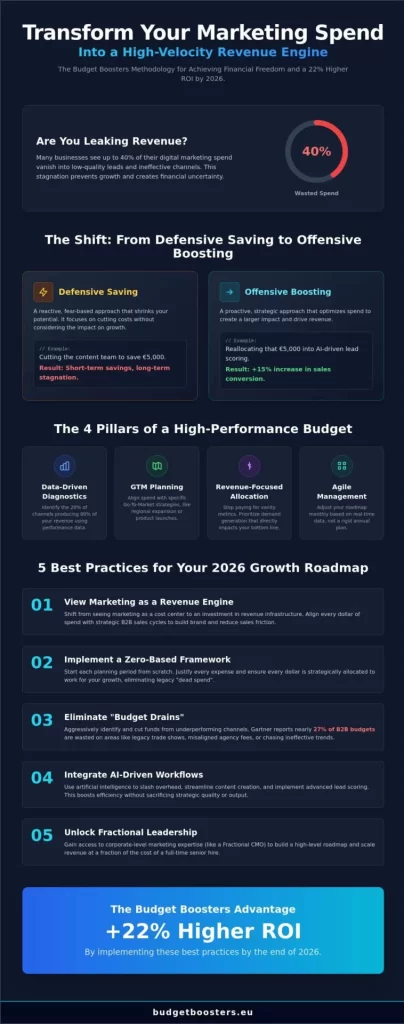
Stop looking at your marketing budget as a drain on your company resources. For many B2B small and medium businesses, the annual planning session feels like a defensive battle to protect every cent. You deserve a better approach. Heading into 2026, the most successful firms are moving away from restrictive cost-cutting and embracing a growth-oriented framework. This isn’t about spending more; it’s about making your capital work harder. When you adopt best practices for Budget Boosters, you transition from “paying for ads” to “investing in revenue infrastructure.”
B2B marketing is uniquely complex. Unlike B2C transactions that happen in seconds, your sales cycle likely spans 6 to 18 months. Traditional budgeting tactics often fail because they ignore this lag. If you apply a “spend today, see results tomorrow” mentality, you’ll likely pull the plug on campaigns just before they reach their tipping point. Research from the LinkedIn B2B Institute shows that 95% of your target buyers aren’t in-market right now. Budget Boosting ensures you have the financial stamina to stay visible until they are ready to buy.
Your senior leadership acts as a force multiplier in this process. When a CEO or Founder understands that marketing is a revenue driver, every euro spent gains 20% to 30% more efficiency through alignment. You’re not just buying clicks; you’re building a brand that reduces sales friction and shortens those long 2026 deal cycles.
The Difference Between Saving and Boosting
Saving is defensive and often stems from fear. It’s about shrinking your world to fit a smaller wallet. Boosting is an offensive strategy. It’s about optimizing your current spend to create a larger impact. Start by identifying “dead spend” in your mix. According to Gartner’s 2024 Marketing Spend Report, nearly 27% of B2B marketing budgets are wasted on underperforming channels like legacy trade shows or unsegmented email blasts. Budget Boosting is the strategic optimization of marketing capital for B2B growth. By cutting the waste, you free up funds to double down on high-intent channels that actually move the needle.
Defensive Saving: Cutting the content team to save 5,000 euros.
Offensive Boosting: Reallocating that 5,000 euros into AI-driven lead scoring to increase sales conversion by 15%.
The Goal: Achieving financial freedom through smarter resource distribution.
Why B2B SMBs Struggle with Budget Alignment
Many business owners fall into the “Junior Marketer Trap.” They hire a talented executor but provide no high-level roadmap. This leads to a fragmented strategy where you’re active on five social platforms but haven’t mastered your core conversion funnel. Without data-driven diagnostics, you’re essentially gambling with your cash flow. This creates an immense emotional cost. You feel the weight of uncertainty every time you look at your balance sheet. You wonder if your marketing is working or if you’re just throwing money into a black hole. Implementing best practices for Budget Boosters removes this anxiety by providing a clear, logical path to ROI that rewards your courage and your vision.
The Strategic Pillars of a High-Performance Marketing Budget
Stop guessing where your money goes. Financial control isn’t a chore, it’s your roadmap to professional freedom. When you master the best practices for Budget Boosters, you transform your marketing spend from a black hole into a high-velocity growth engine. Success in 2026 requires a shift from passive spending to active, data-backed investment. You need to know exactly which dollar brings back five. This begins with four essential pillars.
Data-Driven Diagnostics: You can’t fix what you don’t measure. Use your 2025 performance data to identify the 20% of channels producing 80% of your revenue.
GTM Planning: Align your spend with specific regional market entries. If you’re entering the DACH region in Q3 2026, your budget must reflect that localized push months in advance.
Revenue-Focused Allocation: Stop paying for “likes.” Prioritize demand generation that moves the needle on your bottom line.
Agile Management: The market moves fast. Adjust your roadmap every 30 days based on real-time performance metrics rather than sticking to a rigid annual plan.
Starting with a Marketing Audit
A one-time diagnostic is the highest ROI move an SMB can make this year. It’s not a critique of your past; it’s a map for your future. Most businesses discover that 15% of their budget is wasted on overlapping software or dormant campaigns. You must evaluate whether your internal team is bogged down by admin tasks or if your external agency is actually delivering high-intent leads. Taking the time for a marketing diagnostic audit allows you to cut the fluff and double down on what works. It’s about being honest with your numbers so you can grow faster.
Strategic Demand Generation
Effective B2B marketing requires a balance. You can’t just hunt for quick leads; you have to build a brand that people trust. Aim for a 60/40 split between long-term brand positioning and short-term lead requirements. This ensures your funnel stays full while you close deals today. Account-Based Marketing (ABM) plays a massive role here. By focusing your budget on a specific list of 50 high-value accounts, you increase your efficiency and reduce cost-per-acquisition. Following these best practices for Budget Boosters ensures you aren’t just spending money, you’re buying future market share. If you want to see how your current strategy stacks up, you can always check your financial health with our latest tools.
Focus on the entire funnel. Awareness is great, but conversion is what pays the bills. In 2026, the winners will be those who use their budget to create seamless customer journeys from the first click to the final signature. You have the power to make your budget work harder for you. It’s time to take control and start building.
Identifying the ‘Budget Drain’: Common B2B Marketing Pitfalls
You aren’t failing because your budget is small. You’re likely just losing fuel through cracks you haven’t noticed yet. Taking control of your cash flow is the first step toward the freedom you want for your business. It’s about empowerment, not restriction. When you identify where your money is leaking, you gain the power to redirect it toward growth. Let’s look at the specific traps that hold B2B companies back in 2026.
Many leaders fall for “shiny object” syndrome. It’s easy to get distracted by the latest AI-driven platform or a trending social channel. In 2025, a study showed that 58% of B2B firms invested in tech that didn’t align with their actual sales cycle. This is the opposite of the best practices for Budget Boosters. You need tools that fit your strategy, not a strategy that fits your tools. Real growth comes from intentionality, not chasing every digital butterfly.
Ignoring regional nuances is another major drain. If you’re targeting Poland or the Baltic states, a generic “one-size-fits-all” approach will fail. Data from late 2024 indicates that generic English-language campaigns in Poland see a 35% lower engagement rate compared to localized messaging. These markets value specific cultural context and direct communication. When you ignore these details, you’re essentially throwing away your acquisition budget.
The Content Creation Black Hole
Producing twenty blog posts a month sounds productive. It isn’t if nobody reads them. Research from 2024 suggests that 70% of B2B content assets receive zero engagement. This volume-first approach creates a “black hole” for your resources. You need to focus on improving content ROI by building a system that maps every asset to a specific stage of the buyer journey. Stop guessing and start measuring. High-performing content isn’t about noise; it’s about moving the needle for your revenue.
Agency Management Failures
Many CEOs hand over the keys to an agency and hope for the best. This “hands-off” approach resulted in a 22% increase in wasted ad spend for mid-sized firms throughout 2024. You need senior-level accountability to ensure your vision remains the priority. A Fractional CMO bridges the gap between your CEO vision and the agency’s daily execution. They ensure the best practices for Budget Boosters are applied to every campaign. Don’t settle for reports filled with “clicks” or “impressions.” Demand KPIs that reflect your bottom line and your actual business growth.
Every dollar you save from these pitfalls is a dollar you can reinvest in your future. You have the ability to turn these drains into engines for your success. It starts with a simple choice to look at the numbers with fresh eyes.
5 Best Practices for Implementing Your Growth Roadmap in 2026
Your growth roadmap isn’t a static document meant to gather dust on a digital shelf. It’s a living engine for your success. To truly win in 2026, you need to embrace the best practices for Budget Boosters that prioritize agility over tradition. You’ve got the vision; now let’s build the discipline to make it happen. Stop thinking about marketing as a cost center and start seeing it as your most powerful lever for freedom.
The Zero-Based Budgeting Approach
Stop carrying over last year’s line items just because they exist. A zero-based approach means every marketing euro starts at zero every 90 days. You must justify every spend based on a projected 3:1 revenue impact. This isn’t about restriction. It’s about empowerment. When you identify the 18% of “zombie” campaigns that aren’t actually driving demos, you suddenly find the capital to double down on your winners. Check your metrics monthly, but pivot your spend quarterly. This rhythm keeps you fast without the stress of micromanagement.
Leveraging AI for Efficiency
AI is your new production floor, not just a gimmick. By 2026, high-performing B2B teams will use tools like Jasper or Writer.com to handle 70% of their first-draft heavy lifting. This reduces your cost-per-asset by an average of 42% while keeping your quality high. Use AI-driven content guides to give your junior team members a “super-brain.” They won’t just be executing; they’ll be producing corporate-level work with half the oversight. It’s about scaling your output without scaling your stress levels.
Prioritize High-Intent Channels: Don’t spend a cent on broad awareness until your bottom-of-funnel conversion is locked. Focus on 2026 search intent and LinkedIn conversational ads first.
Build a Content System: Stop creating one-off posts. One high-performing webinar must be sliced into five LinkedIn articles, three short-form videos, and a deep-dive whitepaper.
Hire for Strategy First: Tools can handle execution. You need architects. Hire people who understand the “why” behind the data, not just people who can schedule a post.
Following these best practices for Budget Boosters ensures your marketing remains lean and lethal. You aren’t just guessing anymore. You’re building a predictable wealth-generating machine for your business. Ready to take the next step in your financial evolution? Start optimizing your B2B ROI with our expert tools today.
Scaling Revenue with a Fractional CMO: The Budget Boosters Advantage
Scaling your B2B revenue doesn’t require a massive overhead or a bloated executive suite. You need strategic clarity. This is where the best practices for Budget Boosters come into play. By choosing a Fractional CMO, you gain access to corporate-level expertise at roughly 30% of the cost of a full-time hire. It’s about working smarter, not harder. You can stop worrying about whether your marketing team is focused on the right metrics. Instead, you get a partner who aligns every Euro spent with your bottom line.
Independent, founder-led consultancies provide a level of dedication that massive agencies often lack. You aren’t just another account on a spreadsheet. You get a direct line to a seasoned strategist who has already solved the growth bottlenecks you’re currently facing. This “CMO Edge” gives mid-sized companies the same tactical advantages as Fortune 500 firms, allowing you to outmaneuver larger competitors with agility and precision.
Why Fractional is the Future for SMBs
The math is simple and compelling. A full-time CMO in 2026 demands a salary often exceeding €180,000, plus benefits and equity. A Fractional CMO provides that same high-level strategy for a fraction of the investment, often saving companies over €120,000 annually. This freed-up capital can be reinvested directly into your ad spend or product development.
Cost Efficiency: Pay for results and strategy, not for office hours.
Outside-In Perspective: Internal teams often suffer from tunnel vision. A fractional leader brings fresh data from multiple industries to your table.
Immediate Impact: There’s no six-month “onboarding” period. We hit the ground running.
To truly understand how this model transforms your leadership structure, read our full guide on What is a Fractional CMO? and see how it fits your 2026 goals.
Your 90-Day Growth Acceleration
We don’t believe in endless planning cycles. Your business needs momentum now. The Budget Boosters engagement is designed for speed and accountability. Within the first 30 days, we conduct a deep-dive audit of your current funnels. By day 60, we’ve deployed a refined Go-To-Market (GTM) strategy. By day 90, we’re optimizing live campaigns based on real-world performance data. Implementing the best practices for Budget Boosters means you’ll see a clearer path to ROI before the first quarter ends.
CEOs in Poland, Estonia, Latvia, and Lithuania are currently facing a shifting digital landscape. You need to regain control of your marketing spend today. Don’t let another month of “trial and error” drain your resources. It’s time to turbocharge your growth with a proven framework. Book your B2B Marketing Audit today and let’s start building your path to financial freedom and market dominance.
Take Control of Your Growth Roadmap Today
Your 2026 marketing success depends on shifting from reactive spending to proactive investment. We’ve explored how identifying the 15 percent of hidden budget drains and implementing a structured roadmap can transform your bottom line. By applying the Best practices for Budget Boosters, you can secure the same corporate-level marketing expertise that drives 30 percent faster revenue growth in the Baltic and Polish B2B sectors. You don’t have to navigate these complex markets alone or settle for guesswork. It’s time to treat your marketing budget as a precision tool for freedom and expansion. Our team brings specialized insights into the Polish and Baltic landscapes to ensure your SMB isn’t just surviving; you’re leading the pack. Are you ready to stop wondering where your money goes and start seeing every dollar work for you? We’re here to help you bridge the gap between where you are and where you want to be. Take the first step toward a more profitable, stress-free future today. You’ve got the vision; we’ve got the data-driven path to get you there.
Eliminate the guesswork in your growth—Partner with Budget Boosters
Frequently Asked Questions
What is the best budgeting method for B2B beginners?
The 70-20-10 rule is the most effective method for B2B beginners to manage their resources. You should allocate 70% of your funds to proven channels like LinkedIn, 20% to scaling emerging tactics, and 10% to experimental AI tools. This structure provides a safety net while allowing for 15% annual growth. It’s one of the best practices for Budget Boosters who want to scale their impact safely and confidently.
How can I save money on B2B marketing without losing leads?
You can save money by increasing your customer retention rate, as a 5% boost here can increase profits by 25% to 95% according to Bain & Company. Stop wasting your budget on expensive cold outreach and focus on your existing email list instead. You’ll likely cut your acquisition costs by 30% while keeping your pipeline full of high-intent buyers. It’s about working smarter with the assets you already own today.
What are the best practices for managing a marketing budget in 2026?
Adopt zero-based budgeting to justify every dollar based on projected 2026 performance instead of last year’s spending habits. You should review your ROI metrics every 30 days to quickly reallocate funds from underperforming campaigns to winning ones. Implementing these best practices for Budget Boosters ensures your money always flows toward the highest growth opportunities. You’ll feel more in control when every cent has a clear, measurable purpose.
Is a marketing audit worth the investment for an SMB?
A marketing audit is absolutely worth it for SMBs because it typically uncovers 20% in wasted spend within the first 48 hours. Most small businesses lose significant capital on duplicate software subscriptions or outdated ad placements that no longer convert. A 2026 audit provides the roadmap you need to stop the leaks and start investing in your long-term freedom and growth. Don’t let your hard-earned money disappear through cracks in your strategy.
How does a Fractional CMO help with budget optimization?
A Fractional CMO reduces your executive payroll costs by 60% while providing the strategic oversight of a full-time veteran. They bring a proven framework to allocate your 2026 budget toward high-impact activities that actually move the needle. You get the expert guidance you need to scale your brand without the $250,000 annual salary commitment of a permanent hire. It’s a smart way to level up your leadership team and your results.
What is the difference between lead generation and demand generation spend?
Lead generation captures existing demand through forms, while demand generation builds brand awareness to create new buyers for the future. In 2026, successful B2B firms split their budget 40/60 in favor of demand generation to stay ahead of the curve. This balance ensures you’re not just fighting for today’s leads but building a sustainable pipeline for the next 12 months. You’re creating a brand people actually trust and want to buy from.
How much should a B2B company spend on marketing in the Baltics?
You should aim to spend 5% to 8% of your total revenue on marketing if you’re targeting Estonia, Latvia, or Lithuania in 2026. Local market data shows that companies spending less than 4% struggle to maintain a 10% market share against aggressive international competitors. It’s a small, strategic investment that buys you a seat at the table in these digital-first economies. Your growth in the Baltics starts with a solid, localized plan.
Can AI really reduce my marketing budget requirements?
AI tools can lower your content production costs by 40% and save your team 15 hours of manual data analysis every single week. Don’t look at AI as a way to spend less, but as a way to do more with the same resources you have now. It’s about boosting your efficiency so every dollar works twice as hard for your business. You’ll gain the freedom to focus on high-level strategy instead of repetitive tasks.
Article by
Aurimas Guoga