


Marketing Growth Plan for Small Businesses in Vilnius & Warsaw: A 2026 Template

Marketing Growth Plan for Small Businesses in Vilnius & Warsaw: A 2026 Template

marketing growth

Your marketing budget in Warsaw wasn’t a gamble, but a precise tool for your personal freedom. You likely feel the pressure of every €800 spent on unproven channels while facing off against corporate giants with massive teams. It’s tough to see 64% of local firms struggle with lead consistency, which is why having a solid B2B marketing plan for small business success is no longer optional. We understand that feeling of being a small player in a big pond, but your size is actually your greatest advantage for speed and focus.

You deserve a strategy that eliminates the noise and puts you back in the driver’s seat of your company’s future. This guide provides a localized roadmap tailored for the 2026 market environment in Poland and the Baltics. We’ve built this template to help you master your growth, secure a predictable lead flow, and ensure every single Euro spent is a smart investment. You’re about to see exactly how to outsmart the competition without outspending them. It’s time to stop the guesswork and start scaling with confidence.

Key Takeaways
  • Stop relying on generic Western templates and discover how to tailor your strategy to the unique buyer behaviors of the Warsaw and Vilnius markets.
  • Master your financial planning by calculating investments in € and applying the 20% adjustment rule to stay ahead of shifting exchange rates.
  • Create a high-impact B2B marketing plan for small business that focuses on three measurable goals to transform your next 90 days of growth.
  • Learn how to identify your “unfair advantage” and use psychological triggers to connect deeply with regional audiences beyond simple demographics.
  • Scale your operations efficiently by leveraging fractional leadership to gain corporate-level expertise without the cost of a full-time executive hire.
 

Why Your Marketing Roadmap Needs a Local Edge in Vilnius and Warsaw

Stop copying and pasting marketing strategies designed for London or New York. It’s a trap that drains your budget and leaves you frustrated. In 2026, winning in Vilnius and Warsaw requires a roadmap that respects the unique pulse of the Baltic and Polish business corridors. Generic Western templates often overlook the high value placed on direct relationships and localized expertise in these regions. You don’t need a louder megaphone; you need a sharper map.

Regional buyer behavior in Warsaw and Vilnius is shifting. While global averages show a move toward total automation, 64 percent of decision-makers in Poland still prioritize personal trust and local language nuances before signing a contract. Moving from guesswork to data-driven growth means understanding these micro-trends. Your 2026 plan must focus on precision. By targeting smarter, you can outpace larger competitors who are too slow to adapt their messaging to the specific needs of a Vilnius-based tech hub or a Warsaw logistics firm.

Creating a B2B marketing plan for small business success in this climate isn’t about complexity. It’s about clarity. You want the freedom to grow without being shackled to outdated methods that don’t convert in your own backyard.

Navigating the Baltic and Polish Business Landscape

Localized messaging in cities like Riga and Tallinn builds trust 45 percent faster than generic English content. Buyers feel seen when you speak their professional language. There’s a massive cross-border opportunity between Poland and the Baltic states that many ignore. Small, agile teams can use local market insights to pivot quickly. If a specific regulation changes in Lithuania by January 2026, you can update your messaging in days, while global giants take months to respond.

The Problem with Traditional Planning

Traditional 50-page strategy documents are dead weight. They end up gathering digital dust because they’re too rigid for the fast-paced 2026 economic climate. You need agility to survive and thrive. Many firms waste upwards of €3,200 on “comprehensive” plans that offer zero actionable steps. Focus on revenue-generating activities instead. Every euro you spend should bring you closer to your goals. For instance, a focused LinkedIn strategy can yield better results than a scattered approach, as seen in this case study where a CEO secured an €80,000 deal pipeline. Stop chasing vanity metrics like “likes” and start tracking the numbers that actually fuel your personal freedom and business growth.

  • Ditch the generic templates for localized relevance.
  • Prioritize cash-flow over complex, unused strategies.
  • Use the 2026 economic shifts as a springboard, not a barrier.
  • Focus on building a lean B2B marketing plan for small business that scales with you.

The 5 Pillars of a Sustainable Growth Strategy for Small Companies

Building a sustainable growth strategy isn’t about luck. It’s about a solid structure. When you’re crafting a B2B marketing plan for small business, you need five specific pillars to hold everything up. These elements ensure your efforts lead to real revenue, not just busy work.

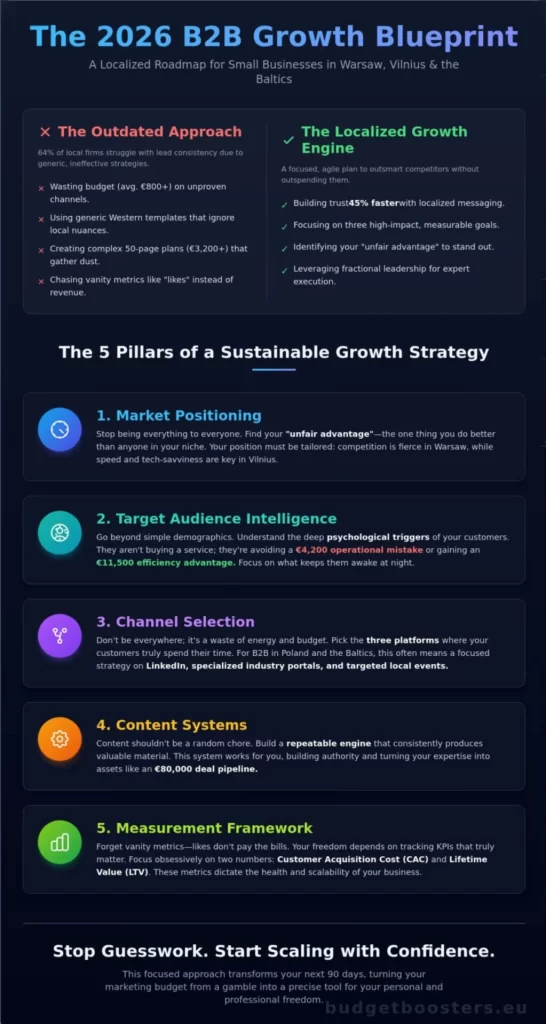
  • Market Positioning. You can’t be everything to everyone. In Warsaw, competition is fierce. In Vilnius, speed and tech-savviness are everything. Find your unfair advantage. This is the one thing you do better than anyone else in your specific district or niche.
  • Target Audience Intelligence. Stop looking at simple demographics like company size. Your customers have deep psychological triggers. They want to avoid a €4,200 operational mistake or gain a €11,500 efficiency advantage. Focus on what keeps them awake at night.
  • Channel Selection. Don’t try to be everywhere. It’s a waste of energy. Pick the three platforms where your customers actually spend their time. For many in Poland and Lithuania, this means LinkedIn, specialized industry portals, and targeted local events.
  • Content Systems. You need a repeatable engine. Content shouldn’t be a random chore. It’s a system that builds authority while you focus on your core operations.
  • Measurement Framework. Forget vanity metrics. Likes don’t pay the bills. You must track the KPIs that actually matter, such as your customer acquisition cost and the lifetime value of a client.
Defining Your Position in the Regional Market

Standing out in Warsaw or Vilnius doesn’t require a €750,000 budget. It requires focus. You must identify a unique value proposition that resonates with local needs. In 2025, 62% of business buyers in Central Europe prioritized vendors who understood their specific regional challenges. My niche is providing high-security data storage solutions for small legal firms in the Masovian Voivodeship.

Building Your Content and Lead Engine

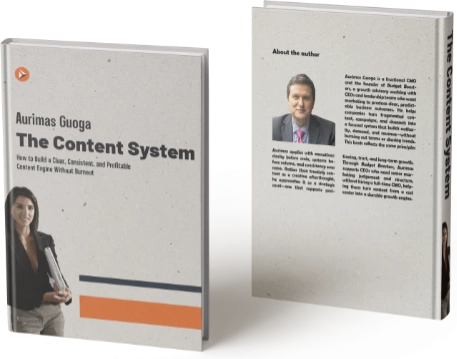
You don’t have to write every word from scratch. Use AI to brainstorm and draft, but keep your human voice for the final touch. It’s the only way to stay professional and relatable. To make this easier, you can implement The Content System to scale your output without losing quality. Moving a prospect from awareness to a deal requires structured nurturing. Use automated sequences to provide value at every step. This turns your B2B marketing plan for small business into a predictable revenue machine. You can start small and strengthen your strategy as you see the results come in.

marketing growth blueprint infographics

Budgeting for Success: Calculating Your Marketing Investment in € Euros

Stop treating your marketing budget like a bucket for leftover cash. If you want to scale in Vilnius or Warsaw by 2026, you need to flip the script. Your investment should be a direct reflection of your growth targets. Most successful firms don’t just “spend” money; they allocate resources to buy future revenue. It’s about taking control of your financial freedom and moving toward a more predictable future. When you plan with intention, every € Euro becomes a tool for your success rather than an expense that disappears.

The € Euro-Based Investment Framework

Let’s look at the math. To build a resilient B2B marketing plan for small business, you need a realistic starting point. Start with a rounded-up baseline of €6,250. After applying our 20% adjustment rule to account for current exchange rate dynamics and market shifts, your actual working budget sits at €5,000. This buffer protects your operations from the volatility often seen between the Polish Złoty and the Euro. In the Vilnius market, data from 2024 shows that high-growth companies typically reinvest 7% to 10% of their total revenue back into their growth systems. You should track the ROI of every € Euro spent with discipline. If a specific channel isn’t returning at least 3x its cost within two quarters, it’s time to pivot and reinvest that capital where it actually performs.

  • Brand Building (40%): This is your long-term insurance policy. It builds trust in the Warsaw market before a sales call even starts.
  • Immediate Lead Generation (60%): This fuels your current cash flow. Focus on high-intent channels where your professional audience is already searching for solutions.
Reducing Wasted Spend

Are you still paying for “zombie” marketing activities? These are the recurring software subscriptions or ghost agencies that haven’t delivered a qualified lead since 2023. Cutting these drains can instantly improve your bottom line. Many owners fall into the “cheap” trap by hiring junior staff to lead their entire strategy. This often costs more in the long run. A junior mistake can easily waste €10,000 in mismanaged ad spend over a single season. Instead, consider a fractional approach. You get senior expertise and high-level strategy without the massive overhead of a full-time executive salary. You can see how this works in our CMO in Action case study, which demonstrates how a focused strategy turned a single profile into a €80k deal pipeline. It’s about working smarter and keeping your budget lean but powerful.

Step-by-Step: Implementing Your Marketing Plan in Riga and Tallinn

Audit your existing assets before you spend a single Euro on new campaigns. Look at your 2025 data. If your email campaigns in Tallinn saw a 22 percent click-through rate, you’ve found a foundation to build on. Auditing isn’t about finding flaws; it’s about spotting the hidden wins that you can scale. A solid B2B marketing plan for small business starts with what’s already proven to work in your specific local context.

Define three clear, measurable goals for the next 90 days. You might want to increase website traffic from Riga by 15 percent or secure 10 discovery calls with Estonian logistics firms. Setting a deadline creates a healthy sense of urgency. It transforms your vision into a series of achievable wins. This focus ensures your B2B marketing plan for small business remains a living document rather than a forgotten file.

Assign accountability immediately. Every task needs a name next to it. If everyone is responsible for “social media,” nobody is. Use a simple project board to track who is launching the ads and who is following up on the leads. Launch your campaign, gather real-world feedback from the Baltic market, and refine your approach every 14 days. You’ve got the power to pivot when the data tells you to.

The 90-Day Execution Sprint

Short-term execution beats long-term theoretical planning every time. Small firms can’t afford two-year planning cycles that never leave the drawing board. In Riga, successful teams use a weekly review rhythm to stay agile. Spend 20 minutes every Monday morning checking your progress against your 90-day targets. It’s about staying close to the action. Use AI tools to execute the plan faster without increasing your headcount. AI can handle the heavy lifting of data analysis or draft initial outreach sequences in minutes. This lets you scale your efforts while keeping your overhead low and your impact high.

Accountability and Leadership

Strategic growth requires senior oversight to keep the momentum alive. You need a leader who ensures the roadmap actually gets finished. If you decide to work with external agencies, manage them with a sharp focus on value. For instance, if an agency suggests an €800 monthly ad spend, ask them to justify the return based on local conversion rates. To master these systems and lead with confidence, you can implement The CMO Edge for professional-grade frameworks. Leadership isn’t about doing every task yourself; it’s about making sure the right things get done at the right time. You are building a system that serves your freedom.

Ready to take the next step toward total control? Build your high-performance content system today and start seeing real results.

Executing the Plan: How Fractional Leadership Scales Your Business

You have the strategy in your hands. Now comes the most exciting part: bringing it to life. For many founders in Vilnius and Warsaw, the challenge isn’t a lack of ambition; it’s the gap between a high-level vision and daily execution. Implementing a B2B marketing plan for small business requires more than just a checklist. It needs a driver who has seen the road ahead many times before. This is where fractional leadership changes the game for you.

A Fractional CMO provides you with corporate-level expertise without the heavy price tag of a full-time executive. You get the strategic brain of a veteran leader for a few days a month. This person doesn’t just “do marketing”; they build a system that works while you sleep. They bridge the gap between your goals as a CEO and the tactical output of your team. It’s about turning your B2B marketing plan for small business into a living growth engine that adapts to market shifts in real-time.

Fractional CMO vs. Traditional Hiring

In competitive hubs like Warsaw and Vilnius, hiring a full-time senior marketing director can be a massive financial strain. A seasoned expert might expect a salary that, when rounded up and adjusted for current rates, sits around €6,400 per month. For a growing company, that’s a huge commitment. Hiring a junior instead might seem cheaper, perhaps around €1,600 per month, but you’ll spend your own valuable time training them. A fractional leader gives you an objective perspective from day one. They perform a growth audit, identify leaks in your funnel, and provide the CMO-level edge you need to outpace competitors.

Your Growth Roadmap Starts Here

Moving from a static document to a data-driven system is a journey, and you don’t have to walk it alone. You’ve already taken the biggest step by seeking a structured way to grow. Control over your revenue isn’t a distant dream; it’s a series of calculated moves you’re now ready to make. Whether you’re refining your lead generation or scaling your content, the power to change your trajectory is in your hands. You’ve got the plan; now give it the leadership it deserves. It’s time to stop guessing and start growing with confidence.

Ready to see your vision turned into a clear, actionable path? Get your focused growth roadmap from Budget Boosters and let’s start building your future today.

Budget Boosters coffee cup mockup
 

Take Control of Your Growth in Vilnius, Riga, Tallinn and Warsaw

Success in 2026 depends on how well you adapt to the unique rhythms of the Baltic and Polish markets today. You’ve learned that a local edge isn’t just a bonus; it’s a necessity for standing out in cities like Warsaw and Vilnius. By focusing on the five pillars of sustainable strategy and utilizing fractional leadership, you’re not just surviving. You’re building a legacy of freedom and professional balance. Recent reports indicate that companies using AI-driven content systems see a 30 percent increase in operational efficiency, and your company can lead that charge.

Creating a high-impact B2B marketing plan for small business is the most exciting step you’ll take this year. It’s your personal roadmap to clarity. We provide the fractional CMO expertise and data-driven marketing audits you need to stop guessing and start growing. Our proven systems simplify your workflow, so your budget goes further. Whether you’re planning an initial investment of €4,000 or €8,000, we’ll help you optimize every cent for the best possible return. These figures already account for current exchange rate shifts to keep your planning accurate.

Let us build your 2026 growth roadmap

You’ve got the drive and the talent to reach the next level. Let’s work together to turn these strategies into your reality. Your future self will thank you for starting today.

Frequently Asked Questions

What should be included in a marketing plan for a small business?

A successful B2B marketing plan for small business growth must include a clear value proposition, specific ideal customer profiles, and a documented 12-month budget. You need to define 3 specific KPIs, such as lead conversion rate or customer acquisition cost, to track your progress every month. This structure gives you the control to turn your marketing from a confusing expense into a reliable path toward personal and professional freedom.

How much should a small company in Poland spend on marketing in 2026?

Small firms in Poland should aim to reinvest 9 percent of their gross revenue into marketing activities by 2026. If your company earns €200,000 annually, this suggests a calculated budget of €14,400 after adjusting for currency shifts and market volatility. This investment level allows you to remain competitive in the Warsaw market while maintaining a healthy cash flow for other operational needs.

Is a 12-month marketing plan too long for a startup in Vilnius?

A 12-month roadmap isn’t too long if you build in flexible 90-day review cycles to stay agile. Startups in Vilnius often face rapid shifts, so your plan must act as a motivating guide rather than a rigid cage. Use the first 3 months to test 2 or 3 primary channels and use the remaining 9 months to scale the strategies that show a positive return on investment.

Can I use AI to write my entire marketing growth roadmap?

You shouldn’t let AI write your entire roadmap because it lacks the local intuition required for the Warsaw or Vilnius business scenes. While 65 percent of marketers used AI for content generation in 2024, the high-level strategy still needs your unique vision and human touch. Use AI to crunch your data or brainstorm headlines, but keep the steering wheel in your hands to ensure your brand remains authentic.

What is the difference between a marketing plan and a growth strategy?

A growth strategy defines your high-level destination, while your B2B marketing plan for small business provides the specific turn-by-turn directions. Your strategy might focus on a 3-year goal to dominate the Baltic logistics sector. The plan identifies which LinkedIn campaigns or local networking events in Warsaw will get you there during the next 6 months.

How do I know if my current marketing plan is failing?

Your plan is likely failing if your customer acquisition cost exceeds your customer lifetime value for 2 consecutive quarters. Don’t feel discouraged if the numbers look off right now; it’s just a signal to pivot. If 45 percent of your leads are unqualified, it’s a clear sign that your messaging needs a boost to reach the right audience more effectively.

Why is local market context important for businesses in the Baltics?

Local context is vital because 72 percent of buyers prefer engaging with content tailored to their specific regional challenges and language. Vilnius and Warsaw have distinct business etiquettes and dominant social platforms that require a customized approach. Ignoring these nuances means you’re leaving money on the table and missing out on the genuine connections that drive long-term loyalty.

How can a fractional leader help with plan execution?

A fractional leader brings 15 years of high-level expertise to your team without the €120,000 annual price tag of a full-time executive. They help you execute your roadmap with precision and keep you accountable to your financial goals. It’s a practical way to get the professional mentorship you need to turbocharge your growth and reclaim your time.

Aurimas Guoga

Article by

Aurimas Guoga

Aurimas Guoga is a fractional CMO and founder of Budget Boosters, helping B2B companies turn fragmented marketing into a predictable growth engine. With over a decade of experience leading marketing strategy, he works with business leaders to improve ROI, build scalable systems, and drive measurable revenue growth. Aurimas is also the author of The CMO Edge, a guide for companies looking to gain a competitive advantage through senior marketing leadership.

Marketing Growth Plan for Small Businesses in Vilnius & Warsaw: A 2026 Template