Does your marketing budget feel like a black hole where money disappears and results rarely emerge? It’s a common frustration for leaders across the Baltics and Poland who find themselves acting as the default marketing manager. You likely feel the weight of managing fragmented tasks from junior staff or agencies that don’t align with your actual sales goals. You want a system that works, but you don’t want to commit to a €200, 000 salary for a full-time executive. Understanding how to improve B2B marketing isn’t about working harder; it’s about building a smarter architecture.
We agree that your marketing should be a predictable growth engine, not a source of constant stress. This guide will show you how to transform scattered activities into a disciplined system using senior oversight and proven frameworks. You’ll learn how to gain control over your processes and lower your Customer Acquisition Cost while maintaining high-level strategy for €60, 000 to €120, 000 a year. We’re going to explore how to move from “random acts of marketing” to a high-performing system that empowers your team and drives measurable revenue.
Key Takeaways
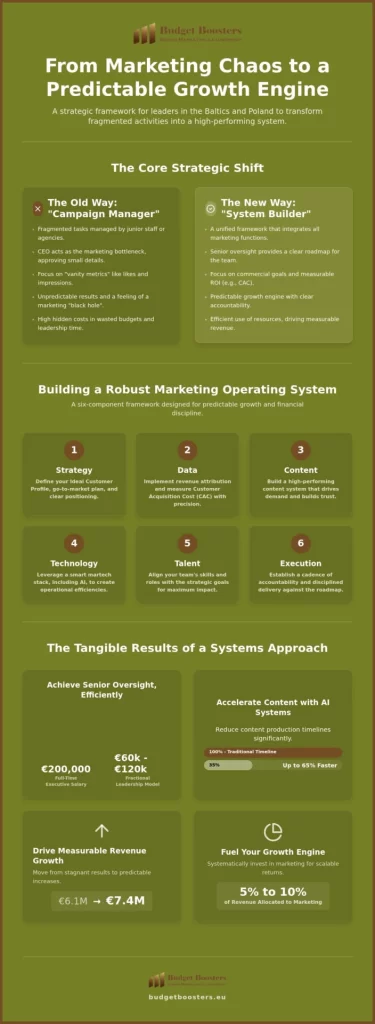
- Shift from chaos to control by adopting a “system builder” mindset that replaces fragmented activities with a predictable growth framework.
- Discover the six core components of a Marketing Operating System designed to align your team with clear priorities and commercial goals.
- Learn how to improve B2B marketing by leveraging AI systems to reduce content production timelines by up to 65 percent.
- See how senior strategic oversight can be achieved for €60, 000 to €120, 000 per year, avoiding the high costs of full-time executive recruitment.
- Understand how to bridge the gap between strategy and execution to drive measurable revenue growth, mirroring results like the jump from €6.1M to €7.4M.
Breaking the Cycle of Fragmented Marketing Activities
Marketing often feels like a series of disconnected chores. You might hire a junior specialist for social media, a freelancer for SEO, and an agency for ads; yet, the results don’t add up to a cohesive growth engine. This is “activity-driven” marketing. It creates a cycle of chaos where the CEO becomes the bottleneck for every decision. Instead of focusing on high-level strategy, you’re stuck approving LinkedIn posts or debating headline fonts. When leaders ask how to improve B2B marketing, they often expect a new tactic. The real answer lies in the architecture, not the activity.
The difference between stagnant growth and a predictable engine is the shift from a “campaign manager” mindset to a “system builder” approach. A campaign manager asks what we should post tomorrow. A system builder asks how our data, technology, and talent work together to create a repeatable revenue stream. Our recent Fractional CMO Landscape Research 2026 shows that high-performing firms in Poland and the Baltics are moving away from this fragmented execution. They’re realizing that junior hires and agencies, while talented, often fail because they lack a senior-level roadmap to follow. They need an architect, not just more builders.
The Cost of Strategic Uncertainty
Guesswork is expensive. It leads to wasted budgets and missed revenue targets that stay hidden behind “vanity metrics” like likes or impressions. For a CEO, acting as the default marketing director is a heavy psychological burden. It pulls you away from your core strengths and leaves you feeling like marketing is a “black hole” for cash. You deserve to see marketing as a governed investment rather than a cost centre. By establishing clear Business-to-business (B2B) governance, you gain the freedom to lead while the system handles the execution. Control isn’t a dry necessity; it’s your path to personal and professional freedom.
Market Dynamics in the Baltics and Poland
Regional SMEs are outgrowing simple tactical execution. In the Baltic states and Poland, the rising complexity of data and marketing technology means that “doing a bit of everything” no longer works. To maintain a competitive advantage in 2026, you need senior oversight that understands regional nuances and global trends. This leadership ensures that every euro spent aligns with your commercial goals. Transitioning to a structured system allows your team to stop guessing and start performing, turning market complexity into a clear, manageable advantage.
Building a Robust Marketing Operating System
Instead of chasing the latest algorithm hack, think about your marketing as a machine. A Marketing Operating System is a six-component framework designed for predictable growth. It integrates strategy, data, content, technology, talent, and execution into a single, high-performing unit. This approach ensures you aren’t just doing “stuff” but following a Modern Business-to-Business Marketing Strategy. By focusing on go-to-market sequencing, you avoid the common trap of launching channels before you’ve mastered your message. This is exactly how to improve B2B marketing without burning through your cash reserves.
From ICP to Measurement Discipline
Everything starts with the Ideal Customer Profile (ICP). We use the “Pinpoint Your People” framework to move beyond basic demographics and job titles. You need to understand the actual business pressures your buyers face in the Baltic and Polish markets. Research from Harvard highlights the strategic importance of B2B branding in building trust before a sales call even happens. Once your ICP is clear, you can implement revenue attribution. Stop guessing which LinkedIn post led to a lead. Measure your Customer Acquisition Cost (CAC) with precision. This creates a cadence of accountability for your team. They aren’t just “busy” with tasks; they’re delivering measurable commercial value.
Financial Discipline and Budget Logic
Scaling firms often struggle with investment levels. If you’re a €5, 000, 000 company, a marketing budget of €300, 000 is a realistic benchmark for growth. For businesses in a scaling phase, allocating 5 percent to 10 percent of revenue to marketing is standard. This isn’t a cost; it’s fuel for your growth engine. The Marketing Operating System is the structural bridge between business goals and daily execution. This logic prevents financial waste by ensuring every euro has a specific, data-driven job to do. When you understand how to improve B2B marketing through financial discipline, the “black hole” feeling disappears. If you’re ready to stop the guesswork, a marketing diagnostic can show you exactly where to start.
Scaling Content ROI with AI-Driven Systems
AI is not a replacement for your creativity; it’s the engine that powers it. When you integrate AI into a structured “Content Multiplication System,” you can cut production time by as much as 65 percent. This efficiency is a cornerstone of how to improve B2B marketing in a fast-moving landscape. It allows your team to stop being a “content factory” and start being a strategic powerhouse. This system doesn’t just save time; it empowers your marketing team to produce higher quality work with fewer revision cycles. To get started with specific workflows, check out our guide on 7 Practical Ways to Streamline Content Creation with AI.
Preserving Brand Voice in an Automated World
Generic AI output is the enemy of trust. To avoid sounding like a robot, you need a Custom AI Content Style Guide. This ensures your unique voice remains consistent across every LinkedIn post and whitepaper. For technical or industrial sectors, we use the “Bullet-to-Prose Method.” You provide the raw technical facts, and the system handles the polish. This approach maintains technical accuracy while speeding up delivery. It works. One content agency saw revision requests drop by 60 percent, while client satisfaction increased by 40 percent after implementing these specific style guides.
Improving Content ROI through Systems
Content for the sake of content is a waste of money. True success comes from creating revenue-driving assets. Our Improving Content ROI framework helps you identify which pieces of content actually move the needle. Senior leaders can use the “90-Second Outline Formula” to provide strategic direction without getting bogged down in the writing process. This turns your expertise into a scalable asset. By focusing on revenue-driving assets, you ensure your content serves the bottom line, turning your digital channels into actual lead generators.
Stay ahead of these shifts by joining our community. We invite you to subscribe to the Budget Boosters Newsletter for the latest fractional CMO trends in the Baltics and Poland. You’ll get practical insights on strategy, data, and high-performing systems delivered to your inbox. As a bonus, you’ll receive a free ebook, The CMO Edge. Why Companies with Senior Marketing Leadership Outperform – and How to Get There (a €29 value), to help you master senior-level marketing oversight.
Strengthening the Bridge Between Marketing and Sales Revenue
Alignment isn’t just a corporate buzzword. It’s a financial necessity. When marketing and sales work in silos, you lose revenue in the gaps. Strengthening this bridge is a core pillar of how to improve B2B marketing and drive sustainable growth for your firm. Look at Polmet Solutions S.A. as a prime example. By restructuring oversight and aligning commercial strategy with execution, their revenue grew from €6.1M to €7.4M. This wasn’t just about volume. It was about quality. Senior leadership helped them achieve a 2.3 percentage point improvement in gross margins. This is the power of a “Demand Generation” approach. It fills your pipeline predictably by focusing on high-intent buyers rather than just collecting email addresses.
Governance and Accountability
For industrial and manufacturing firms in Poland and the Baltics, this focus on efficiency should extend to all operational costs; for example, to optimize your utility expenses and improve the bottom line, check out EnergoStrateg.
A fractional leader serves as the architect of this bridge. They manage the feedback loop between what sales hears on calls and what marketing produces. This data-driven framework is essential to reduce your Customer Acquisition Cost (CAC). Instead of guessing, you use real-world feedback to refine your message. This ensures your team isn’t wasting time on leads that will never close. We’ve seen this work in our CMO in Action case study, where a focused strategy turned a CEO’s LinkedIn presence into a €80k deal pipeline. Governance ensures that every activity serves a commercial purpose, creating a culture where everyone is accountable for revenue.
Measuring What Matters
It’s time to stop celebrating vanity metrics. Likes and impressions don’t pay the bills. You need to measure qualified-lead volume and conversion rates. When you have senior leadership, even simple channels perform better because they are part of a larger plan. For instance, People Element saw email open rates jump from 3 percent to 30 percent after professionalizing their approach. This level of efficiency is within your reach. It turns a “black hole” budget into a transparent investment. If you aren’t sure where your leaks are, conducting a Marketing Diagnostic & Audit can find immediate efficiency gains. It’s the first step toward a system that actually supports your sales team and fuels your growth.
Ready to see how your current system stacks up? Book your Marketing Diagnostic & Audit today and start building a predictable revenue engine.
The Strategic Shift to Fractional Marketing Leadership
You don’t need a full-time executive to get executive results. A fractional CMO is a senior leader who joins your team on a part-time basis, typically one to three days per week. They don’t just give advice; they take ownership of your growth machine. This is the most direct path for those wondering how to improve B2B marketing without the overhead of a massive hire. While a full-time executive often costs over €200, 000 annually, a fractional leader provides the same level of expertise for €60, 000 to €120, 000 per year. It’s about paying for the outcome, not the desk space.
Think of this leader as an architect. They design the blueprint for your growth and supervise the builders, ensuring your agencies and junior staff are laying bricks according to a master plan. Without an architect, your marketing team is just busy, not effective. This strategic oversight is what turns fragmented activities into a unified system. For a deeper look at how this leadership model scales firms, explore The CMO Edge. It’s time to stop being the default marketing manager and start being the CEO your company needs.
Fractional vs. Interim vs. Full-Time
Choosing the right leadership model depends on your current growth stage. If your company is in a crisis or a major transition, an interim CMO provides focused support for three to nine months. For steady, scalable growth in the Baltic or Polish markets, the fractional model is often the best fit. It provides long-term stability without the full-time price tag. You only need to consider a permanent executive placement once your revenue consistently exceeds €20M. Until then, senior part-time leadership gives you the sophistication you need to compete with larger players. To explore how veteran-led management consulting can enhance your leadership and operational performance, learn more about Marshall Solutions Group.
The first 90 days of an engagement are transformative. We start with a diagnostic to see where your budget is leaking and where your team is stalled. Once the leaks are plugged, we implement the Marketing Operating System. This shift finally removes the CEO from the tactical decision-making loop. You stop approving social media posts and start reviewing revenue reports. Control over your processes isn’t a burden; it’s the path to your personal freedom. If you’re ready to build a predictable growth engine, explore our Fractional CMO services and take the first step toward a more professional marketing structure.
Step Into Your New Role as a Strategic Leader
The journey from fragmented activities to a predictable growth engine is within your reach. You’ve seen how a Marketing Operating System provides the structure needed to scale. It’s not just theory; it’s about real results like the €1.3M revenue growth achieved by Polmet Solutions or the 40 percent increase in qualified leads for People Element. By leveraging AI systems to reduce content production time by 65 percent, your team can finally focus on high-level strategy instead of just staying afloat. Learning how to improve B2B marketing is the first step toward personal freedom and professional excellence.
You don’t have to navigate this transition alone. To understand how firms across the Baltics and Poland are evolving, Download the Fractional CMO Landscape Research 2026 for free. This report provides the evidence-based insights you need to align your commercial goals with a high-performing system. It’s time to stop acting as the default marketing manager and start building the engine your business deserves. You have the vision; now you have the framework to make it a reality. Let’s build something beautiful together.
Frequently Asked Questions
How do I improve my business-to-business marketing strategy in 2026?
Focus on shifting from tactical execution to a system-builder approach. Instead of chasing viral trends, prioritize building a Marketing Operating System that aligns with your commercial goals. This involves defining a clear Ideal Customer Profile and establishing data-driven priorities. When you understand how to improve B2B marketing through governance rather than just more content, you create a predictable growth engine that doesn’t rely on the CEO for every minor decision.
What exactly is a fractional CMO and how do they work?
A fractional CMO is a senior marketing executive who works for your company on a part-time basis, typically one to three days per week. They act as the architect of your marketing system, providing the same strategic oversight as a full-time director but at a fraction of the cost. They manage your existing team or agencies, implement high-level frameworks, and ensure every marketing activity is directly tied to your revenue and sales targets.
How much does it cost to hire a fractional marketing leader?
Hiring a fractional leader typically costs between €60, 000 and €120, 000 per year, depending on the scope and complexity of your needs. This is significantly more efficient than hiring a full-time executive, where total costs can easily exceed €200, 000 annually. You get senior-level expertise and strategic governance without the heavy financial burden of a permanent executive salary, allowing you to invest those savings back into your actual marketing campaigns.
What is a Marketing Operating System?
A Marketing Operating System is a six-component framework that replaces guesswork with financial discipline and structured processes. It integrates your strategy, data, content systems, technology, talent, and execution into a single, cohesive unit. By treating marketing as a governed machine rather than a series of random activities, you ensure that every euro spent is an investment toward a measurable outcome. It’s the structural bridge between your high-level business goals and daily tactical execution.
How can AI help my SME with content creation without losing our brand voice?
AI can reduce content production timelines by up to 65 percent when managed through a Custom AI Content Style Guide. This guide acts as a set of guardrails, ensuring the AI mimics your unique tone and industry expertise. By using the “Bullet-to-Prose Method,” you provide the raw technical facts, and the AI handles the formatting. This allows you to scale your output while maintaining the technical accuracy and human warmth your audience expects.
Why is sales and marketing alignment crucial for revenue growth?
Alignment ensures that marketing efforts are actually generating the types of leads your sales team can close. When these two functions work in a feedback loop, you reduce your Customer Acquisition Cost and improve gross margins. We’ve seen this restructuring lead to revenue growth from €6.1M to €7.4M in regional firms. It turns your pipeline into a predictable engine where every lead is qualified and every campaign serves a clear commercial purpose.
What are the first steps in a marketing diagnostic audit?
The audit begins by identifying where your current budget is leaking and which activities are failing to deliver ROI. We analyze your data, existing technology stack, and team structure to find immediate efficiency gains. Within the first 90 days, the goal is to plug these leaks and begin implementing a structured Operating System. This diagnostic phase is essential for removing the CEO from tactical decision-making and establishing a baseline for future growth.
How do fractional CMO services differ between Poland and the Baltic states?
While the core principles of how to improve B2B marketing remain consistent, regional nuances in Poland and the Baltics require localized expertise. In these markets, SMEs are rapidly outgrowing simple tactical execution and face increasing complexity in data and technology. Fractional services in this region focus on bridging the gap between local talent and global strategy. This ensures your growth engine is sophisticated enough for international competition while remaining grounded in regional market dynamics.

Article by
Aurimas Guoga
Aurimas Guoga is a fractional CMO and founder of Budget Boosters, helping B2B companies turn fragmented marketing into a predictable growth engine. With over a decade of experience leading marketing strategy, he works with business leaders to improve ROI, build scalable systems, and drive measurable revenue growth. Aurimas is also the author of The CMO Edge, a guide for companies looking to gain a competitive advantage through senior marketing leadership.