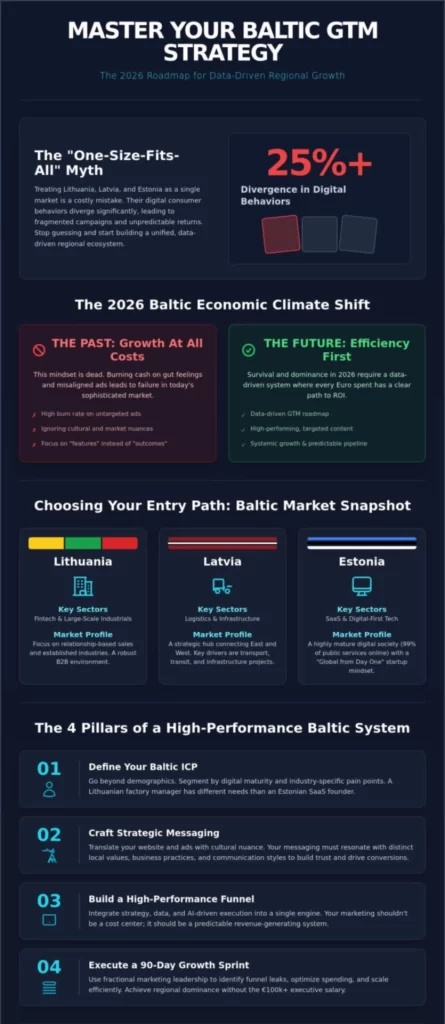


Why are you still treating Lithuania, Latvia, and Estonia as a single, blurry block when 2024 regional data shows their digital consumer behaviors diverge by over 25%? It’s exhausting to watch your expansion budget disappear into three fragmented markets without seeing a clear, predictable return. You’ve likely felt the sting of high executive costs or the frustration of marketing efforts that feel like throwing spaghetti at the wall. You deserve a system that provides freedom through control.
It’s time to stop guessing. You’re about to master a proven gtm strategy baltics framework that turns your regional growth into a data-driven engine. We’ll explore the roadmap for 2026, showing you how to build a high-performing lead generation pipeline while maximizing your ROI. If you’re ready to scale, join the Budget Boosters Newsletter. It’s the most comprehensive resource for fractional marketing leadership in the region. You’ll also get our free ebook, “The CMO Edge,” a €29 value, to help you make better decisions today.
Key Takeaways
- Break free from the “Build It and They Will Come” myth by learning how to treat the Baltics as a unified, data-driven regional ecosystem.
- Master your gtm strategy baltics by refining your ICP and crafting strategic messaging that resonates across the distinct cultural nuances of Lithuania, Latvia, and Estonia.
- Identify your ideal entry point by comparing Estonia’s digital-first SaaS hub against Lithuania’s strengths in fintech and large-scale industrial sectors.
- Execute a focused 90-day growth sprint that identifies funnel leaks and scales your business efficiently using high-level fractional marketing leadership.
The Baltic Market Paradox: Why Great Products Fail to Scale in 2026
A successful gtm strategy baltics isn’t just a sales plan; it’s your roadmap to regional freedom. Many founders believe that if they build a great tool, customers will naturally flock to it. This is a dangerous myth. Local validation in one city doesn’t guarantee regional dominance. In 2026, the market is too crowded for “good enough” products. You need a system that translates technical features into real human value. If you’re still selling “features” instead of “outcomes,” you’re leaving money on the table.
We see brilliant teams fall into the trap of technical perfection while ignoring market resonance. The Baltic Tiger economies have evolved into sophisticated hubs where buyers demand more than just a functioning app. They want to know how you’ll save them time or increase their revenue. Without this shift, you’re just another noise in a crowded inbox. It’s time to stop guessing and start building a predictable growth engine.
The cost of misaligned marketing is staggering. Many scaling companies burn through €10,000 monthly on LinkedIn ads and cold outreach without seeing a single qualified lead. This happens because the strategy isn’t tailored to the unique cultural nuances of the region. You don’t have to be a math genius to see that this math doesn’t work. True growth comes from alignment, not just spending more. You can take control of your budget and turn it into a powerful growth tool.
The Shift from Local to Regional Dominance
Staying only in your home market, like Lithuania or Latvia, artificially caps your company’s valuation. Investors in 2026 look for regional scalability from the first quarter. You should adopt the “Global from Day One” mindset that’s long been the secret sauce of Estonian tech success. This means building systems that work in Vilnius just as well as they do in Tallinn. To lead effectively, you need a senior marketing perspective that understands these shifts. You can find these insights in The CMO Edge, which helps you bridge the gap between local sales and regional leadership.
The 2026 Economic Climate in the Baltics
The venture capital landscape has cooled down significantly. “Growth at all costs” is dead. Today, “Efficiency First” is the only way to survive and thrive. Your gtm strategy baltics must prioritize high-performing content and data-driven roadmaps over gut feelings. Every Euro spent must have a clear path to ROI. It’s about being smarter, not just louder. We’re here to help you navigate this transition with confidence and clarity.
The 4 Pillars of a High-Performance Baltic Marketing System
Building a successful gtm strategy baltics requires more than just translating your website into three languages. It demands a system where every part works together to drive revenue. You don’t need a massive team to dominate. You need a setup that integrates strategy, data, and execution into a single, high-performing engine. This approach gives you the freedom to scale without losing sleep over your marketing budget.
Defining Your Baltic ICP
A Lithuanian persona rarely works for an Estonian procurement manager. While Lithuania often focuses on larger scale manufacturing and relationship-based sales, Estonia is a digital-first society where 99% of public services are online. When analyzing the Investment Climate in Latvia, it’s clear that infrastructure and logistics are key drivers there. You must segment your market by digital maturity and specific industry pain points rather than just company size. Your ICP is the cornerstone of every €1 spent in marketing.
Don’t treat the region as a monolith. A tech startup in Tallinn has different buying triggers than a logistics firm in Riga. Focus on the decision-maker’s actual daily challenges. By narrowing your focus, you increase your relevance and your ROI. It’s about working smarter, not harder.
Building Your Content System (with Language That Actually Converts)
Stop doing random acts of content. High-performing companies in 2026 don’t just “post”—they build structured revenue engines that turn insights into real business outcomes. Content is no longer about activity. It’s about clarity, credibility, and conversion.
But here’s where most companies quietly lose value:
Your message may be strong in one language… and completely diluted in another.
When expanding across the Baltics or international markets, content isn’t just translated—it must be adapted to local context , tone, and expectations. This is where real growth either accelerates—or stalls.
This is exactly where Magistrai comes in. At Magistrai, language is treated as a strategic asset, not an afterthought. Their team ensures your content:
Retains its original intent and persuasive power
Feels native in every market you enter
Aligns with institutional, legal, and brand expectations
Builds trust—not confusion or resistance
Yes, AI can help with speed. It can handle drafts, formatting, and initial translation layers. But trust—the thing that actually converts—comes from precision, cultural understanding, and editorial expertise.
Your content should guide the buyer through their journey. If you want to stop guessing and start growing, you need to implement The Content System. This framework ensures your messaging resonates across borders without requiring a full-time marketing director for each country. It’s about creating a repeatable process that builds your brand’s authority 24/7.
Choosing Your Entry Path: Lithuania, Latvia, and Estonia Compared
Success isn’t about being everywhere at once. It’s about being in the right place at the right time. For your gtm strategy baltics, this means recognizing that while these three nations share a border, they operate on different frequencies. You need a surgical approach to your expansion to ensure your resources hit the mark.
Lithuania: This is your gateway for fintech and heavy industrial sectors. With over 260 fintech companies registered by 2024, Vilnius has become a European leader. If your product requires deep relationship-building and large-scale contracts, start here.
Estonia: The digital-first hub. It’s the home of unicorns. 99% of government services are digital; your sales process should be too. It’s the perfect testing ground for SaaS and highly automated service providers who value speed over long lunches.
Latvia: The central logistics heart. Riga’s central position makes it the natural choice for manufacturing and distribution. It’s the pivot point for the entire region.
To maximize cash flow, sequence your entry. Don’t drain your budget by launching in three capitals simultaneously. You should aim to secure your first €80,000 in revenue in one market before moving to the next. This reduces risk and lets your wins in Tallinn fund your growth in Vilnius. It’s about building momentum, not just spending a budget.
Market Nuances and Cultural Business Etiquette
Communication styles vary across the borders. In Tallinn, directness is a sign of respect. Don’t waste time with fluff; focus on the data and the ROI. In Vilnius, business is personal. You’ll need to invest time in relationship-building and “Meet the Buyer” sessions to build trust. If you’re also looking toward the south, check out our Go-to-Market Strategy Poland: The 2026 Expansion Guide to see how these dynamics shift again.
Regulatory and Tech Stack Considerations
Standardize your sales tech stack early. Whether you use HubSpot or Pipedrive, ensure your cross-border teams share the same data architecture to avoid silos. Beyond GDPR, local privacy expectations are high. When selling and marketing in Latvia, localizing your outreach via top outbound agencies can bridge the gap. They know the local gatekeepers better than any generic AI tool could.
5 Steps to Building Your Baltic Growth Roadmap
Winning in the Baltic markets requires more than just showing up. You need a repeatable system that turns curiosity into cash flow. Your gtm strategy baltics shouldn’t be a 50 page document that gathers dust; it needs to be a living, breathing roadmap. Follow these five steps to take control of your regional expansion and build a presence that lasts.
Conduct a Marketing Audit: Start by identifying leaks in your current funnel. A January 2024 industry analysis showed that 42% of marketing budgets are wasted on channels that don’t convert because of poor tracking. Look at your data. Are people dropping off at the landing page or the checkout? Fix the holes before you pour more money in.
Develop a 90-Day Sprint: Don’t try to conquer Estonia, Latvia, and Lithuania all at once. Pick one market for your first sprint. Focus your energy to gain momentum quickly.
Align Sales and Marketing: Stop the internal silos. Sales and marketing must share a single revenue goal. When these teams align, companies see a 27% increase in profit growth according to recent performance benchmarks.
Automate Lead Generation: Build a system that works while you sleep. This isn’t about spamming; it’s about using marketing technology to stay present when your customer is ready to buy.
Track the Bottom Line: Focus on the € symbol. Vanity metrics like “likes” or “impressions” won’t pay the bills. Track your Customer Acquisition Cost (CAC) and optimize for the metrics that impact your actual profit.
The 90-Day GTM Sprint
Speed is your biggest advantage in a gtm strategy baltics. Set realistic KPIs for your market entry, such as booking 15 qualified discovery calls by day 60. It’s not just about closed deals in the first month. You can test your messaging quickly using AI-driven content guides to see what resonates in Tallinn versus Vilnius. To ensure your efforts actually pay off, focus on Improving Content ROI from the very first week.
Filling the Sales Pipeline
There’s a massive difference between demand generation and simple lead scraping. One builds authority; the other builds a bad reputation. In the Baltics, personal branding is a powerhouse for growth. You can turn a CEO’s LinkedIn profile into a deal machine that attracts high-value partners. We’ve seen this approach result in a €80k deal pipeline through strategic positioning and consistent value delivery. It’s about being the expert your market already trusts.
Scaling Without the €100k Executive: The Fractional CMO Edge
Your Local Captain for the Baltic Market
Once you understand the differences between Baltic markets, the real question becomes:
who will help you turn that knowledge into results? A **local fractional CMO **acts as your on-the-ground captain—someone who doesn’t just know the theory, but knows how to move within the market.
For investors and exporters, the benefits are immediate:
Faster market traction – less trial and error, quicker path to real opportunities
Stronger positioning – your offer is framed in a way local buyers actually value
Access to the right people – partners, channels, and decision-makers that are hard to reach externally
Smarter execution – budgets directed to what works locally, not what “should” work
Most importantly, you gain control. Instead of relying on fragmented agencies or guesswork, you have one senior leader aligning everything—strategy, execution, and partnerships—around clear outcomes. You’re no longer testing the market. You’re navigating it with intent.
Step Into Your Baltic Growth Era
Success in 2026 doesn’t require a massive internal team or a multi-million euro budget. It requires a system. You’ve seen how Estonia, Latvia, and Lithuania offer distinct opportunities that demand a tailored approach. By focusing on the four pillars of a high-performance marketing system, you turn potential into predictable revenue. Your gtm strategy baltics must rely on data-driven roadmaps that eliminate guesswork and focus on ROI. This ensures your product scales effectively across borders without hitting the common roadblocks that stop most companies.
You can scale your operations without the weight of an €80,000 executive salary. We provide corporate-level marketing expertise at a fraction of the cost, specializing specifically in Baltic and Polish market expansion. It’s about getting the strategic leadership you need to win right now. Get the strategic leadership you need—Explore Fractional CMO services and take control of your regional growth.
Frequently Asked Questions
What is the average cost of a GTM strategy for the Baltic market?
A professional market entry strategy for Northern Europe typically ranges between €15,000 and €45,000 according to 2024 industry benchmarks. After adjusting for regional cost efficiencies, you should expect to invest approximately €12,000 to €36,000 for a comprehensive plan. This investment covers your market research, competitor mapping, and localized positioning. It’s a vital step to ensure you don’t waste your expansion budget on unproven tactics.
How long does it take to see results from a new GTM plan in Lithuania or Estonia?
You’ll usually see initial traction and lead flow within 4 to 6 months of launching your gtm strategy baltics. Lithuania and Estonia are highly digitized societies, which means feedback loops are faster than in many Western European markets. Data from 2025 shows that 72% of successful market entrants reach their first significant scaling milestone by the 9 month mark. Speed is your competitive advantage if you have a clear system in place.
Do I need a local office in every Baltic country to execute a GTM strategy?
No, you don’t need a physical presence in Tallinn, Riga, and Vilnius to succeed. Modern digital infrastructure allows 85% of international tech firms to manage the entire region from a single hub or through a remote model. You can maintain a lean operation by using localized digital content and centralized sales management. This approach keeps your overhead low while you build brand authority across all three borders.
What is the biggest mistake companies make when expanding across the Baltics?
Treating the three Baltic states as a single, uniform market is the error that costs companies 30% of their potential regional revenue. While they’re geographically close, Lithuania, Latvia, and Estonia have distinct business cultures and legal nuances. Successful brands tailor their messaging to address specific local pain points. Don’t just copy and paste your materials; invest in localizing your value proposition to build trust with your new audience.
Can a Fractional CMO help with a product launch in Poland as well?
Yes, an experienced fractional leader can manage your expansion into both the Baltics and Poland simultaneously. Regional data from 2026 indicates a 40% increase in companies using flexible leadership to bridge these markets. To stay ahead of these trends, subscribe to the Budget Boosters Newsletter. You’ll receive our free ebook, “The CMO Edge,” a €29 value, and learn how to build high performing content systems that work across Central and Eastern Europe.
Is LinkedIn effective for business lead generation in the Baltics?
LinkedIn is the most powerful tool for professional outreach, with over 1.5 million active users across the Baltic region as of 2025. It’s the primary channel for reaching decision makers in tech, logistics, and manufacturing. Focus on a demand generation strategy rather than simple cold messaging. A structured LinkedIn system can reduce your acquisition costs by 22% compared to traditional paid advertising channels.
What is the difference between a GTM plan and a regular marketing plan?
A GTM plan is a specific roadmap for a new launch or market entry, while a marketing plan focuses on ongoing brand growth. Your gtm strategy Baltics defines exactly how you’ll win your first 100 customers in the region. It integrates sales, product, and marketing into a single execution system. It’s the difference between just “being present” and actually capturing market share with a focused strike.
How do I measure the ROI of my Baltic expansion efforts?
Track your Customer Acquisition Cost (CAC) against the Lifetime Value (LTV) of your new regional clients. You should aim for an LTV to CAC ratio of at least 3:1 within your first 12 months of operation. Use a CRM like HubSpot or Pipedrive to monitor conversion rates at every stage of your funnel. Clear data helps you stay in control of your finances and proves that your expansion is a profitable path to freedom.

![]()
Article by
Aurimas Guoga
Aurimas Guoga is a fractional CMO and founder of Budget Boosters, helping B2B companies turn fragmented marketing into a predictable growth engine. With over a decade of experience leading marketing strategy, he works with business leaders to improve ROI, build scalable systems, and drive measurable revenue growth. Aurimas is also the author of The CMO Edge, a guide for companies looking to gain a competitive advantage through senior marketing leadership.