Why are you spending more to find new customers when the gold mine is already sitting in your CRM? It’s a common trap. You’re working harder than ever, yet high churn and a rising cost of acquisition keep eating your margins. You likely feel that marketing should be more than just a series of scattered campaigns that don’t build lasting brand equity. That’s exactly where relationship marketing comes in. It isn’t just about being “nice” to clients; it’s a technical discipline of trust that transforms how you do business.
You’ve probably noticed that the old way of transactional selling is becoming a race to the bottom. We agree that building a business on one-off deals is exhausting and expensive. In this guide, you’ll discover how to build a systematic loyalty engine that turns every client interaction into a building block for predictable revenue. We’ll move past the guesswork. You’ll learn how to architect a structured system for managing trust, increasing your customer lifetime value, and finally getting off the acquisition treadmill. Let’s look at the frameworks that turn marketing into a high-performing growth engine.
Key Takeaways
- Learn how to shift from exhausting transactional sales to a resilient strategy that prioritizes long-term client connections and brand equity.
- Discover the financial power of retention and how a small 5% increase can significantly outperform the high cost of new customer acquisition.
- Build a structured relationship marketing operating system using a six-component framework to manage client trust with absolute precision.
- Scale your outreach by leveraging AI workflows that reduce content production time by 65% while keeping your personal brand voice authentic.
- Understand the role of a fractional CMO as a system architect who builds predictable growth engines rather than just managing scattered campaigns.
What is Relationship Marketing in a Strategic Context?
Stop thinking about the next sale for a second. Start thinking about the next decade. Traditional marketing often feels like a frantic sprint to find a new buyer, close the deal, and move on. This “one-and-done” transactional model is a relic that drains your energy and your budget. In contrast, relationship marketing is a long-term strategy designed to foster deep, individualized connections with your clients. It’s about moving from a series of isolated events to a continuous, value-driven journey that feels like a partnership rather than a pursuit.
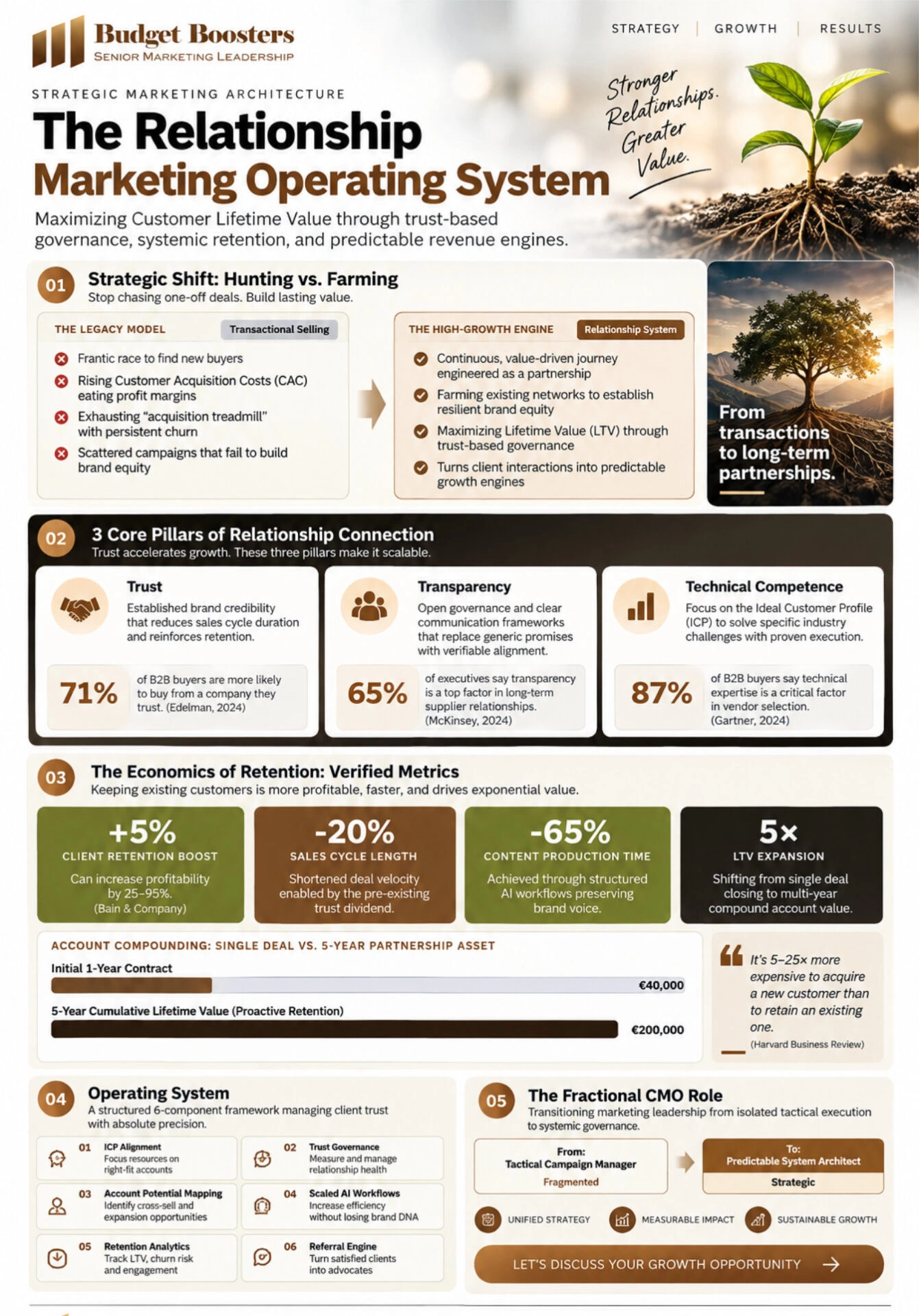
Relationship marketing is a system for maximizing LTV through trust-based governance.
In the Baltics and Poland, the 2026 market environment is shifting rapidly. Buyers are more skeptical of flashy ads and generic promises. They want partners who understand their specific industrial or service challenges. Companies across the region are moving toward this model because it offers a level of stability that transactional sales simply cannot match. It’s about building a fortress around your market share by making your brand indispensable to those you already serve.
The Shift from Hunting to Farming
Constant hunting for new leads is exhausting. It’s also unsustainable for mid-sized firms facing rising costs. When you focus on farming your existing network, you build brand equity that works for you 24/7. This equity acts as a lubricant; it reduces sales friction because the trust is already established. Senior marketing leadership doesn’t see a customer as a target to be hit. They see them as an asset to be nurtured. This shift gives you back control over your growth and turns your client base into a predictable revenue engine.
Key Pillars of Connection
How do you build this connection? It starts with three pillars: trust, transparency, and technical competence. You don’t just promise results; you prove them through consistent governance and clear communication. This requires a laser focus on your Ideal Customer Profile (ICP). You can’t build deep relationships with everyone, so you must choose to invest in the right ones. This approach is a core part of a modern B2B Marketing Strategy that prioritizes quality over quantity. By aligning your systems with client needs, you create a bond that competitors can’t easily break with a lower price tag.
Math doesn’t lie. A 5% boost in client retention isn’t just a “nice to have” metric; it can skyrocket your bottom-line profit. In the high-stakes world of professional services, your Customer Acquisition Cost (CAC) is likely climbing every month. By 2026, the gap between CAC and Lifetime Value (LTV) will define who wins and who merely treads water. Companies that master relationship marketing don’t just survive; they thrive when the economy gets shaky. Why? Because loyal partners don’t run at the first sign of a market downturn. They stay because you’ve become a vital part of their operational success.
Think about a single €40,000 annual contract. On its own, it’s a solid win. But if you keep that client for five years through proactive management, it transforms into a €200,000 asset. That’s the power of thinking long-term. It’s not just a sale; it’s a cumulative growth engine that compounds over time. When you stop chasing every shiny new lead and start nurturing the gold you already have, your stress levels drop while your margins rise.
Calculating the Real Value of a Client
Stop looking at the initial deal size. It’s a narrow view that limits your potential. You need to look at “Total Account Potential.” This means using data to see where else you can help. Are there other departments that need your expertise? Can you solve a bigger problem for them? To get this right, you first need to understand how to calculate Customer Acquisition Cost accurately. Once you know what it costs to get them in the door, you can focus on making sure that door stays open forever. It’s about shifting your mindset from “closing” to “opening” a long-term partnership.
The ‘Trust Dividend’ in Professional Services
Trust is a financial multiplier. Established relationships can reduce the length of your sales cycle by 20%. You aren’t starting from zero every time. There’s no need for lengthy “get to know you” phases or endless proof-of-concept trials. The trust is already there. This “Trust Dividend” also brings in high-quality referrals, which are essentially free leads for your pipeline. A fractional CMO acts as the architect of these outcomes, ensuring your relationship marketing systems protect and grow these bonds. It’s a predictable path to personal and professional freedom. Ready to see where your growth is hiding? A Marketing Diagnostic & Audit can reveal your best retention opportunities.
Building a Relationship Marketing Operating System
Relationship marketing isn’t just a philosophy; it’s a technical discipline that requires a robust operating system to function at scale. We use a six-component Marketing Operating System that replaces guesswork with financial discipline. This isn’t about sending occasional holiday cards. It’s about building a structured engine where trust is a measurable output. To make this work, you need a “cadence of accountability.” This means regular, data-backed communication that keeps your team and your clients aligned on the value you’re delivering every single day.
When your sales and marketing teams operate in silos, the customer journey feels fragmented and confusing. True alignment happens when both departments share the same goal: protecting and growing the relationship. You need a measurement discipline that tracks more than just clicks or open rates. You need to track relationship health. Are your clients engaging with your high-value content? Is the trust growing or eroding over time? By monitoring these signals, you can act before a client even thinks about leaving.
Governance and Alignment
Growth requires governance. Many SMEs fail because the CEO remains the default marketing decision-maker, which often leads to fragmented, reactive activities. A governed investment strategy moves you away from these “random acts of marketing.” It places the focus on Go-to-Market sequencing, which builds long-term authority and keeps your brand relevant. This structural evolution is exactly what we explore in the Fractional CMO Landscape Research 2026. The data shows how firms in Poland and the Baltics are shifting toward senior marketing leadership to build these very systems.
The Role of the Marketing Audit
Before you can build a system, you must assess your current foundation. A Marketing Diagnostic & Audit identifies the “leaky buckets” in your current customer experience. Why are clients leaving? Which relationships are actually profitable? Using data to validate these points ensures you aren’t wasting resources on low-value connections that drain your team’s energy. It’s the first step toward a more balanced and profitable future.
Want to build a marketing system that actually works? Subscribe to the Budget Boosters Newsletter for practical insights on marketing technology, AI, and go-to-market strategy in the Baltics and Poland. You’ll get a free copy of the ebook, “The CMO Edge. Why Companies with Senior Marketing Leadership Outperform – and How to Get There” (a €29 value), to help you make better decisions without a full-time director.
Leveraging AI to Scale Personalised Connections
AI shouldn’t be a wall between you and your clients. Instead, think of it as a bridge that allows you to show up more often without burning out. By using AI-enhanced content workflows, you can preserve your authentic brand voice while cutting production time by 65%. This efficiency isn’t just about saving hours; it’s about reinvesting that time into high-touch outreach and strategic thinking. Scaling relationship marketing becomes much easier when you aren’t stuck in the weeds of drafting every single post from scratch.
Imagine taking one recorded interview and automatically generating LinkedIn posts, newsletter segments, and personalized follow-up notes. The ‘Universal Content Converter’ does exactly that, turning raw expertise into relationship-building assets. This means your best ideas reach your clients in the format they prefer. AI acts as a personal content assistant for senior leaders, ensuring your authority is always working for you even when you’re focused on operations.
The Content Multiplication System
One strategic insight can fuel your entire marketing engine. The Content Multiplication System allows you to turn a single deep-dive conversation into multiple touchpoints across different platforms. This ensures you maintain a consistent “expert” presence without the heavy lifting. If you want to master this, check out our guide on 7 Practical Ways to Streamline Content Creation with AI. It’s a roadmap for staying visible while staying focused on your highest-value tasks.
Data-Driven Personalisation
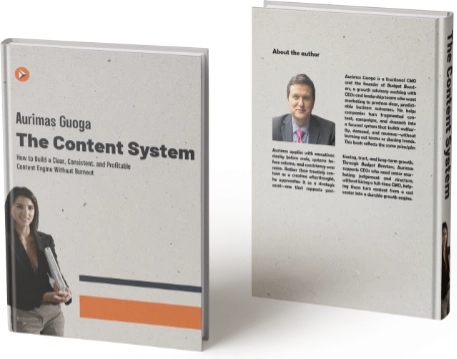
Personalisation at scale is no longer a dream. You can now use AI to analyse client feedback and sentiment across hundreds of interactions. This helps you spot issues before they become churn risks and identify opportunities for expansion. By automating the “boring” parts of outreach, you leave more room for the human strategy that actually closes deals. Our Fractional CMO Landscape Research 2026 provides the evidence needed to lead this shift in the Polish and Baltic markets. Ready to transform your output? Explore The Content System to build your own multiplication engine.
Strategic Leadership: The Fractional CMO as System Builder
Many SMEs in the Baltics and Poland find themselves trapped in a cycle of “random acts of marketing.” You might hire an agency for execution or a junior specialist for social media, but without senior oversight, these activities rarely connect to your bottom line. An agency focuses on execution; they are the builders. A fractional CMO is the architect. They ensure that every activity is a deliberate brick in a larger structure of relationship marketing. This strategic leadership is the difference between a series of one-off campaigns and a governed system that produces predictable revenue.
The financial logic is compelling. To hire a full-time, senior marketing director with global experience, you might need to budget €250,000 annually. A fractional leader delivers that same caliber of strategic oversight for approximately €80,000. You gain the strategic governance and accountability your business deserves without the overhead of a full-time executive. It’s an exciting path toward personal freedom and professional clarity where you finally take control of your growth engine.
Replacing Guesswork with Financial Discipline
Growth shouldn’t be a gamble. A fractional CMO brings budget logic and revenue attribution to the table, ensuring you know exactly where your leads come from and why they stay. They act as the technical supervisor who manages both your internal teams and external agencies toward a single commercial goal. This level of Marketing Leadership for SMBs turns marketing from a confusing cost center into a high-performing investment. You stop guessing and start building based on evidence.
Your Roadmap to Relationship Excellence
Senior marketing leadership acts as the guardian of your commercial outcomes. They don’t just “do” marketing; they build the systems that drive it. This transition from chaotic execution to a predictable growth engine is a level-up for your entire organization. It allows you to focus on your strengths while the system manages the trust. Ready to master these frameworks? We invite you to subscribe to the Budget Boosters Newsletter and get ‘The CMO Edge’ ebook for free (a €29 value). You’ll join a community of leaders focusing on demand generation, AI-driven efficiency, and relationship marketing systems that actually scale.
Lorem ipsum dolor sit amet, consectetur adipiscing elit. Ut elit tellus, luctus nec ullamcorper mattis, pulvinar dapibus leo.
Build Your Engine of Trust Today
You now have the blueprint to move from fragmented activity to a governed system. We’ve seen how relationship marketing isn’t just about being friendly; it’s a financial strategy that boosts LTV and slashes acquisition costs. Whether it’s achieving 30% email open rates through storytelling or driving €1.3M in revenue growth within 12 months as we did for Polmet Solutions, the results come from structure, not luck. This is about taking control of your future and turning your marketing into a predictable asset.
Aurimas Guoga brings over 12 years of senior leadership experience to help you navigate this transition. You don’t have to do it alone. It’s time to stop chasing every lead and start building a fortress around your current market share. Download the Fractional CMO Landscape Research 2026 to see how senior leadership drives growth. Your path to a predictable, efficient growth engine is closer than you think. Let’s make it happen together.
Frequently Asked Questions
Is relationship marketing only for large corporations with big budgets?
Relationship marketing is actually more critical for mid-sized firms than for giants. While large corporations have huge budgets to burn on acquisition, SMEs with €1M to €15M in revenue need every euro to count. Building loyalty reduces the pressure to constantly find new leads. It allows you to grow sustainably by focusing on the clients you already have. This strategic shift turns your marketing into a governed investment rather than a series of expensive experiments.
What is the difference between CRM and relationship marketing?
CRM is the technical database; relationship marketing is the strategic system. Think of your CRM as the engine and the strategy as the driver. A tool like HubSpot or Salesforce only stores information. This strategy uses that data to create a cadence of trust and accountability. It ensures your communication is personalized and relevant. Without a strategy, your CRM is just an expensive digital filing cabinet that doesn’t drive revenue.
How do I measure the ROI of a relationship-focused strategy?
You measure success through three primary metrics: Customer Lifetime Value (LTV), retention rates, and the cost of acquisition (CAC). A healthy strategy should see your LTV rise as clients stay longer and buy more. For example, Polmet Solutions saw marketing efficiency increase by approximately 22% after restructuring their oversight. You should also track expansion revenue and referral volume. These numbers prove that your clients see you as a partner, not just another vendor.
Can AI really help build genuine relationships in a professional setting?
AI handles the heavy lifting so you can stay human. It acts as a personal content assistant that cuts production time by up to 65% while preserving your unique brand voice. By automating the “boring” parts of data analysis and content multiplication, you gain back hours of your week. This time is better spent on high-touch strategy and direct client conversations. AI isn’t replacing the connection; it’s scaling your ability to be present.
How much does it cost to implement a relationship marketing system?
Implementing a professional system varies based on your company’s stage. A fractional CMO typically costs between €60,000 and €120,000 per year, which is a fraction of the €250,000+ you would pay for a full-time director. Many businesses start with a fixed-fee marketing audit to identify immediate efficiency gains. This diagnostic approach ensures you aren’t overspending on tools or campaigns that don’t align with your long-term growth goals and financial discipline.
What is a fractional CMO’s role in customer retention?
The fractional CMO acts as the architect of your retention engine. They implement a six-component framework that replaces guesswork with clear data and priorities. By establishing a “cadence of accountability,” they ensure your team stays focused on client success. They also align sales and marketing activities to create a seamless customer journey. This senior oversight prevents the “leaky bucket” syndrome where new leads enter while existing clients quietly slip away through the back door.
How long does it take to see results from a shift to loyalty-based marketing?
You can see tactical wins, such as improved engagement, in just a few weeks. People Element saw email open rates lift from 3% to 30% during their fractional engagement. However, structural revenue growth usually takes 6 to 12 months to fully materialize. For example, Polmet Solutions grew from €6.1M to €7.4M in revenue over a year. This shift requires patience as you move from “hunting” new leads to “farming” your existing brand equity for long-term stability.

Article by
Aurimas Guoga
Aurimas Guoga is a fractional CMO and founder of Budget Boosters, helping B2B companies turn fragmented marketing into a predictable growth engine. With over a decade of experience leading marketing strategy, he works with business leaders to improve ROI, build scalable systems, and drive measurable revenue growth. Aurimas is also the author of The CMO Edge, a guide for companies looking to gain a competitive advantage through senior marketing leadership.