
The era of the “lone wolf” marketing leader officially died in early 2024. You likely feel the constant pressure of choosing the right AI tools while maintaining a growth trajectory that actually shows up in your bank account. It’s exhausting to operate in a vacuum where every strategic move feels like a high-stakes gamble. You deserve the freedom that comes from validated decisions. This is where the specific marketing peer group benefits come into play, offering you a seat at a table of collective intelligence that turns solo guesswork into a systematic engine for growth.
Key Takeaways
Move beyond traditional networking into a structured collective of non-competing leaders to gain the strategic clarity and accountability needed to scale.
Unlock the most impactful marketing peer group benefits by accessing battle-tested AI workflows and technology stacks that have already been proven to deliver results.
Learn how to gain executive-level marketing insights and ROI-focused frameworks without the high overhead costs of a full-time senior hire.
Identify the right peer group for your business by prioritizing data-driven roadmaps and specific expertise tailored to your company’s market size.
Beyond Networking: What is a Marketing Peer Group in 2026?
Forget the awkward happy hours and the stack of business cards you’ll never call. In 2026, a marketing peer group isn’t a social club. It’s a structured collective of non-competing leaders who act as your external board of advisors. While traditional networking focuses on “who you know,” these groups focus on “how you win.” They provide a high-level strategy exchange that replaces small talk with solutions.
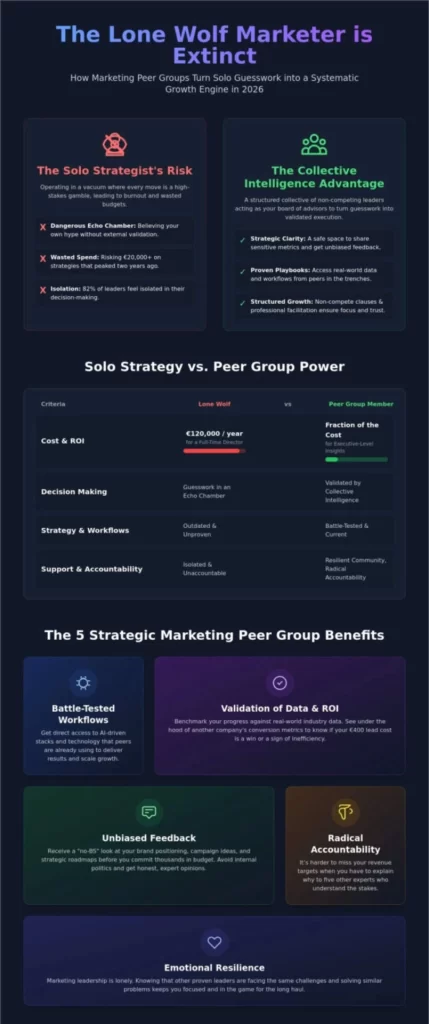
The primary marketing peer group benefits stem from a shift toward collective intelligence. As AI-generated noise saturates 90% of digital channels, solo strategists struggle to identify what actually moves the needle. You need real-world data from peers who are in the trenches right now. This is a safe space. You can share sensitive performance metrics, like a €12,000 monthly ad spend leak or a failing conversion funnel, without fearing judgment or competition. Accessing these marketing peer group benefits means moving from guesswork to validated execution.
The Core Structure of a High-Impact Group
A true high-impact group isn’t just an informal chat. It requires professional facilitation to keep the energy high and the focus sharp. In 2026, these groups use a strict “non-compete” clause. This ensures you aren’t sitting across from your direct rival, allowing for total transparency. Most groups follow a hybrid format: monthly 90-minute virtual deep dives and one intensive in-person retreat per year. This structure builds the trust necessary for deep peer learning to occur, where everyone is both a student and a teacher.
Why Solitary Marketing Strategy is a Risk
Working alone or within a small internal team creates a dangerous echo chamber. You start believing your own hype. A 2025 industry survey showed that 82% of marketing leaders feel isolated in their decision-making. Without external validation, you might waste €20,000 on an outdated TikTok strategy that peaked two years ago. A peer group acts as a reality check. It forces you to justify your decisions to people who understand the stakes but have no bias toward your company’s internal politics.
Ready to sharpen your edge? Subscribe to the Budget Boosters Newsletter. It’s the most comprehensive channel for fCMO developments in the Baltics and Poland. You’ll get the latest on go-to-market strategies, marketing technology, and building high-performing content systems. Plus, you’ll receive our free ebook, “The CMO Edge. Why Companies with Senior Marketing Leadership Outperform – and How to Get There,” a €29 value.
The 5 Strategic Marketing Peer Group Benefits for Growth
Isolation is a growth killer. In 2026, trying to solve every marketing puzzle alone is a recipe for burnout and wasted budgets. Collective intelligence moves faster than any individual strategy. When you tap into a circle of peers, you stop guessing and start executing with confidence. One of the most immediate marketing peer group benefits is the ability to learn from shared failures. If a peer in Warsaw spent €8,000 on a LinkedIn campaign that tanked because of a specific algorithm shift, you keep that money in your pocket. You don’t just get advice; you get a shortcut to what actually works right now.
Growth isn’t just about knowing what to do. It’s about having the guts to do it. Many leaders consider joining a peer group to overcome the paralysis of high-pressure decision-making. These groups provide:
Battle-tested workflows: Direct access to AI-driven stacks that others are already using to scale.
Unbiased feedback: A “no-BS” look at your brand positioning before you spend thousands on a launch.
Radical accountability: It’s harder to miss your revenue targets when you have to explain why to five other experts.
Emotional resilience: Marketing leadership is lonely; knowing others face the same fires keeps you in the game.
Validation of Data and ROI
Are your numbers actually good, or are you just comfortable? Peer groups allow you to benchmark your progress by improving content ROI through direct comparison. Seeing under the hood of another company’s conversion data removes the guesswork from your performance metrics. You can finally see if your €400 lead cost is an industry win or a sign of inefficiency. A marketing peer group acts as a real-time audit that strips away your internal biases and exposes the structural gaps in your strategy.
Mastering the Marketing Technology Curve
The tech landscape moves too fast for one person to track. Within a group, you can discuss streamlining content creation with AI without falling for “shiny object syndrome.” You learn which tools are actually driving revenue and which ones your peers have already discarded as expensive distractions. This is especially vital for vetting regional vendors across the Baltics and Poland, where local nuances can make or break a tool’s effectiveness. You gain a vetted shortlist of partners who understand the specific dynamics of these markets.
Comparing Peer Groups to Other Leadership Models
Choosing the right leadership structure determines how fast your business scales. You don’t need a massive payroll to access high-level strategy. Many leaders feel trapped in daily execution, fixing broken campaigns or chasing lead counts. This is “in the business” work. One of the primary marketing peer group benefits is the forced transition to “on the business” thinking. It provides a dedicated space to analyze your systems without the noise of Slack notifications.
A marketing agency focuses on deliverables like ads or SEO content. They’re executors. A peer group is different. It functions as a collective brain trust that questions your direction before you spend a single euro on ads. While an agency asks “How do we run this?”, a peer group asks “Should we be running this at all?”. This distinction saves companies an average of 15 per cent in wasted ad spend annually.
Peer Group vs. Fractional CMO
Think of these two models as a powerful growth system rather than rivals. A fractional CMO offers depth. They embed themselves in your team to build systems and manage people. A peer group offers breadth. It exposes you to diverse industries and fresh perspectives you won’t find within your own four walls. You get to see what’s working in other markets before your competitors do.
The cost difference is significant. A senior executive salary can easily exceed €8,000 per month. In contrast, a high-quality peer group membership often sits around €320 per month. You gain access to collective intelligence for a fraction of a full-time hire’s cost. It’s an efficient way to boost your strategic capacity without increasing your fixed overhead.
Peer Group vs. Traditional Consulting
Consultants often provide one-off audits. They deliver a thick PDF, collect their fee, and leave. Peer groups prioritize long-term consistency. You meet regularly, which builds accountability that a standard consultant can’t match. Peer-to-peer advice carries more weight because it comes from people currently facing the same market pressures, not from theorists using last year’s data.
You can use resources like The CMO Edge as a foundation for these group discussions. It helps ground the conversation in proven frameworks. This ensures your sessions stay focused on ROI and system building rather than just venting about common problems. Consistency is the key to seeing real marketing peer group benefits in your bottom line.
How to Choose and Evaluate a Marketing Peer Group
Selecting the right circle isn’t just about finding people with similar job titles. You need a group that mirrors your specific challenges. If you’re managing a company with €12,000,000 in annual revenue, advice tailored for a solo freelancer won’t move the needle for you. Look for groups that segment members by company size and market type. This ensures the marketing peer group benefits you receive are actually applicable to your scale and complexity.
Prioritize data over vibes. A high-quality group moves beyond generic “best practices” and focuses on data-driven roadmaps. Ask potential groups if they share actual conversion benchmarks or tech stack audits. You want a community that treats marketing as a system of strategy and execution, not a collection of creative guesses. Verification is key. Has the facilitator actually led a marketing department? Experience matters. You need a mentor who has managed seven-figure budgets and navigated real boardrooms, not just someone who facilitates discussions for a living.
Success in these groups depends on a “give and get” culture. If the room is full of lurkers, the collective intelligence stalls. Look for communities that require active participation and regular contributions. This ensures every session delivers fresh perspectives you can’t find in a textbook.
Red Flags to Avoid
Be wary of groups that feel like a hidden sales pitch. If the “expert” advice always leads back to a specific software or agency service, you’re in a funnel, not a peer group. Another warning sign is a lack of structure. Without a firm agenda and accountability follow-ups, meetings quickly devolve into unproductive coffee chats. While networking is a perk, it shouldn’t be the main event. If the group prioritizes social mixers over ROI and strategic growth, your time is better spent elsewhere.
Measuring Your Membership ROI
Don’t leave your growth to chance. Track the “implementable ideas” you gain from every single session. Aim for at least one high-impact tactic per meeting that you can test within 14 days. Set specific goals for your quarterly marketing plan that are directly driven by peer feedback. This could be a 15 per cent reduction in customer acquisition costs or a faster go-to-market timeline for a new product.
Scaling Your Strategy with Budget Boosters Advisory
You have seen how collective intelligence transforms a lonely strategy into a powerhouse plan. Now, it’s time to turn those insights into measurable revenue. Budget Boosters doesn’t just provide advice; we build the engine that drives your growth. We integrate the core marketing peer group benefits directly into a fractional CMO advisory model. This approach moves you beyond the “what” and focuses entirely on the “how.”
We believe marketing is a system. It’s not a collection of random social media posts or disconnected ads. A true system combines high-level strategy, clean data, and relentless execution. Many growth-stage companies in Poland and the Baltics struggle because they have great ideas but lack the infrastructure to scale them. We solve this by creating a data-driven roadmap. We help you stop the guesswork and start making decisions based on what the numbers actually say.
Our regional expertise is your secret weapon. The market dynamics in Warsaw, Tallinn, or Vilnius are unique. Generic advice from Western markets often fails here because it lacks local context. We understand the regional talent pools, the cultural nuances of demand generation, and the specific hurdles of scaling across these borders. You get a partner who knows your backyard as well as you do.
From Peer Insight to Execution
Talking about best practices is easy. Implementing them while running a business is the real challenge. Our advisory helps you bridge the gap between the great ideas you hear in peer groups and the daily reality of your marketing team. We provide the frameworks that turn inspiration into a repeatable process.
We use The Content System to standardise how your brand communicates. It removes the chaos from your production cycle and ensures every piece of content serves a strategic purpose. You can see the results of this systematic approach in our latest case study. It shows how senior leadership turns profiles into €64,000 pipelines. We don’t just suggest strategies; we give you the tools to make them work.
Join the Most Comprehensive Regional Network
Scaling your business shouldn’t feel like a solo mission. You deserve access to the same strategic depth that giant corporations use, but tailored for your specific needs. To stay ahead of the latest fractional CMO trends and marketing technology developments in the Baltics and Poland, you should subscribe to our newsletter. It’s the most comprehensive channel for leaders who want to master demand generation and go-to-market strategies.
When you join our community, you’ll receive a free gift: “The CMO Edge. Why Companies with Senior Marketing Leadership Outperform – and How to Get There” ebook. This is a €29 value that we provide to help you understand the power of senior-level guidance. Don’t let your strategy stall. Embrace the power of collective marketing leadership and start building your roadmap to success today.
Step Into the Future of Collective Leadership
Marketing in 2026 is too complex for a single perspective. You’ve discovered how collective intelligence transforms a stagnant plan into a high-performing system. By tapping into marketing peer group benefits, you gain access to the same ROI-focused frameworks used by senior fractional CMOs across Poland and the Baltics. This isn’t just about networking; it’s about building a data-driven strategy that survives market shifts. You’re ready to move from maintenance to true momentum.
Frequently Asked Questions
What is the typical time commitment for a marketing peer group?
You should plan to invest 4 to 6 hours per month in your group activities. This usually includes one 2-hour deep dive session and about 1 hour per week for implementation or asynchronous discussion. A 2024 report by the Peer Institute found that 88% of leaders find this schedule manageable while still driving measurable growth. It’s a small price to pay for the clarity and speed you’ll gain in your decision making.
Will I have to share my company’s trade secrets with competitors?
You won’t share sensitive trade secrets because high-quality groups use strict non-compete filters and NDAs. Moderators ensure that no direct competitors sit at the same table, so you can speak freely about your challenges. You’ll focus on sharing frameworks, data trends, and strategy rather than proprietary code or private client lists. This protected environment lets you leverage collective intelligence without risking your competitive edge.
How do marketing peer groups differ from standard business masterminds?
Marketing peer groups focus exclusively on the marketing system, including demand generation, MarTech stacks, and content systems. While general masterminds might touch on HR or legal issues, these groups dive deep into GTM strategies and ROI. You’ll find that marketing peer group benefits are far more specialized, providing specific answers to growth questions that general business groups often miss. It’s about mastering the mechanics of growth with people who speak your language.
Can a peer group replace the need for a full-time marketing director?
A peer group doesn’t replace a director but it provides the strategic oversight that many companies lack without a €120,000 annual senior hire. It functions as a fractional CMO board that helps you build systems and manage your existing team or agencies more effectively. You get access to high-level strategy and data-driven insights that help you make better decisions. This approach allows you to scale your marketing efforts without the immediate overhead of a full-time executive salary.
What kind of ROI can I expect from joining a marketing peer group?
Members typically see a 25% increase in lead quality within the first 6 months of active participation. By avoiding just one bad hire or a failed €10,000 ad campaign, the group pays for itself multiple times over. Data from 2025 industry surveys shows that companies using collective intelligence scale their revenue 1.5 times faster than those working in isolation. You’re investing in a system that prevents costly mistakes and accelerates your wins.
Are there marketing peer groups specifically for companies in Poland and the Baltics?
Yes, there are specialized cohorts that focus on the unique market dynamics of Poland and the Baltic states. These groups address regional demand generation challenges and local go-to-market nuances that global groups might overlook. To stay informed about these regional developments and fractional CMO trends, subscribe to the Budget Boosters Newsletter. You’ll also receive a free copy of “The CMO Edge,” a guide valued at €29 that explains how senior leadership drives performance.
How much does a high-quality marketing peer group cost in 2026?
High-quality facilitated groups in 2026 typically range from €300 to €900 per month. A 2025 industry report by the Marketing Alliance indicates that premium groups average around €450 monthly for fully moderated sessions. This investment covers the cost of expert facilitation, vetted peer matching, and access to proprietary growth frameworks. It’s a calculated investment in your professional freedom and your company’s financial future.
What happens if I don’t feel like I’m getting value from the group?
Most reputable groups offer a 30-day or 60-day satisfaction guarantee to ensure the fit is right for everyone. If the chemistry isn’t working or the insights aren’t actionable, you can leave without further commitment. Statistics show that 92% of members who stay past the initial 90-day period remain for at least 2 years. This high retention rate proves that once the systems start clicking, the value becomes an essential part of your success.

![]()
Article by
Aurimas Guoga
Aurimas Guoga is a fractional CMO and founder of Budget Boosters, helping B2B companies turn fragmented marketing into a predictable growth engine. With over a decade of experience leading marketing strategy, he works with business leaders to improve ROI, build scalable systems, and drive measurable revenue growth. Aurimas is also the author of The CMO Edge, a guide for companies looking to gain a competitive advantage through senior marketing leadership.