What if your marketing didn’t need you to breathe life into it every single morning? You’ve likely felt the exhaustion of “random acts of marketing” where every lead feels like a manual win and visibility into your ROI is a total mystery. It’s frustrating when growth depends entirely on your personal bandwidth. This guide will teach you how to build a marketing engine that runs itself, turning that chaotic cycle into a predictable growth system that delivers results while you focus on high level strategy.
You deserve a business that scales without your constant intervention. We’ll dive into the 2026 blueprint for SMEs, covering everything from AI powered automation to the strategic findings in our Fractional CMO Landscape Research 2026. You’ll learn how to align your tools, like HubSpot starting at €12 per seat, with a governance model that ensures your systems work for you, not the other way around. We’ll explore how to move from fragmented execution to a structured system that creates freedom and measurable success across the Baltics and Poland.
Key Takeaways
- Break free from the founder bottleneck by moving away from fragmented marketing tasks that drain your budget and energy.
- Discover the 2026 blueprint for how to build a marketing engine that runs itself through a seamless blend of strategy, AI, and data.
- See how a Fractional CMO serves as the architect of your growth, building a self-sustaining system that your business owns for the long term.
- Follow a practical 5-step roadmap that begins with a Marketing Diagnostic to identify leaks and align with your 2026 revenue targets.
- Learn to implement governance and use regional research to ensure your marketing engine stays efficient and predictable without daily supervision.
Breaking the Cycle of Random Acts of Marketing
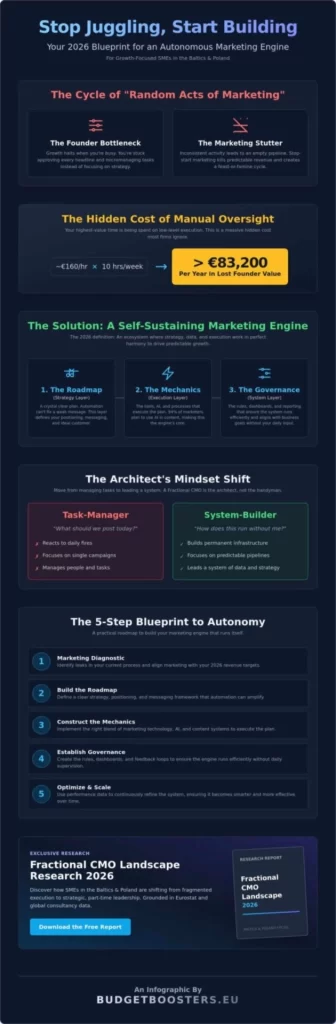
Do you feel like you’re constantly pushing a heavy boulder uphill? Many SME founders in the Baltics and Poland spend their days reacting to marketing fires rather than leading growth. You hire a junior specialist or a small agency, but you still find yourself approving every single headline and checking every link. This is the founder bottleneck. It’s a frustrating place to be, but here is the truth: it’s not a lack of effort on your part. It’s a lack of architecture. You’re stuck in a cycle of random acts because you haven’t yet mastered how to build a marketing engine that runs itself.
Most small businesses operate on a campaign-led model. You launch a promotion, cross your fingers, and hope for a spike in sales. When the campaign ends, the momentum dies. A system-led approach is different. It’s about building a permanent infrastructure that generates demand while you sleep. Think of it like the difference between carrying buckets of water and building a pipeline. One requires your physical presence every day; the other just needs you to check the gauges occasionally.
If you are looking for a partner to help construct this digital infrastructure and establish your brand, you can check out Cornerstone Marketing Solutions to see how an experienced agency builds a professional online presence.
The High Cost of Manual Oversight
Let’s look at the real numbers behind your involvement. If your time is worth roughly €160 per hour and you spend 10 hours a week on basic marketing tasks, that’s €1,600 every single week. Over a year, you’re spending more than €83,200 of your highest-value time on low-level execution. This is a massive hidden cost that most firms ignore. Beyond the money, manual oversight creates the “Marketing Stutter.” This happens when you get a surge of new clients and stop marketing because you’re too busy with operations. Three months later, your pipeline is empty and you have to start from zero again. Our Fractional CMO Landscape Research 2026 shows that growth-stage firms are moving away from this grind. They are embracing Marketing automation to ensure the system keeps humming even when the CEO is in a deep focus session.
Moving from Task-Manager to System-Builder
Building an autonomous engine requires a fundamental mindset shift. You have to stop being a task manager who asks “What should we post today?” and start being a system builder who asks “How does this run without me?” You’ll know your marketing has hit a ceiling if lead flow drops the moment you stop checking the dashboard. Real freedom comes from knowing the mechanics are handled by a strategic asset you own. It’s about creating a roadmap where data drives the decisions, not your gut feeling at 10 PM. When you stop managing people and start leading a system, you unlock a level of predictable growth that manual processes can never match.
- The Bottleneck: Growth stops when the founder is busy.
- The Stutter: Inconsistent activity leads to inconsistent revenue.
- The Solution: A self-sustaining system of strategy and data.
What is a Marketing Engine? The 2026 Definition
In 2026, a marketing engine is far more than a simple collection of software tools. It’s a self-sustaining ecosystem where strategy, data, and execution work in perfect harmony to drive growth. Think of it as a living structure that evolves alongside your business. When you focus on how to build a marketing engine that runs itself, you’re essentially constructing three core pillars: The Roadmap, The Mechanics, and The Governance. Without all three, the system eventually breaks down. A roadmap without mechanics is just a dream. Mechanics without governance is just expensive, uncoordinated noise that drains your resources.
This engine doesn’t operate in a vacuum. It must be perfectly aligned with your sales objectives to ensure every lead has a clear path to revenue. Data serves as the essential fuel here. Research shows that 94% of marketers plan to use AI in their content creation processes, proving that manual guesswork is a thing of the past. This data doesn’t just sit in a static spreadsheet. It actively optimizes your campaigns in real-time. By understanding a modern AI Marketing Strategy, you can ensure your engine learns from every customer interaction, becoming smarter and more efficient with every euro you invest.
The Strategy Layer: Your Growth Roadmap
You can’t automate a message that doesn’t resonate with people. If your positioning is weak, automation only helps you reach the wrong people faster. Before you turn on the engine, you need a crystal clear understanding of your audience’s deepest pains. For many firms in Poland and the Baltics, this means moving away from generic corporate speak and finding a unique voice. You need to nail your messaging first. If you want to see how this fits into a broader vision, our Fractional CMO Landscape Research 2026 provides a deep dive into how growth-stage companies are structuring these roadmaps for long-term success.
The Execution Layer: People and Platforms
Who keeps the engine running? In 2026, the most resilient systems balance internal talent with senior external expertise. You don’t need a massive team. A lean group that understands AI is often more effective than a bloated department. The concept of “operational cadence” is vital here. This rhythm acts as the heartbeat of your marketing. Whether it’s a weekly data review or a monthly sprint, this rhythm ensures the engine never stops. Anyone feeling overwhelmed by the technical side might want to explore our Content System to see a practical framework in action. This isn’t about working harder. It’s about letting the architecture do the heavy lifting so you can focus on high-level strategy.
Fractional Leadership: The Architect of Your Marketing Engine
Most SMEs in the Baltics and Poland have plenty of “doers” but very few “architects.” You might have a talented social media person or a reliable SEO agency. But who is making sure these pieces actually fit together? Without a senior leader, the founder usually becomes the default strategist. This is exactly what creates the bottleneck we discussed earlier. You don’t need a full-time executive to design a master plan. A Fractional CMO acts as the engine architect. They show you how to build a marketing engine that runs itself by creating the blueprints before anyone starts execution. This ensures every euro you spend is working toward a single, unified goal.
The financial math is also incredibly compelling. Hiring a full-time marketing director in 2026 can easily cost over €120,000 when you factor in taxes and benefits. For many growth-stage firms, that’s a massive, risky commitment. Fractional leadership offers a much smarter path. You get the same level of senior strategy and experience for approximately €24,000 annually. It’s about buying the brainpower you need without the heavy overhead. This approach gives you the freedom to invest the savings back into the engine itself, accelerating your growth even faster. This model of high-impact, variable-cost leadership is becoming the standard for modern SMEs, with firms like SA Unlimited offering similar fractional CFO and financial advisory expertise to keep the entire business operationally lean and strategically sound.
Building vs. Buying Your Marketing System
Hiring a junior marketer to “figure it out” is a common mistake. You end up paying for their learning curve, and the results are often inconsistent. Agencies are great for scaling execution, but they rarely build internal systems that you actually own. They sell you their process, not your own asset. A fractional leader bridges this gap. They help you build an internal system that belongs to your company. You stop being dependent on external partners for your core strategy. It’s a fundamental shift from renting a marketing presence to owning a marketing machine.
Governance: Keeping the Engine on Track
A self-running engine still needs a pilot to check the gauges. Marketing governance is the set of rules, metrics, and rhythms that keep everything aligned. It’s the difference between a system that works and one that eventually drifts off course. This involves establishing a weekly operational cadence where you review data, not just feelings. Our Fractional CMO Landscape Research 2026 shows that SMEs are increasingly adopting this model to introduce accountability. Governance ensures that your team knows exactly what to do, even when you aren’t in the room. It turns marketing from a black box into a transparent, predictable part of your business.
- Accountability: Clear ownership of every metric.
- Predictability: Data-driven decisions that replace guesswork.
- Efficiency: Senior strategy at a fraction of the full-time cost.
The 5-Step Blueprint to Build Your Autonomous System
Leadership provides the foundation, but you need a practical map to get the machine moving. You don’t have to do everything at once. Small, deliberate steps lead to a system that eventually takes care of itself. Here is how to build a marketing engine that runs itself in five clear stages. This blueprint ensures your efforts are connected rather than fragmented.
- Step 1: Conduct a Marketing Diagnostic. Stop guessing where your leads are going. Identify the specific leaks in your current funnel before you spend another euro.
- Step 2: Build a Data-Driven Roadmap. Align your technology and tactics with your 2026 revenue goals. Every tool must have a clear purpose.
- Step 3: Systemise Content Creation. Use AI-driven frameworks to handle the heavy lifting. This reduces manual work while keeping your brand voice consistent, whether you are producing digital assets or professional print communications with Linemark.
- Step 4: Automate Lead Nurturing. With 81% of small businesses relying on email for acquisition, you can’t afford to let leads go cold. Set up sequences that trigger automatically, and consider using The Better Creative to ensure your email design and development are optimized for conversion.
- Step 5: Implement AI-Powered Reporting. Get real-time visibility into your ROI. Since 54% of small business owners already use AI marketing tools, you should use them to track performance without manual spreadsheets.
Streamlining Content with AI
Content is the fuel that keeps your engine running. In 2026, 94% of marketers plan to use AI in their content creation processes. You can scale your output without hiring a massive team by using 7 practical ways to streamline content creation with AI. This isn’t about generic robot-speak. It’s about building a Content System that produces high-quality assets on autopilot. This shift gives you more time to think about big-picture growth while your system handles the daily publishing grind.
Automation Workflows for Lead Generation
What happens once a prospect finds you? Most firms lose revenue because their follow-up is slow or non-existent. You can set up automated lead capture that triggers instant, personalised responses. By using CRM data, your engine sends the right message at the right moment based on user behaviour. This is the heart of effective demand generation. It keeps your pipeline full without you having to manually check your inbox every ten minutes. It’s a level of efficiency that manual processes just can’t match.
Want to stay ahead of these trends in the Baltics and Poland? Join our Budget Boosters Newsletter for practical frameworks on marketing technology and demand generation. You’ll also receive the ebook “The CMO Edge” (a €24 value) for free: Get The CMO Edge here.
Sustaining Growth: Governance and the Future of SME Marketing
Building your engine is a massive achievement. But even the most sophisticated machinery needs a regular tune up. A self running system doesn’t mean a neglected one. Governance is the secret ingredient that ensures your growth doesn’t stall after the initial launch. It’s about setting the rules of the road. You need a clear process for reviewing data and adjusting your tactics without getting sucked back into the daily grind. This is how to build a marketing engine that runs itself for the long haul. You move from being the person who turns every screw to the person who reads the dials and makes the big calls.
The shift we see across the Baltics and Poland is undeniable. Our Fractional CMO Landscape Research 2026 highlights that successful SMEs are moving away from fragmented execution. They’re no longer just hiring agencies for individual tasks. Instead, they’re investing in senior, part time leadership to maintain the system’s integrity. This research, grounded in Eurostat and global consultancy data, shows that governance is what separates firms that scale from those that simply stay busy. Benchmarking your progress against these regional trends helps you stay competitive and agile.
The Role of the Modern Marketing Leader
The most valuable person in a scaling firm isn’t the one who can write the best email. It’s the system builder. This leader creates a structure where sales aren’t dependent on your personal network or late night LinkedIn sessions. You’re building a path to personal freedom. When you transition from founder led sales to system led growth, you finally get your time back. You can focus on the high level strategy that actually moves the needle. If you want to keep up with these shifts, join our Budget Boosters Newsletter. We focus on marketing as an integrated system of strategy and data. You’ll also get our ebook, “The CMO Edge” (a €24 value), for free: Download your copy here.
Next Steps: Auditing Your Current Engine
Where do you start? You can’t fix what you haven’t measured. A one time, comprehensive evaluation of your marketing data is essential. This isn’t about pointing fingers at past mistakes. It’s about finding the fastest route to efficiency. A Marketing Diagnostic gives you the immediate roadmap you need. It reveals exactly where your engine is leaking and how to plug those holes. Don’t wait for another month of inconsistent leads. Start building your engine today. The control you’ll gain over your revenue and your schedule is worth the effort. You have the tools and the blueprint. Now, it’s time to step into your role as the architect of your own success.
If securing capital is the first step in your roadmap, Opolskie Centrum Kredytowe offers the professional financial advisory needed to obtain the credit and loans that fuel business expansion.
- Audit: Identify leaks with a diagnostic.
- Benchmark: Use regional research to stay ahead.
- Lead: Focus on the system, not the tasks.
Step Into the Future of Your Growth
You’ve seen the blueprint. Moving from the exhaustion of “random acts” to a structured system is the only way to scale without burning out. By embracing fractional leadership and the 5-step roadmap, you’re not just fixing your ads; you’re building a strategic asset. Our Fractional CMO Landscape Research 2026 confirms that SMEs in the Baltics and Poland are already winning by choosing systems over sheer effort. These are the same frameworks used to generate €80k deal pipelines for firms just like yours. You now have the knowledge of how to build a marketing engine that runs itself, so don’t let this momentum fade.
Frequently Asked Questions
How much does it cost to build a self-running marketing engine?
The total cost depends on your choice of tools and the level of leadership you need. You can start with a CRM like Zoho for about €12 per user, while a Professional HubSpot plan for how to build a marketing engine that runs itself begins at €720 per month. You should also consider the investment in senior strategy, which is often much more affordable through a fractional model than a full-time executive hire.
Can a small business-to-business firm really automate its marketing?
Absolutely, and many growth-stage firms in the Baltics are already doing it. With 54% of small business owners using AI marketing tools in 2026, the technology is now accessible to everyone. Automation handles lead capture and nurturing while you focus on closing deals. It’s about replacing manual, repetitive tasks with smart workflows that work even when you aren’t in the office.
What is the difference between marketing automation and a marketing engine?
Marketing automation refers to the specific software tools you use to send emails or post on social media. A marketing engine is the entire ecosystem that includes strategy, leadership, and data. You can have automation without an engine, but you can’t have an engine that runs itself without automation. One is simply the tool; the other is the complete system.
How long does it take to see results from a new marketing system?
You can often see efficiency gains within the first 30 days by fixing leaks found during a Marketing Diagnostic. Building the full system usually takes three to six months of consistent implementation. The goal is to create a permanent asset that delivers predictable revenue, not just a quick campaign spike that eventually fades away. Patience in the building phase leads to long-term freedom.
Do I need a full-time CMO to manage this engine?
You don’t need a full-time executive to maintain your engine. A fractional leader provides the senior strategy you need at a fraction of the cost. This allows you to access top-tier expertise without the heavy overhead of a full-time director. It’s a much more flexible way to manage governance and keep your system on track as your business scales across Poland and the Baltics.
What are the best tools for building a marketing engine in 2026?
The best tools in 2026 are those that integrate seamlessly with your sales process. HubSpot and Zoho are excellent for CRM and lead tracking. For content, AI platforms are essential, as 94% of marketers now use them for creation. The key is choosing tools that talk to each other to avoid data silos and wasted time. Your tech stack should empower you, not confuse you.
How does a fractional CMO help in building these systems?
A fractional CMO acts as the architect who knows how to build a marketing engine that runs itself. They design the workflows, select the right tech stack, and establish the governance you need. Instead of just doing tasks, they build a system that your company owns and operates independently. They introduce the accountability and senior oversight that agencies often lack.
Is AI necessary for a marketing engine to run itself?
AI is the operating system of the modern marketing engine. It handles everything from data analysis to content production at a scale humans simply can’t match. Since nearly all marketers are now using AI in their workflows, it’s a critical component for anyone who wants a truly autonomous growth system. It’s the fuel that keeps your engine efficient and your messaging personalised.

Article by
Aurimas Guoga
Aurimas Guoga is a fractional CMO and founder of Budget Boosters, helping B2B companies turn fragmented marketing into a predictable growth engine. With over a decade of experience leading marketing strategy, he works with business leaders to improve ROI, build scalable systems, and drive measurable revenue growth. Aurimas is also the author of The CMO Edge, a guide for companies looking to gain a competitive advantage through senior marketing leadership.