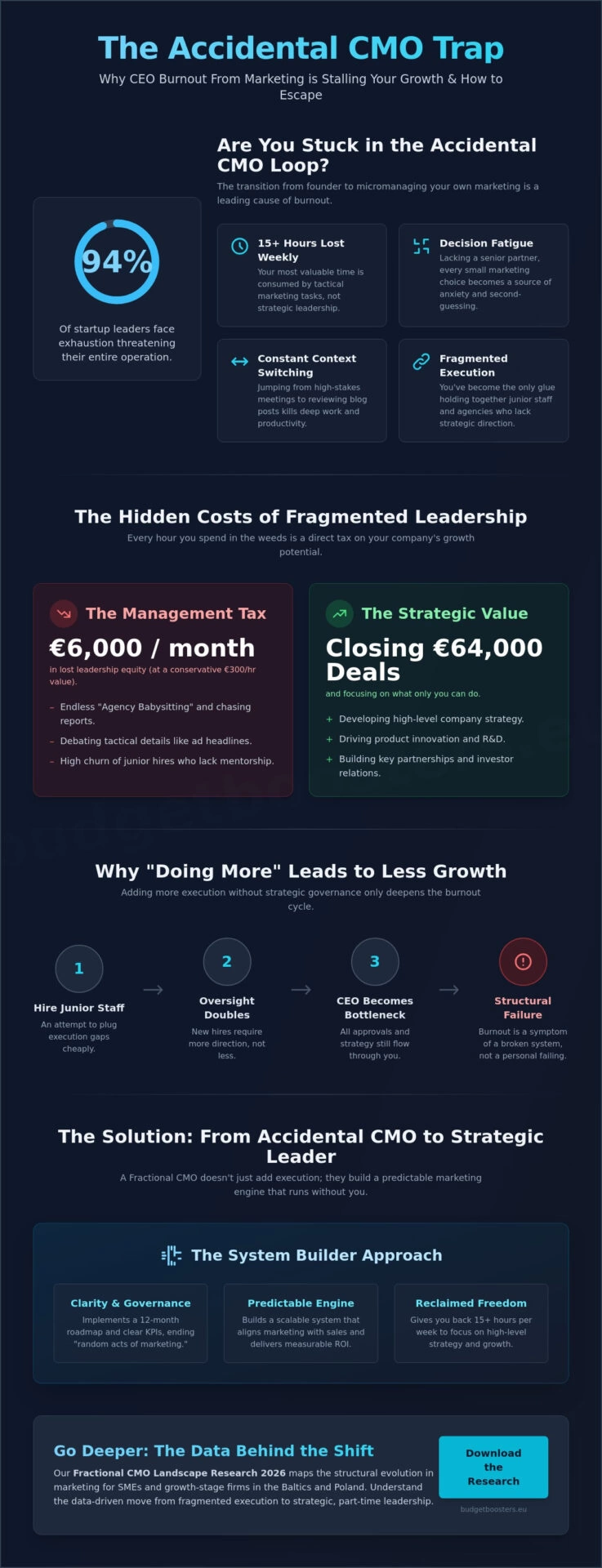
Did you know that 94% of startup leaders are currently facing levels of exhaustion that threaten their entire operation? It’s a staggering reality, but for most, the root cause isn’t just work in general. It’s the heavy, invisible toll of CEO burnout from managing marketing when you should be leading the company. You’re likely tired of the constant context switching and the feeling that if you stop pushing the marketing team for five minutes, the whole engine will stall. It’s frustrating to feel like the “accidental CMO” while your growth remains stagnant.
We understand that frustration. You shouldn’t have to micromanage every campaign just to ensure your brand stays visible in the Baltics and Poland. You deserve a system that functions like a predictable engine, providing clear data without requiring a PhD to understand. In this article, you’ll discover how to stop being the glue for fragmented execution and transition to a scalable marketing system that runs without your constant intervention. We’ll show you how to regain your freedom to focus on high-level strategy while your marketing finally starts delivering the ROI you’ve been promised. It’s time to build a future where growth feels exciting again.
Key Takeaways
- Identify the symptoms of the Accidental CMO syndrome and reclaim 15 hours of your week for strategic leadership.
- Stop paying the Management Tax by focusing on €64,000 deals instead of getting lost in tactical execution.
- See why hiring junior staff or cheap agencies often triggers CEO burnout from managing marketing by doubling your oversight duties.
- Learn to use a marketing diagnostic and team audit to find exactly where your growth engine is failing.
- Discover how a Fractional CMO builds a scalable system that gives you back your sanity and delivers predictable results.
The Accidental CMO: Identifying the Symptoms of Marketing Management Burnout
You started your company to build something great, not to argue over font sizes or LinkedIn ad copy. Yet, here you are. If you’re spending 15 hours or more every week on marketing tasks, you’ve officially entered the “Accidental CMO” territory. This isn’t where you belong. It’s a heavy transition from the early excitement of building a brand to the quiet dread of the weekly agency call. You feel like the only person holding the marketing department together, and that weight is exhausting.
Many leaders in the Baltics and Poland find themselves stuck in this loop. You’re likely facing CEO burnout from managing marketing, a specific type of exhaustion that comes from being the only bridge between business goals and a fragmented execution team. This isn’t just a busy season; it’s a state of Occupational burnout that drains your creative energy. You might notice these warning signs: constant decision fatigue, the lack of a clear 12-month roadmap, and a series of “random acts of marketing” that feel like throwing spaghetti at a wall. According to our Fractional CMO Landscape Research 2026, this fragmentation is the leading cause of leadership stagnation in growth-stage firms.
The Decision Fatigue Cycle
Choosing between a new SEO strategy and a LinkedIn campaign feels impossible without a senior partner by your side. Every €4,000 spend becomes a source of deep anxiety because you lack data confidence. You second-guess every move. This constant context switching is a productivity killer. One minute you’re in a high-stakes meeting; the next, you’re reviewing a blog post. Your brain never gets the chance to stay in deep-work mode, and your other departments, like Sales or R&D, suffer because of it.
Why “Doing More” Is Leading to Less
It’s tempting to add more tools or hire another junior to fix the gap. This is a trap. Adding more execution power without strategic governance just increases the number of things you have to oversee. You’re caught in a paradox of choice where more options lead to slower growth. You don’t need more “doing”; you need better “directing.”
Remember this: marketing management burnout is a structural failure, not a personal one.
The Hidden Costs of Fragmented Marketing Leadership
Every hour you spend reviewing a social media calendar or chasing an agency for a report is an hour stolen from your company’s future. This is the “Management Tax.” It’s the literal price you pay for not having a senior system builder in place. When you calculate your true hourly value, that “affordable” agency retainer suddenly looks incredibly expensive. You’re likely losing thousands of euros in pure leadership equity every month. This financial leak is a primary driver of CEO burnout from managing marketing, as you realize your time is being consumed by tactical weeds rather than strategic growth.
The real damage, however, is the opportunity cost. What could your business achieve if you focused on closing €64,000 deals instead of debating ad headlines? Growth-stage firms in Poland and the Baltics often hit a “marketing ceiling” because the CEO becomes a bottleneck. Without senior governance, your external partners often fall into the “Agency Babysitting” trap. They wait for your instructions; they don’t offer proactive solutions. This fragmented marketing leadership creates a vacuum where strategy should be, leaving your brand to drift without a clear destination.
Calculating Your Personal ROI as a Leader
Be honest with yourself. If your time is worth €300 per hour, spending five hours a week on marketing execution costs the business €6,000 a month. That’s more than the cost of a senior part-time director. You’re effectively overpaying for a role you don’t even want. This imbalance also leads to the invisible cost of “churned” junior hires. Without a mentor to guide them, talented juniors often leave, forcing you to start the recruitment cycle all over again. You can see how a structured approach changes this dynamic in our case study: CMO in action: turning a CEO’s LinkedIn profile into an €80k deal pipeline.
The Governance Gap
Marketing requires a system builder, not just a content creator. When you lack a senior leader, your sales and marketing objectives inevitably drift apart. Sales wants leads; marketing wants “awareness.” Without alignment, you waste money on regional market entries that fail because the data was fragmented. A cohesive system ensures that every euro spent on technology or content actually moves the needle on your revenue. If you’re ready to stop guessing, exploring a marketing diagnostic could be your first step toward total clarity.
Structural evolution isn’t just about hiring more people. It’s about introducing the right level of governance so you can finally step back and lead.
The €80,000 Management Fallacy: Why More Execution Won’t Save You
Many founders think hiring a junior marketer for €40,000 or a “budget” agency for €1,500 a month is the cure for their stress. It isn’t. This is what we call the €80,000 Management Fallacy. You’re buying execution power, but you’re paying for it with your own mental bandwidth. When you hire for “doing” instead of “directing,” you don’t actually offload the work. You just change your role from doing the marketing to managing the people who do the marketing. This cycle is a direct path to CEO burnout from managing marketing. You end up as the bottleneck, reviewing every social post and approving every ad spend because your team lacks the seniority to make those calls themselves.
It’s vital to understand the difference between execution power and strategic governance. Execution is the “how”; governance is the “why” and “when.” Without a senior strategist, you remain the sole source of direction. When expectations are unclear and you feel a lack of control over the results, the clinical symptoms of burnout start to appear. You might feel increasingly cynical about your growth prospects or overwhelmed by the sheer volume of tactical decisions. This isn’t a personal failure. It’s a structural one. You’ve built a team of “hands” when your business actually needs a “head” to lead the function.
Senior Leadership vs. Junior Execution
There’s a massive gap between the “I need someone to post on social” mindset and the “I need a revenue engine” reality. Junior staff are talented and hardworking, but they thrive best under a mentor. If you don’t have a CMO, you are that mentor by default. This is why juniors often fail in growth-stage companies; they’re looking to you for a roadmap you’re too busy to build. To fix this, you must shift your focus toward Improving Content ROI through a system that doesn’t require your constant input. A Fractional CMO can provide this governance, allowing your junior team to actually succeed while you step back into your CEO role.
The AI Paradox in 2026
AI was supposed to save us time, but in 2026, it has created a new paradox. AI tools allow your team to create more content than ever before. However, more content requires more strategic filtering. Without a senior leader, you become the person who has to sift through a mountain of AI-generated drafts to find the ones that actually match your brand voice. You can find 7 Practical Ways to Streamline Content Creation with AI to help, but tools alone won’t save you. You need “The CMO Edge” framework to ensure your AI-driven growth is actually aligned with your business goals. Technology is a multiplier; if your strategy is zero, the result will still be zero.
Transitioning from Accidental CMO to Strategic Leader
The path out of the Accidental CMO trap isn’t found by working harder. It’s found by building better. You need to move from being the “glue” that holds fragmented tasks together to being the architect of a self-sustaining growth engine. This shift is the only sustainable way to cure CEO burnout from managing marketing. It requires a deliberate transition from tactical interference to strategic oversight. Let’s look at the five steps to reclaim your time and your sanity.
- Step 1: Conduct a Marketing Diagnostic. You can’t fix a system if you don’t know where it’s leaking. Identify the bottlenecks in your lead flow and messaging before spending another euro on ads.
- Step 2: Audit Your Current Assets. Evaluate your agency and team performance against actual business goals, not just vanity metrics like “likes” or “impressions.”
- Step 3: Define Governance vs. Execution. Separate the “why” from the “how.” You keep the vision; your team or a senior partner owns the roadmap and the daily fires.
- Step 4: Implement a Marketing System. Build a framework that provides automated reporting and clear accountability. This ensures you only see the data that actually matters for decision-making.
- Step 5: Introduce Senior Part-Time Leadership. Bring in a specialist who has built these systems before. They own the roadmap, so you don’t have to.
Building the Marketing System
A true “Marketing System” is the seamless integration of strategy, data, and execution. It’s the difference between guessing what works and knowing what scales. When you move from gut feelings to data-driven decision-making, the anxiety of “invisible ROI” disappears. You can start this process by implementing The Content System, which transforms your output into a predictable revenue driver. It’s about creating a machine that functions whether you’re in the office or not.
Regional Insights for Poland and the Baltics
The business landscape in the Baltics and Poland is evolving rapidly. Growth-stage firms are increasingly ditching the overhead of full-time executive hires in favor of senior, part-time leadership. According to the Fractional CMO Landscape Research 2026, this model allows SMEs to access corporate-level expertise without the traditional price tag. It’s a structural level-up that’s helping regional firms compete on a global scale while keeping their leadership teams lean and agile.
If you’re ready to stop being the “accidental CMO” and start building a real system, join our Budget Boosters Newsletter. You’ll get practical frameworks for demand generation and GTM strategy delivered to your inbox. Plus, we’ll send you the ebook “The CMO Edge” (a €29 value) for free. Download your copy here and start your transition today.
The Fractional CMO: Restoring CEO Sanity and Predictable Growth
You’ve identified the symptoms and calculated the costs. Now, it’s time for the solution that actually scales. A Fractional CMO isn’t just another consultant; they are a system builder. Their primary role is to take the heavy weight of CEO burnout from managing marketing off your shoulders by installing a framework that operates independently. They don’t just “do” marketing; they govern it. This shift allows you to stop being the bottleneck and start being the visionary leader your company needs.
The financial advantage is clear. A full-time executive in 2026 can cost your business upwards of €202,400 annually when salary and benefits are included. For growth-stage firms in Poland and the Baltics, that’s a significant overhead that often isn’t necessary. A fractional leader provides that same corporate-level expertise at a fraction of the cost. You get the strategic brain of a veteran without the long-term commitment or the recruitment headache. It’s about buying the results, not the desk space.
We’ve seen this transformation happen repeatedly. Moving from chaos to a structured growth roadmap changes the entire energy of a business. As seen in our deal pipeline case study, the result isn’t just revenue; it’s the CEO’s ability to sleep through the night. Your next step is simple. Decide that your time is too valuable to be spent on tactical execution. Reclaim your focus and let a system builder handle the rest.
What to Expect in the First 90 Days
The first three months are about a total shift in power. We move from CEO-led chaos to CMO-led governance. You’ll stop reviewing every ad draft. Instead, you’ll monitor clear, high-level KPIs that take you 15 minutes a week to understand. We align your marketing spend directly with your sales objectives, ensuring your efforts in the Baltics and Poland are driven by revenue data, not just gut feelings. It’s a structured evolution that creates immediate mental space for you.
The Future of Marketing Management
The fractional model is the new standard for agile companies. It provides the flexibility to scale up or down based on your current growth phase. An interim leader builds the foundation of governance, creating the systems and processes that will eventually support a full-time hire when you’re truly ready. You don’t need a full-time director yet; you need a system that works.
Ready to see how marketing functions as a predictable engine? Join our Budget Boosters Newsletter. Stay ahead of fractional and interim CMO trends specifically for the Baltics and Poland. We’ll even send you our ebook, “The CMO Edge” (a €29 value), for free. It’s time to lead with clarity and build a future where growth is inevitable.
Level Up Your Leadership and Scale Without the Stress
You’ve built an incredible business. It’s time your marketing system reflected that same level of excellence. We’ve seen that the “Accidental CMO” trap isn’t just about a heavy workload; it’s a structural barrier to your next level of growth. By shifting from tactical execution to strategic governance, you can finally eliminate CEO burnout from managing marketing. Your value lies in closing high-level deals and setting the vision, not in paying a “management tax” on tactical tasks that a system should handle for you.
The transition to a scalable marketing engine is an exciting journey toward personal freedom and predictable results. To help you navigate this shift, we’ve compiled data-driven insights specifically for the Baltic and Polish SME markets. Grounded in Eurostat and global consultancy data, our report offers practical frameworks for revenue and demand generation. Download the Fractional CMO Landscape Research 2026 today. You deserve a system that fuels your growth while giving you back your sanity. Let’s start building it together.
Frequently Asked Questions
What are the first signs of CEO burnout from managing marketing?
The first signs often include decision fatigue and a feeling of dread before your weekly agency calls. You might find yourself spending 15 hours or more every week reviewing social media posts or ad copy instead of leading your company. This shift from visionary to micromanager is a clear indicator of CEO burnout from managing marketing. You feel like the bottleneck because the growth engine can’t move without your constant approval.
How much time should a CEO ideally spend on marketing strategy?
You should ideally spend no more than 2 to 4 hours per week on marketing strategy. This time should be focused on high-level alignment, reviewing key performance data, and ensuring marketing stays connected to your overall business goals. If you’re spending more time than this on execution or “babysitting” external partners, your current marketing structure is likely broken and needs a senior system builder to take over.
Can a Fractional CMO manage my existing marketing agency?
Yes, a Fractional CMO acts as the professional bridge between your business and your marketing agency. They provide the senior governance that agencies need to stay productive and aligned with your revenue goals. Instead of you chasing them for reports, your Fractional CMO manages their roadmap and reviews their output. This frees you from the tactical “babysitting” trap and ensures your external partners deliver a clear ROI.
Is it better to hire a junior marketer or a Fractional CMO first?
It’s almost always better to hire a Fractional CMO first to build the strategy and governance system. Hiring a junior marketer without a senior leader often increases your management load because they look to you for a roadmap you’re too busy to create. A Fractional CMO builds the engine first; they can then help you hire and mentor a junior to handle the execution under their expert guidance.
What is the cost difference between a full-time and a Fractional CMO?
A full-time CMO in 2026 can cost your business between €202,400 and €368,000 per year when salary and benefits are included. In contrast, a Fractional CMO provides the same level of senior expertise for a monthly retainer that is significantly lower. This model allows growth-stage firms to access high-level leadership without the massive overhead of a full-time executive hire, keeping your company lean and agile during scaling.
How does a Fractional CMO help with regional growth in Poland and the Baltics?
A Fractional CMO helps you navigate the unique challenges of the Baltic and Polish markets by building localized go-to-market strategies. They understand regional consumer behavior and can align your demand generation efforts across different borders. This expertise is crucial for scaling without making expensive mistakes in new territories. They turn regional expansion from a risky “gut feeling” into a data-driven process that actually moves the needle.
What is a “Marketing System” and why does it prevent burnout?
A “Marketing System” is the seamless integration of strategy, data, and execution into a predictable engine. It prevents CEO burnout from managing marketing by automating reporting and creating clear accountability for every task. When the system works, you don’t have to guess what’s happening; the data shows you exactly where your growth is coming from. It transforms marketing from a source of constant stress into a reliable, self-sustaining asset.
Can I still have a say in the creative direction if I hire a Fractional CMO?
Absolutely. You retain full control over the brand’s vision and core values, while the Fractional CMO handles the technical execution and management. Think of it as being the director of a film; you set the tone and the story, while your CMO ensures the cameras, lighting, and actors are all perfectly aligned. You get to approve the big ideas and key messaging without getting bogged down in the daily creative grind.

Article by
Aurimas Guoga
Aurimas Guoga is a fractional CMO and founder of Budget Boosters, helping B2B companies turn fragmented marketing into a predictable growth engine. With over a decade of experience leading marketing strategy, he works with business leaders to improve ROI, build scalable systems, and drive measurable revenue growth. Aurimas is also the author of The CMO Edge, a guide for companies looking to gain a competitive advantage through senior marketing leadership.