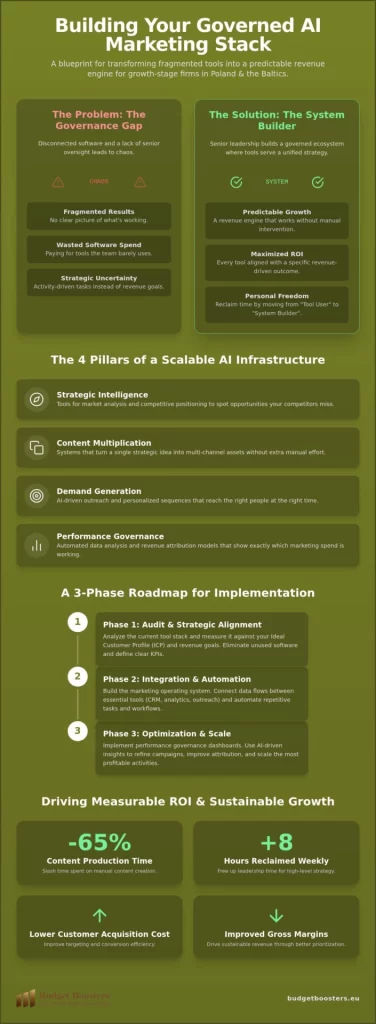
What if you could reclaim eight hours of your work week while simultaneously increasing your marketing output? Many growth-oriented leaders in Poland and the Baltics currently feel buried under a mountain of disconnected software subscriptions. You’ve likely invested in various tools hoping for a miracle, yet you’re still facing fragmented results and strategic uncertainty. It’s frustrating to see your budget disappear into an unmanaged AI marketing stack that your team barely uses. You aren’t alone in this struggle; the solution isn’t more tools, but better governance.
This article shows you how to transform those fragmented pieces into a high-performing system that drives predictable revenue growth. We’ll move away from activity-driven chaos toward a structured blueprint that empowers your team and secures your investments. You’ll discover how senior leadership acts as a system builder to lower Customer Acquisition Costs and slash content production time by up to 65 percent. We’re going to explore the exact framework needed to turn your marketing into a streamlined, AI-enhanced engine that delivers consistent results and personal freedom.
Key Takeaways
- Learn why specialized AI agents are replacing all-in-one platforms as the foundation of modern marketing ecosystems.
- Identify the four essential pillars needed to build a governed AI marketing stack that scales with your business goals.
- Understand how senior marketing leadership prevents strategic bottlenecks and closes the governance gap that often leads to wasted software spend.
- Follow a proven 3-phase roadmap to transition from fragmented, activity-driven marketing to a predictable growth engine.
- Discover how to improve gross margins and drive sustainable revenue through better segment prioritization and systemized execution.
Defining the AI Marketing Stack in 2026
Imagine your marketing tools actually talking to each other. In 2026, an AI marketing stack isn’t just a collection of separate logins. It’s a living ecosystem of software that uses machine learning to automate execution. By Defining the AI Marketing Stack as a curated ecosystem of machine learning tools, we see how automation transforms execution into a competitive advantage. You’ve likely felt the weight of too many subscriptions. That ends when you stop being a “Tool User” and become a “System Builder” of your own marketing engine.
Control isn’t a burden. It’s the path to your personal freedom. A true Marketing Operating System acts as the foundation for your growth. It ensures every piece of technology you buy actually talks to your strategy. Without this grounding, you’re just buying expensive digital paperweights. The goal is to build a structure where data flows seamlessly. This allows you to make decisions based on facts rather than gut feelings. It’s about creating a predictable revenue stream that doesn’t require your constant, manual intervention.
The Evolution from Legacy Tools to Adaptive Agents
The days of static content calendars are over. We’ve moved past siloed data workflows where your email tool doesn’t know what your CRM is doing. In 2026, the focus has shifted from “all-in-one” platforms to specialized, integrated AI agents. These agents don’t just wait for instructions; they handle real-time engagement at scale. They learn from customer behavior and adjust your messaging instantly. This shift from manual guesswork to predictive performance optimization means your team spends less time on repetitive tasks and more time on high-level strategy. It’s a necessary level up for any growth-oriented organization; for those seeking a partner to navigate this complexity, Media BrAIns – We think, we create and you grow offers a unique blend of creativity and AI-driven growth strategies.
It’s easy to fall for “shiny object syndrome.” You see a new tool and think it’s the magic bullet. But tools fail without senior oversight. For growth-stage firms in Poland and the Baltics, alignment is everything. Your AI marketing stack must align perfectly with your Ideal Customer Profile (ICP). Every tool should serve a specific revenue-driven outcome. Are you trying to lower your Customer Acquisition Cost? Or are you looking for 7 Practical Ways to Streamline Content Creation with AI?
If you don’t have a framework, you’re wasting budget. Our Fractional CMO Landscape Research 2026 shows that SMEs are increasingly shifting toward senior, part-time leadership to manage this complexity. A strategic approach ensures your investment builds a predictable growth engine rather than a pile of unused software. You deserve a system that works as hard as you do.
The 4 Pillars of a Scalable AI Infrastructure
A high-performing AI marketing stack rests on four foundational pillars. These aren’t just software categories. They are the structural supports for your entire revenue engine. Using these pillars correctly allows you to stop guessing and start growing with confidence. AI’s role in marketing decision-making is to remove the fog of uncertainty. It empowers you to lead with facts rather than intuition. These pillars include:
- Strategic Intelligence: Tools that handle market analysis and competitive positioning to help you spot gaps your competitors miss.
- Content Multiplication: Systems that turn a single strategic idea into multi-channel assets without extra manual effort.
- Demand Generation: AI-driven outreach and personalized email sequences that reach the right people at the right time.
- Performance Governance: Automated data analysis and revenue attribution models that show you exactly which euro is working for you.
By focusing on these four areas, you move away from vanity metrics. You start focusing on what actually impacts your bottom line. It’s about building a house that won’t fall down when you decide to add a second floor to your business. To ensure this structural integrity across your entire enterprise, executive advisory services like techaxisadvisors.com can help align your technology and AI initiatives with long-term business strategy.
Content Multiplication and Brand Voice Preservation
When implementing the demand generation pillar, many firms turn to specialized providers like The Fraction to deploy automated lead generation systems that consistently fill the sales pipeline.
Content is your most valuable asset, but creating it shouldn’t be a full-time job for your entire team. You can use systems to turn a single strategic idea into multi-channel assets. We suggest the “Bullet-to-Prose Method.” You provide the raw insights in simple points, and the AI handles the formatting and expansion. To avoid sounding like a robot, you must use a Custom AI Content Style Guide. This preserves your unique brand voice across all platforms. By adopting AI-enhanced content workflows, businesses often reduce production time by up to 65%. It’s an exciting way to stay visible and authoritative without burning out your staff.
Data-Driven Outreach and Lead Generation
How do you find the right buyers in Poland and the Baltics? You look for “intent signals.” AI tools can now identify when a company is researching solutions exactly like yours. Once you have this data, you can trigger personalized email sequence automation. These aren’t cold, robotic blasts. They are highly relevant messages that drive open rates between 30% and 38%. This precision is powerful. It allows you to reduce Customer Acquisition Cost (CAC) by approximately 18% because you aren’t wasting budget on uninterested leads. You’re building a predictable growth engine that feels personal to every prospect. If you’re looking to maximize these results, focusing on improving content ROI is a great next step for your system.
Many CEOs in Poland and the Baltics find themselves acting as the default marketing decision-maker. This creates a massive strategic bottleneck. You’re trying to grow your business, but you’re stuck approving social media posts or choosing which tool to add to your AI marketing stack. It’s an exhausting way to work. It often leads to “shiny object syndrome” where tools are bought but never fully utilized. Junior hires or generalist agencies often lack the senior-level experience to integrate these complex systems. Agencies are often incentivized to sell more services, not necessarily to build a lean, efficient system that you own.
You don’t need a full-time executive to fix this. A senior marketing leader on a full-time basis might require an investment of €200,000. For many growth-stage firms, that’s a heavy burden that limits your agility. A fractional CMO acts as the architect who designs, builds, and governs your system for about €48,000. This isn’t just about saving money; it’s about gaining the strategic oversight needed to turn a collection of tools into a high-performing engine. You gain the freedom to focus on your core business while your marketing operates with professional precision, often utilizing specialists like Sean Brightman to provide the AI roadmapping and leadership necessary for such a transformation.
Growth-stage firms across our region are shifting away from scattered, activity-driven marketing. They are moving toward senior, part-time leadership to manage the rising complexity of data and technology. This transition is essential because tools alone cannot solve strategic problems. Our Fractional CMO Landscape Research 2026 highlights how businesses in the Baltics and Poland are professionalizing their marketing governance. By focusing on alignment and accountability, you ensure that every part of your technology stack serves your long-term goals. It’s a powerful way to regain control and stop wasting budget on unused software.
The Fractional CMO Decision Framework
Choosing the right leadership depends on your current stage and goals. An interim leader might fill a temporary gap during a transition, but a fractional CMO builds the actual foundation for future growth. Senior oversight has a direct, measurable impact on your bottom line. We’ve seen this approach increase qualified lead volume by 40% simply by replacing guesswork with a repeatable, data-driven cadence. You deserve a marketing system that delivers results without requiring you to manage every detail. It’s time to step out of the bottleneck and into a role where you lead with clarity and confidence. If you are seeking strategic guidance to overcome growth obstacles, you can learn more about Top7 and their execution support.
Building an AI marketing stack doesn’t happen overnight. It’s a journey. You need a clear path to avoid getting lost in a forest of tools. We recommend a 90-day sprint to establish initial momentum. This timeframe is short enough to stay focused but long enough to see real results. It’s about taking that first step toward a more organized, successful future. You are building a system that serves you, not the other way around. This roadmap ensures your investment in technology translates into measurable revenue growth in the Polish and Baltic markets.
Phase 1: The Diagnostic and Audit
Before you build, you must look at what you already have. Where are the “leaky buckets” in your funnel? You might find that your current AI marketing stack is actually hindering your growth because it’s disconnected. A thorough marketing diagnostic identifies immediate efficiency gains. It’s not about pointing out mistakes; it’s about finding opportunities for you to shine. You need a solid foundation. This is why establishing a robust senior marketing leadership structure is so vital. You must have clear revenue attribution in place before you even think about adding new software. It’s about replacing guesswork with data-driven clarity.
Phase 2: Building the Content and Demand Engine
Now we get to the exciting part. You’re ready to build. Phase 2 focuses on your Ideal Customer Profile (ICP) and Go-to-Market sequencing. You’ll implement The Content System to streamline your production workflows. This involves setting up an Idea Bank where your best thoughts are stored and ready for use. By automating production workflows, your team can focus on high-value creative work. We ensure the technology aligns with your sales team’s needs. This alignment is what leads to higher conversion rates and a more harmonious work environment for everyone involved.
Phase 3 is all about scaling and optimization. Once the core is stable, you can introduce advanced automation and predictive analytics. You’ve already built the engine; now you’re just fine-tuning it for maximum performance. You’ll move from simple sequences to complex, personalized journeys that speak directly to your audience. The goal is a predictable growth engine that gives you back your time and peace of mind. Want to stay ahead of these trends? Subscribe to our Budget Boosters Newsletter for practical insights on demand generation and marketing technology. You’ll also receive our free ebook, The CMO Edge. Why Companies with Senior Marketing Leadership Outperform – and How to Get There (a €29 value), to help you make better strategic decisions. Ready to see how this works in practice? Check out our CMO in Action case study to see how a structured system turns activity into deals.
Driving Measurable ROI and Sustainable Growth
Real results aren’t an accident. They’re the product of a well-governed system. We’ve seen industrial clients in Poland and the Baltics transform their results by simply restructuring their oversight. One firm moved from €4.9 M to €5.9 M in annual revenue after implementing a governed AI marketing stack. This growth wasn’t because they bought more tools. It was because they prioritized the right segments and improved their gross margins through better targeting. You can achieve this same level of control and success. It’s about moving away from exhausting seasonal campaigns toward a predictable growth engine that works around the clock. You deserve a system that delivers peace of mind alongside profit.
Measuring What Matters in an AI-Driven World
Don’t get distracted by likes or shares. In an AI-driven world, you must move beyond vanity metrics. You need to focus on improving content ROI and tracking what truly moves the needle. Are your leads qualified? Is your Customer Acquisition Cost (CAC) dropping? Senior leadership uses data to make faster, better business decisions that align marketing with sales. This alignment is the secret sauce for sustainable growth. When your data is clean and your tools are integrated, you stop guessing and start leading with professional confidence. It’s a powerful shift that puts you back in the driver’s seat of your business.
The Future of Marketing Leadership: The CMO Edge
The complexity of modern technology requires a System Builder mindset. Our research shows that companies in our region with senior marketing leadership consistently outperform those without it. You don’t have to navigate this journey alone. We invite you to subscribe to the Budget Boosters Newsletter. It’s designed to help you stay ahead of regional trends in demand generation and marketing technology. When you join, you’ll receive our free ebook incentive, The CMO Edge. Why Companies with Senior Marketing Leadership Outperform – and How to Get There (a €29 value). This framework is your map to building a sophisticated, efficient marketing management system that delivers long-term, sustainable growth. It’s time to stop chasing activity and start building your legacy.
Step into Your Role as a Strategic Architect
Building a high-performing AI marketing stack isn’t about collecting the latest software. It’s about designing a system that works while you sleep. You’ve seen how senior leadership closes the governance gap and turns fragmented tools into a revenue engine. With the right roadmap, you can save up to eight hours per week on content production and focus on what you truly love. We’ve seen this approach increase qualified lead volume by 40% for companies like People Element. You have the power to move beyond seasonal guesswork and build something sustainable.
Our founder, Aurimas Guoga, brings over 12 years of senior leadership experience to help you navigate this transition. You don’t have to figure it all out alone. It’s time to stop being a tool user and start being a system builder. Take the next step in your growth journey today. Download the Fractional CMO Landscape Research 2026 to see how senior leadership transforms growth across Poland and the Baltics. You’re closer to a predictable, efficient marketing machine than you think. Let’s make it happen together.
Frequently Asked Questions
What is an AI marketing stack?
An AI marketing stack is an integrated ecosystem of software tools that use machine learning to automate and optimize your marketing tasks. Instead of manual data entry or guesswork, these tools talk to each other to handle execution and analysis. It is the engine that powers your growth. You can move from fragmented activity to a governed system that delivers predictable results and frees up your time.
How much does it cost to build a marketing system for an SME?
The total investment depends on your current infrastructure and growth goals. While we don’t quote specific service fees, industry professionals find that a structured system prevents wasted budget on unused software. By auditing your current setup, you can often identify significant potential savings from redundant tools. A well-designed system pays for itself by lowering your Customer Acquisition Cost and increasing overall team efficiency.
Do I need a full-time CMO to manage my AI tools?
You don’t necessarily need a full-time executive to manage a modern AI marketing stack. Many growth-stage firms find that a fractional CMO provides the necessary senior oversight at a fraction of the traditional cost. This “system builder” approach gives you the strategic leadership you need without the overhead of a full-time hire. It is a smart way to professionalize your marketing while maintaining financial agility.
How can AI help with content creation without losing our brand voice?
AI helps by handling the heavy lifting of production through methods like the “Bullet-to-Prose” workflow. You provide the raw, authentic insights, and the AI expands them based on your Custom AI Content Style Guide. This ensures your unique voice stays intact while cutting production time by up to 65%. It is about using technology to amplify your human expertise, not to replace it with generic messaging.
What is the difference between a fractional CMO and a marketing agency?
A fractional CMO acts as an internal leader and system architect, while an agency typically focuses on hands-on execution of specific tasks. Agencies often sell specific services; a fractional CMO builds the governance and strategy that makes those services actually work. This senior leader aligns marketing with your sales goals and holds all partners accountable. It is the difference between buying a campaign and building a permanent growth engine.
How long does it take to see ROI from an AI-enhanced marketing system?
Most businesses see initial efficiency gains within the first 90 days of a strategic sprint. You will likely notice reduced production times and better data clarity almost immediately. Measurable revenue growth and lower Customer Acquisition Costs typically follow as the system matures and your demand generation becomes more precise. It is a journey from initial diagnostic to a fully optimized, predictable revenue stream that scales with your ambition.
Is the fractional CMO model popular in Poland and the Baltics?
The model is rapidly gaining traction as SMEs in Poland and the Baltics look for sophisticated marketing management. Growth-stage firms are shifting away from junior hires and fragmented agencies toward part-time, senior leadership. While some businesses still find success by partnering with a digital marketing agency Berlin for specialized execution, the overall trend is driven by the rising complexity of data and the need for better technology governance. It is an exciting time for regional leaders to adopt these global best practices for local success.

Article by
Aurimas Guoga
Aurimas Guoga is a fractional CMO and founder of Budget Boosters, helping B2B companies turn fragmented marketing into a predictable growth engine. With over a decade of experience leading marketing strategy, he works with business leaders to improve ROI, build scalable systems, and drive measurable revenue growth. Aurimas is also the author of The CMO Edge, a guide for companies looking to gain a competitive advantage through senior marketing leadership.