What if your company doesn’t need another software subscription, but a true architectural upgrade? Too many leadership teams find themselves trapped in a cycle of disjointed campaigns, watching expensive tools produce vanity metrics while pipeline growth stalls. If you’re exhausted from acting as the default marketing firefighter while internal teams and external agencies pull in opposite directions, take a breath. Establishing a structured marketing operating system is how you turn chaotic marketing into a calm, repeatable engine for commercial growth.
You already know that creative effort without strategic coordination simply drains your capital and focus. Gaining control over your growth isn’t a rigid chore; it’s the fastest path to clarity and leadership freedom. In this guide, you’ll discover how to replace fragmented marketing tactics with a unified operating system that aligns strategy, accountability, and revenue. We’ll unpack the six-part framework that establishes predictable customer acquisition costs, disciplines your budget governance, and brings absolute alignment across leadership, internal team members, and agency partners.
Key Takeaways
- Understand why software subscriptions alone fail and how a documented marketing operating system creates structured, repeatable commercial governance.
- Discover the six structural pillars that unite customer profiling, go-to-market sequencing, and financial discipline into a unified growth engine.
- Learn how to distinguish tactical tool stacks from operating architecture to eliminate software bloat and vanity reporting.
- Follow a phased 90-day implementation roadmap designed to audit data hygiene, calibrate spend, and establish operational momentum.
- Explore executive governance models that free CEOs from tactical firefighting by placing senior system builders in charge of marketing accountability.
What Is a Marketing Operating System and Why Software Stacks Fail?
Many leadership teams believe their growth bottlenecks stem from a shortage of modern tools. They purchase new analytics platforms, sign up for AI copywriting assistants, and hire specialized agencies. Yet revenue remains erratic. A marketing operating system is not another software dashboard or an automated script; it is an integrated commercial governance structure that unites strategy, financial discipline, and team accountability. While tools execute individual tasks, an operating system dictates how decisions happen, how resources flow, and how activities tie directly to pipeline generation.
Accumulating software without operational architecture only accelerates internal confusion. When disparate applications multiply, each team tracks separate numbers, leading to conflicting reports and stalled execution. To explore how systemic operations redefine how high-growth organizations scale, watch this breakdown on building structured business engines:
The Core Definition of an Operating System in Commercial Marketing
At its heart, a marketing operating system sets the cadence, policies, and commercial metrics that guide growth. It differs fundamentally from simple project boards or campaign calendars. A project board tracks deadlines; an operating system defines commercial priorities, validates target audiences, and enforces budget logic. Implementing this disciplined governance creates immense leadership freedom. Founders stop functioning as daily marketing referees, empowering their internal staff and external partners to operate within clear guardrails.
The Tool Trap: Why Software Fails Without Operational Architecture
SaaS platforms cannot fix ambiguous positioning or unclear value propositions. While marketing automation platforms handle distribution smoothly, they cannot determine who your best buyer is or why they should care. Without governance, tech stacks produce fragmented silos, unread dashboards, and rising subscription bills. According to industry research from Business Research Insights in July 2026, companies actively utilize only about 56% of their purchased marketing software features.
When you establish clear architectural frameworks, such as The Content System, every tool serves a documented commercial purpose. This operational clarity eliminates waste, protects capital, and drives down customer acquisition costs across every channel.
The 6 Structural Pillars of an Enterprise Marketing Operating System
A resilient marketing operating system replaces tactical guesswork with an enduring commercial architecture. Rather than relying on isolated campaigns, mid-market organizations build predictable engines across six interdependent pillars:
- Ideal Customer Profile (ICP) Precision: Empirical boundaries separating profitable buyers from high-maintenance distractions.
- Go-to-Market Sequencing: Structured phases aligning message validation with distribution timing.
- Budget Logic: Predictable financial models funding commercial outcomes instead of arbitrary tasks.
- Measurement Discipline: Commercial scorecards connecting channel activities directly to closed pipeline.
- Operational Cadence: Structured review rhythms keeping cross-functional teams synchronized.
- Role Accountability: Unambiguous ownership matrices governing internal talent and external partners.
Strategic Foundations: Customer Precision and Go-to-Market Sequencing
Clear architecture begins with customer clarity. Rather than chasing every inbound inquiry, high-performing firms define their Ideal Customer Profile using actual margin data and sales retention figures. Once identified, go-to-market sequencing validates problem resonance before capital gets deployed across acquisition channels. Mid-market teams often rely on The Ultimate Go-to-Market Strategy Template for SMB Growth in 2026 to structure these rollouts without burning through early working budgets.
Financial and Channel Architecture: Budget Logic and Attribution
Disciplined companies don’t build budgets based on past habits. Marketing allocations typically size between 5% and 10% of gross company revenue targets, directly tied to customer lifetime value and acquisition unit economics. Industry data from mid-year 2026 shows overall enterprise marketing budgets hovering around 7.8% of total revenue. That capital must produce demonstrable commercial pipeline velocity rather than vanity metrics like raw social impressions or unqualified clicks.
Execution Governance: Operational Cadence and Role Accountability
Systems fail when teams run in isolation. A strong marketing operating system institutes mandatory weekly pipeline reviews alongside quarterly strategic retrospectives. This cadence eliminates duplicated effort across in-house staff, freelancers, and external agencies by uniting everyone behind a single operational truth.
When enterprise organizations adopt this structural discipline, commercial performance accelerates rapidly. For instance, manufacturing firm Polmet Solutions expanded revenue from €6.1M to €7.4M while increasing marketing efficiency by 22% through systematic oversight. Similarly, People Element increased qualified leads by 40% after implementing structured governance.
If you want to evaluate your company’s operational maturity across these exact six areas, explore practical executive playbooks like The CMO Edge to see how disciplined systems transform mid-market commercial growth.
Marketing Operating System vs. MarTech Stack: Navigating the Critical Differences
Confusing a software stack with an operational framework is an expensive mistake. A MarTech stack consists of tools your business pays for each month. A marketing operating system, by contrast, represents the architectural blueprint that directs how those utilities generate commercial pipeline. Tools process information and automate delivery; an operating system defines target validation, budget caps, and team accountability. Without that foundational governance layer, adding more applications merely multiplies operational friction.
Deconstructing the Technical Stack: Where Software Belongs
Customer relationship management software, automation engines, and analytics boards belong in the engine room as execution utilities. When organizations lack structural guidance, tool fatigue sets in quickly. Marketing managers spend their working hours exporting conflicting spreadsheets and troubleshooting API syncs rather than closing pipeline gaps. According to a Gartner survey from May 2026, marketing leaders expect AI automation in operational tasks to jump from 16% in 2026 to 36% by 2028. Yet without structured decision rules, automating disorganized workflows only accelerates errors and inflates overhead expenses.
Structural Governance: The True Function of an Operating System
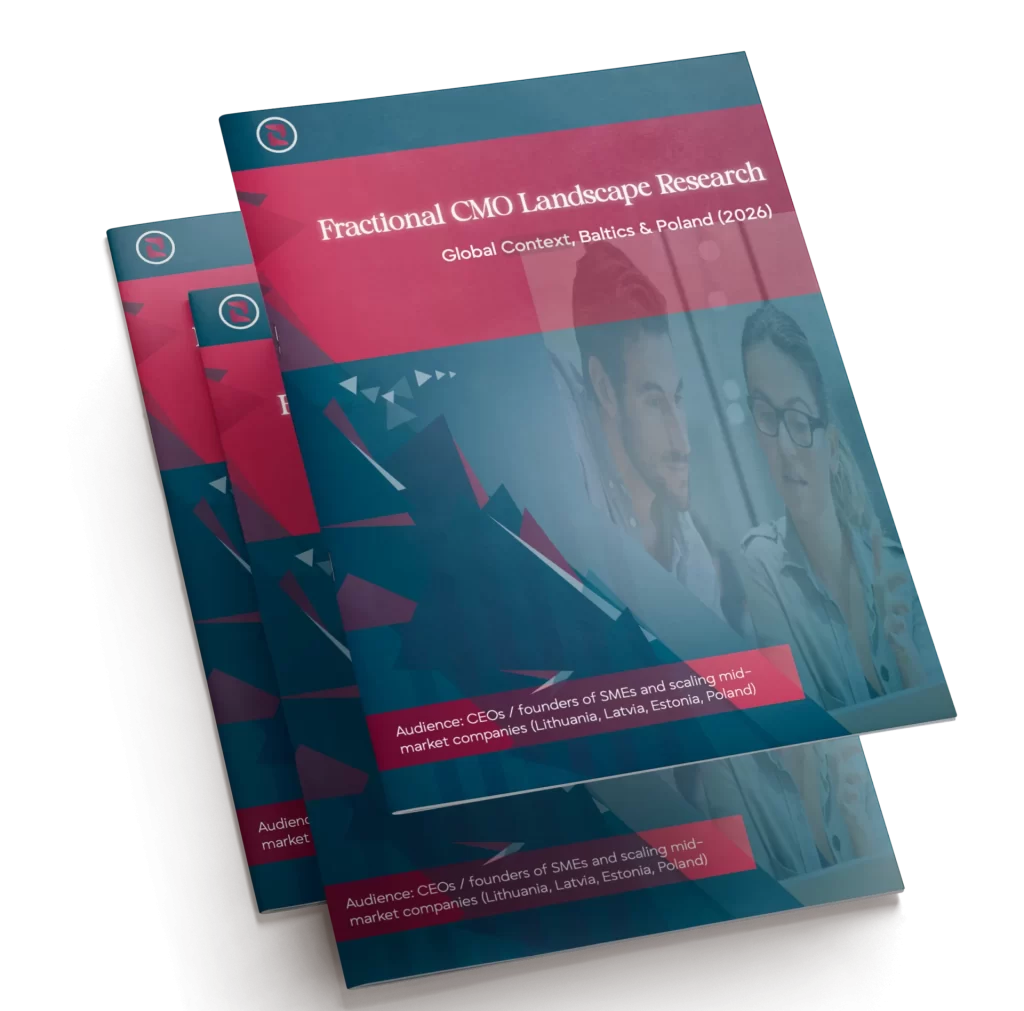
Static dashboards report historical activity, but a true operating system forces forward-looking commercial decisions. It establishes rigorous gates between sales and marketing: defining when a prospect qualifies for outreach, when budget reallocates from paid search to organic channels, and who owns pipeline conversion. This structural shift is transforming mid-market enterprises across Poland and the Baltic countries. As documented in the Fractional CMO Landscape Research 2026, growing enterprises are actively moving away from fragmented agency retainers and isolated point tools, investing instead in senior marketing leadership to build cohesive, revenue-aligned governance frameworks.
Aligning Content and Technology with Structural Standards
Every commercial touchpoint must reflect unified customer positioning. When marketing software operates without clear editorial standards, messaging fractures across email nurture sequences, digital ads, and direct outreach. Integrating a structured engine like The Content System ensures that customer insights translate systematically into compelling material across every distribution channel. Technology should serve documented operational workflows, not dictate them.
How to Implement a Marketing Operating System: A 90-Day Enterprise Roadmap
Installing structural governance does not happen in a 15-minute dashboard setup, nor does it require hiring specialized data scientists. Real transformation requires disciplined execution across distinct operational horizons. Scaling enterprises deploy a progressive 90-day roadmap to build their marketing operating system, taking teams methodically from diagnostic honesty to dynamic commercial momentum.
Days 1–30: The Diagnostic Audit and Baseline Consolidation
You cannot fix what you haven’t measured accurately. The opening month focuses entirely on diagnostic clarity without altering active campaigns prematurely:
- Expenditure & Seat Audits: Catalog every active software subscription, seat license, and agency contract to identify hidden overlap.
- Sales Alignment Interviews: Review pipeline quality directly with commercial sales leaders to uncover why generated leads stall before closing.
- Attribution Hygiene: Establish verified conversion baselines across historical deals, stripping out speculative vanity metrics.
Days 31–60: System Architecture and Workflow Standardization
With diagnostic benchmarks in hand, month two translates strategic priorities into documented operating rules. Leadership codifies Ideal Customer Profile boundaries and go-to-market milestones across the entire organization. Team responsibilities are restructured to balance internal strengths with outsourced execution, applying the modern organizational frameworks outlined in Building a High-Performance Marketing Team Structure. Weekly syncs shift away from open-ended brainstorming to structured exception reporting focused strictly on conversion bottlenecks.
Days 61–90: Full Operational Launch and Dynamic Calibration
The final phase puts governed workflows into live commercial motion. Go-to-market programs launch through standardized approval paths and shared commercial scorecards. Leadership monitors early efficiency indicators closely: qualified deal velocity, cost per acquisition, and pipeline contribution ratios. Budgets adjust dynamically toward high-performing segments while underperforming initiatives receive swift operational correction.
Building this operational foundation gives executive teams permanent control over their growth trajectory. If you’re ready to diagnose your current operational gaps and build an accountable commercial framework, book a comprehensive Marketing Diagnostic & Audit to begin your 90-day transformation.
Operating the System: Leadership Models and Executive Governance
Even the most sophisticated frameworks collapse without clear operational ownership. Who actually directs the system once it’s built? Many mid-market companies struggle because they expect tactical coordinators to architect enterprise governance. A high-performing marketing operating system requires seasoned commercial leadership to steer budget allocations, align department heads, and maintain operational discipline over time.
The Leadership Deficit: Why Tactical Marketers Cannot Build Systems
Tactical specialists excel at producing creative deliverables, running campaigns, and managing social channels. However, designing commercial architecture requires executive experience in financial governance, pipeline attribution, and cross-functional sales integration. When companies delegate system architecture to junior generalists or creative agencies, strategic alignment quickly evaporates. External agencies prioritize billable deliverables, while junior talent focuses on task completion. This leadership vacuum forces the chief executive back into the role of daily marketing manager, wasting valuable executive energy on tactical troubleshooting.
Fractional Executive Leadership: Strategic Governance Without Headcount Bloat
Mid-market organizations rarely require a full-time, six-figure executive package to maintain disciplined oversight. Instead, forward-thinking enterprises deploy fractional CMOs as dedicated system builders. An experienced fractional executive designs the operational pillars, establishes commercial reporting rhythms, and aligns external agency partners with internal sales targets. They deliver senior strategic direction for the exact cadence the business needs. You can explore how growing firms implement this flexible model in Marketing Leadership for SMBs: How to Scale Without a Full-Time CMO in 2026.
Continuous Improvement and Executive Enablement
Operational governance isn’t a one-time project; it demands quarterly audits to keep messaging sharp and resources focused on high-yielding channels. The executive methodologies detailed in The CMO Edge demonstrate how strategic leadership drives compounding enterprise value by treating marketing as an interconnected commercial engine.
Ready to master scalable marketing systems across Poland and the Baltic region? Subscribe to the Budget Boosters Newsletter for actionable frameworks on demand generation, marketing technology governance, and go-to-market execution. When you join, you will receive your free copy of “The CMO Edge. Why Companies with Senior Marketing Leadership Outperform – and How to Get There” (a €29 value).
Step Into Strategic Clarity: Build Your Growth Engine
Moving from chaotic tactics to disciplined governance isn’t just about streamlining marketing tasks; it’s about reclaiming your focus as a leader. When you replace ad-hoc campaigns with an architectural marketing operating system, your entire organization gains clarity. Budgets connect directly to closed revenue, teams operate with clear accountability, and commercial growth shifts from unpredictable guesswork into a steady, reliable rhythm.
Developed by senior marketing leader Aurimas Guoga across 12 years of executive practice, this framework delivers sophisticated leadership while saving scaling enterprises over €150,000 annually compared to full-time executive overhead. Sustainable expansion happens when your positioning, attribution models, and operational rhythms operate in complete harmony.
You don’t have to navigate this operational shift alone. Take the next step toward confident governance: Download the Fractional CMO Landscape Research 2026 Report to discover how scaling companies across Poland and the Baltics are mastering systematic commercial leadership.
Frequently Asked Questions
What is the difference between a marketing operating system and a CRM?
A CRM is an execution database that stores contact records, sales pipelines, and deal stages. In contrast, a marketing operating system is the strategic decision framework that governs how your business uses that data. It defines ideal buyer criteria, spending thresholds, and operational cadences. While your CRM records customer interactions, the operating system dictates commercial priorities, messaging consistency, and cross-functional accountability across your entire revenue team.
How much does it cost to implement a marketing operating system for a mid-market company?
Implementation costs depend on whether leadership builds the framework internally or partners with senior fractional leadership. Mid-market companies typically invest 5% to 10% of gross company revenue targets into their total marketing operations. Rather than incurring full-time C-suite overhead exceeding €250,000 annually, organizations often retain a fractional CMO between €60,000 and €120,000 per year. This embeds an experienced system builder without bloating executive payroll.
Can an existing internal marketing team build a marketing operating system without external help?
Internal teams can build an operating system, but they often struggle with cross-departmental authority and commercial architecture. Tactical marketers usually specialize in content creation, campaign design, or digital channels rather than enterprise governance. Without senior guidance, internal initiatives frequently devolve into task checklists rather than revenue-aligned systems. Partnering with an experienced fractional leader provides the objective perspective and structural discipline needed to align marketing with executive sales targets.
How long does it take to see measurable revenue improvements after deploying an operating system?
Most companies observe operational clarity and cost reductions within the first 30 to 60 days of their implementation roadmap. Measurable revenue improvements, such as shortened sales cycles and improved pipeline conversion, typically emerge between 90 and 180 days. Because commercial deal cycles require time to mature, initial gains appear as improved lead qualification and disciplined ad spend, followed by predictable pipeline growth and reduced customer acquisition costs.
Is a marketing operating system suitable for companies with under €2M in annual revenue?
Yes, especially for owner-led firms seeking to escape random marketing activities. While enterprises require complex governance layers, smaller companies benefit tremendously from basic structural cadences, clear audience definitions, and disciplined budget allocations. Establishing these operational guardrails early prevents expensive software bloat, stops founders from micromanaging daily campaigns, and creates a repeatable foundation that makes scaling toward €5M or €10M significantly smoother.
What specific metrics indicate that a company’s marketing operating system is functioning properly?
A healthy marketing operating system reveals itself through commercial predictability rather than vanity impressions. Key operational indicators include lower customer acquisition costs, accelerating pipeline velocity, and a higher ratio of qualified sales opportunities. Beyond revenue metrics, internal alignment serves as a vital signal: marketing and sales teams operate from shared definitions, campaign budgets follow strict return logic, and leadership reviews focus on solving strategic bottlenecks.
How does a fractional CMO differ from an external marketing agency when operating this system?
Marketing agencies focus on specialized task execution, such as paid advertising, graphic design, or content creation. A fractional CMO acts as your internal commercial architect. Instead of selling billable hours or creative packages, they sit on your executive leadership team to design strategy, govern budgets, and manage vendor performance. They ensure external agencies, internal staff, and sales teams execute in harmony under one documented system.

Article by
Aurimas Guoga
Aurimas Guoga is a fractional CMO and founder of Budget Boosters, helping B2B companies turn fragmented marketing into a predictable growth engine. With over a decade of experience leading marketing strategy, he works with business leaders to improve ROI, build scalable systems, and drive measurable revenue growth. Aurimas is also the author of The CMO Edge, a guide for companies looking to gain a competitive advantage through senior marketing leadership.