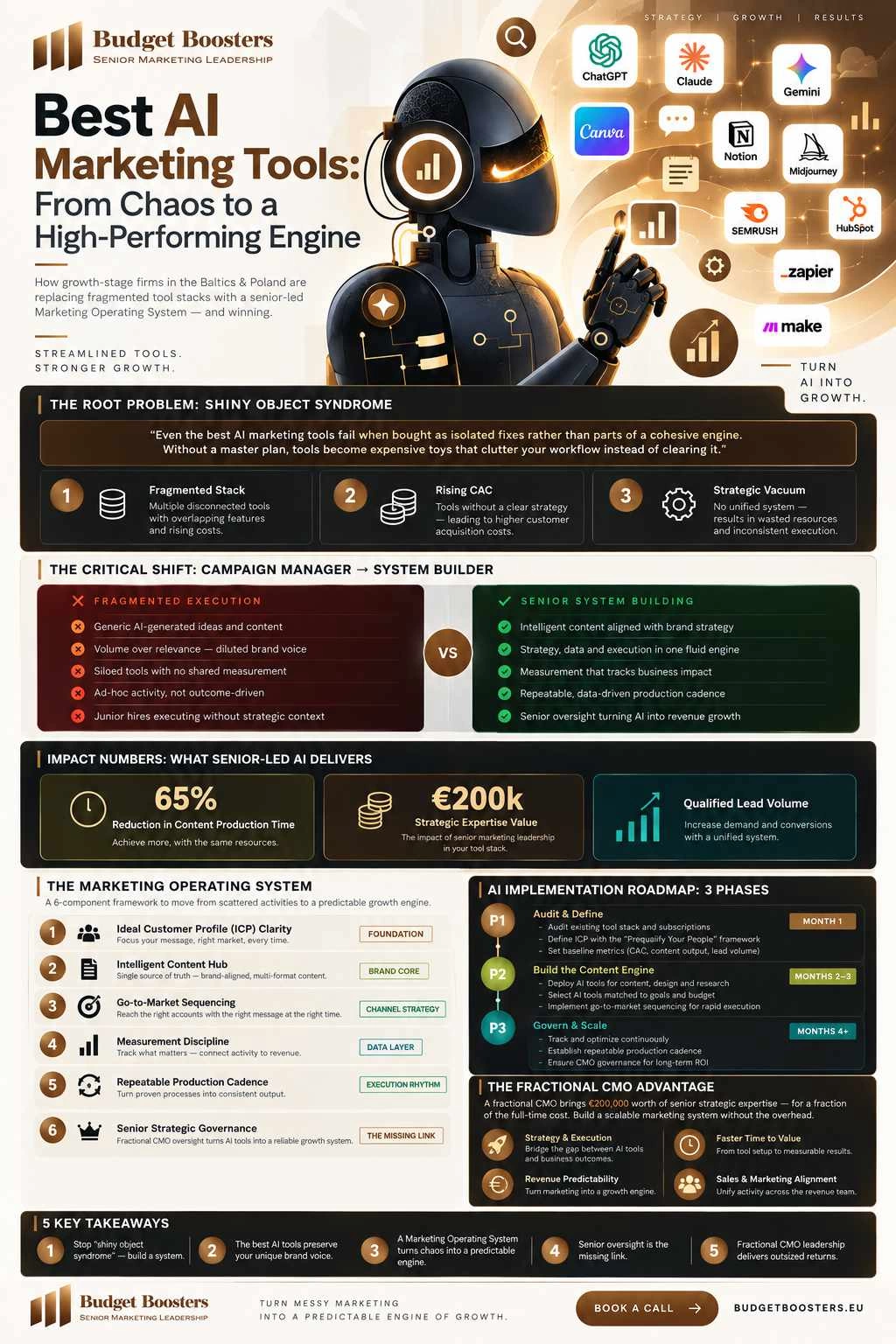
What if the biggest drain on your budget isn’t the software you buy, but the strategic vacuum it falls into? Many leaders struggle with shiny object syndrome, collecting apps that never actually connect to their sales goals. It’s frustrating to manage fragmented activities that don’t lead to predictable growth. You deserve a system that works for you, not the other way around. By selecting the best AI marketing tools and pairing them with senior oversight, you can finally turn your marketing into a high-performing engine.
In this guide, you’ll discover how to stop the chaos and start scaling your operations. We’ll show you how a strategic architect can reduce content production time by up to 65% while increasing qualified lead volume. It’s about moving from execution to governance. We’ll explore how growth-stage firms in the Baltics and Poland are trading junior execution for senior systems to build something truly sustainable. Let’s dive into the tools and frameworks that will redefine your growth and give you back your personal freedom.
Key Takeaways
- Stop the “shiny object syndrome” by shifting from fragmented tool adoption to a structured growth engine that links marketing directly to sales outcomes.
- Identify the best AI marketing tools for 2026 that preserve your unique brand voice while cutting content production time by up to 65%.
- Learn how to implement a Marketing Operating System that integrates strategy, data, and execution into one centralized, high-performing engine.
- Discover why senior oversight is the missing link in AI implementation, transforming tactical shortcuts into a predictable revenue generator.
- Understand the financial advantage of fractional leadership, bringing €250,000 of strategic expertise to your firm for a fraction of the cost.
Have you ever looked at your company’s monthly credit card statement and felt a pang of guilt? You see subscriptions for three different writing assistants, a video generator, and an “all-in-one” platform that no one has logged into since March. You aren’t alone. This “Shiny Object Syndrome” is a common hurdle for growth-stage firms. Even the best AI marketing tools fail when they’re bought as isolated fixes rather than parts of a cohesive engine. Without a master plan, these tools become expensive toys that clutter your workflow instead of clearing it.
The real cost isn’t just the subscription fee; it’s the strategic uncertainty. When a CEO acts as the default marketing decision-maker, they carry a heavy psychological burden. They’re forced to guess which technology will drive revenue. This guesswork leads to fragmented activities that never quite link up with sales. You deserve the freedom to focus on your vision while a professional architect builds the systems that power your growth. Moving from guesswork to a data-driven system isn’t just a business move; it’s an exciting path toward personal freedom and control.
The Trap of Activity-Driven Marketing
Many teams use AI simply to do “more.” They pump out generic blog posts and social updates, hoping volume will solve their lead generation problems. This approach often backfires. It dilutes your brand voice and makes you sound like everyone else. There’s a massive difference between a campaign manager who clicks buttons and a system builder who creates a scalable content engine. When you choose tools based on hype rather than fit, your Customer Acquisition Cost (CAC) inevitably rises because you’re paying for reach without relevance. Our Fractional CMO Landscape Research 2026 shows that firms in Poland and the Baltics are moving away from fragmented execution. They’re looking for leaders who prioritize governance over simple activity.
The Need for Financial Discipline in Marketing
Scaling requires you to treat your tech stack as a governed investment. It isn’t just about spending money; it’s about allocating resources where they generate the highest ROI. A data-driven roadmap helps you eliminate waste by identifying exactly which tools support your 5% to 10% revenue budget logic. If you want to see how to align these systems properly, check out our guide on 7 Practical Ways to Streamline Content Creation with AI. By shifting from tactical costs to strategic investments, you gain the control needed for a predictable future. This financial discipline ensures that every tool in your belt actually helps you build your growth engine.
The 2026 Marketing Operating System: Categorising AI by Impact
Imagine your marketing as a high-performance engine. It’s not just a collection of parts; it’s how they work together that creates speed and reliability. The 2026 Marketing Operating System is a six-component framework designed to integrate your strategy, data, and execution into one fluid motion. Many firms treat the best AI marketing tools as standalone patches for specific problems. This often creates a messy “Frankenstein” stack that’s hard to manage. Instead, you need a centralized system to manage your content lifecycle and move from scattered activities to a repeatable, data-driven cadence.
An intelligent content hub unifies your brand and product messaging. It acts as your company’s single source of truth. By feeding your unique insights and past successes into this hub, you ensure that every AI-generated asset remains authentic. This isn’t just about efficiency; it’s about building a predictable growth engine that feels exciting and manageable. A repeatable cadence transforms marketing from a series of stressful “fire drills” into a rhythmic production line. This rhythm gives your team confidence and your audience a reason to stay engaged.
The Six Components of a Predictable Growth Engine
A successful system starts with clarity. First, you need a clear Ideal Customer Profile (ICP). We use the “Pinpoint Your People” framework to ensure you’re talking to the right crowd with the right message. Then comes go-to-market sequencing. This means choosing the right channels for rapid entry rather than trying to be everywhere at once. Finally, measurement discipline is vital. We track qualified-lead volume and gross margin to ensure your growth is profitable and sustainable. Do you know which activities are actually driving your revenue right now? If you’re unsure, a Marketing Diagnostic & Audit can highlight exactly where to start your transformation.
AI as a Personal Content Assistant
Once the framework is set, AI becomes your most powerful ally. It fits perfectly into your Idea Bank, Content Calendar, and Production Workflow. We use a “Content Multiplication System” to scale your message across platforms without adding more headcount. This allows you to cut production time while maintaining high quality. It’s about working smarter, not harder. To see how this looks in practice, explore The Content System. It’s a blueprint for turning one great idea into a month of high-performing assets. By organizing your tech this way, you remove the strategic uncertainty that keeps many CEOs awake at night and clear the path toward your personal freedom.
Top-Tier AI Marketing Software for Scaling SMEs in 2026
How do you choose from the thousands of apps flooding your feed? It’s easy to get overwhelmed. To build a system that lasts, you must evaluate the best AI marketing tools based on three pillars: ROI, ease of integration, and brand voice preservation. Features are secondary to how well a tool talks to your existing sales data. For leaders in Poland and the Baltics, the goal isn’t just to own the latest tech; it’s to own the market. You need a modular stack that grows with you, rather than a rigid platform that locks you in.
Content Creation and Multiplication Tools
LLMs are no longer just for basic drafting. We recommend moving toward the “Bullet-to-Prose Method.” This involves feeding your unique, raw insights into an LLM to generate high-quality, authentic articles. It ensures your expertise stays at the center. To handle the technical heavy lifting, tools like Descript for video and Zapier for workflow automation are essential. They act as the connective tissue in your production line. When these are managed correctly, you can cut production time by up to 65%. If you want a head start, our guide on 7 Practical Ways to Streamline Content Creation with AI provides the exact prompts we use to keep quality high.
Data Analysis and Sales Alignment Software
The bridge between marketing and sales is often where growth stalls. AI-driven CRM enhancements now allow you to track qualified-lead volume with surgical precision. By analyzing patterns in your data, these tools help reduce your Customer Acquisition Cost (CAC) and can improve conversion rates by up to 23%. This isn’t magic; it’s just better math. Aligning your tech stack with your sales goals ensures that every euro spent is an investment in your future. For a deeper look at making your content more profitable, explore our resource on Improving Content ROI.
Building this engine is a journey, and you don’t have to walk it alone. We invite you to subscribe to the Budget Boosters Newsletter. It’s packed with practical insights and simple frameworks designed for firms in the Baltics and Poland. You’ll learn how to treat marketing as a system that integrates strategy and data. Plus, you’ll receive our free ebook, “The CMO Edge. Why Companies with Senior Marketing Leadership Outperform – and How to Get There” (a €29 value). We also recommend downloading our Fractional CMO Landscape Research 2026. It explores how regional SMEs are shifting away from junior execution toward senior, part-time leadership to manage these very technologies. Take control of your tech stack today and turn it into a predictable growth engine.
Implementation Roadmap: Integrating AI into Your Content Engine
Ready to move from theory to action? Building a content engine isn’t about buying every piece of software on the market. It’s about a disciplined rollout. First, conduct a Marketing Audit. You need to see where your team is currently losing time. Is it in research, drafting, or distribution? Only after identifying these gaps should you look at the best AI marketing tools to fill them. This prevents you from adding more noise to a system that needs clarity.
Next, implement a Custom AI Content Style Guide. This document ensures the AI understands your tone, values, and specific terminology. Then, adopt the 90-Second Outline Formula. By using AI to structure your thoughts based on raw inputs, you can start drafting in record time. Finally, set a measurement cadence. Check your qualified-lead volume weekly. This ensures your new systems actually move the needle and provide a predictable return on your investment. It’s a level-up for your entire operation.
Preserving Brand Voice with AI Shortcuts
Generic output is the enemy of trust. In sophisticated markets, your audience can spot a robotic post from a mile away. You need a Data-Driven Content Framework that positions you as a thought leader. Instead of asking AI to “write a blog post,” use it to refine your unique data and case studies. This approach keeps your brand authentic while using technology as a high-speed shortcut. It’s about empowering your team to produce better work, not just more of it. To see the exact prompts that make this happen, check out our guide on 7 Practical Ways to Streamline Content Creation with AI.
Scaling Through Automation
Automation is where you reclaim your personal freedom. Imagine lifting your email open rates from 3% to 30% by using AI to personalize every message at scale. This isn’t just about volume; it’s about relevance. Our case study on Email Marketing Enhanced by Storytelling shows how a structured system turns cold outreach into warm conversations. By automating these production stages, our clients often reduce production time by 65%. This efficiency allows you to increase output quality without burning out your team. You gain a competitive edge while maintaining a healthy balance. Ready to see where your gaps are? Book a Marketing Diagnostic & Audit to start your roadmap today.
Why a Fractional CMO is Your Best AI Strategy Partner
Tools are only as good as the person directing them. You can buy the best AI marketing tools on the market, but without a master plan, they’ll just sit in your dashboard. Think of the difference between an “Architect” and a “Builder.” A builder knows how to use a hammer; an architect knows how to design a skyscraper. You need senior oversight to ensure your tech stack actually talks to your sales goals. This isn’t just about software. It’s about leadership that ensures your internal teams and external agencies actually adopt these new workflows.
Hiring a full-time marketing director is a massive commitment. In the Baltics and Poland, high-level strategic talent is rare and expensive. Fractional leadership changes the game. You get €250,000 worth of expertise for a manageable investment of €60,000 to €120,000 per year. It’s a smart way to level up without the overhead. This shift is already happening across our region. Growth-stage firms are trading junior execution for senior, part-time systems builders. It’s an exciting path toward a more professional and predictable future.
Governance and Accountability
Stop being the default marketing decision-maker. As a CEO, your time is too valuable to spend on tactical prompts or tool comparisons. A Fractional CMO takes that burden off your shoulders. They build a predictable growth engine that runs on data, not guesswork. This governance ensures every activity is aligned with your revenue targets. To understand how regional leaders are making this shift, dive into our Fractional CMO Landscape Research 2026. It’s time to move from managing chaos to leading a system.
Next Steps for Strategic Growth
You don’t have to build this alone. We invite you to join a community of forward-thinking leaders in Poland and the Baltics by subscribing to the Budget Boosters Newsletter. You’ll get practical insights and simple frameworks delivered straight to your inbox. When you join, you’ll also receive our free ebook, “The CMO Edge. Why Companies with Senior Marketing Leadership Outperform – and How to Get There” (a €29 value). It’s a blueprint for anyone ready to step away from fragmented execution.
Finally, stay ahead of the curve by reading our latest Fractional CMO Landscape Research 2026. This report explores how SMEs are evolving away from agencies and junior hires toward senior accountability. Take the first step toward a more efficient, sophisticated, and profitable marketing management system today. Your path to personal freedom starts with the right strategy partner.
Step into Your Predictable Growth Future
The journey toward a scalable marketing engine is an exciting path to personal freedom. You’ve seen how the best AI marketing tools can transform your operations, but only when they’re guided by senior strategic oversight. By moving from fragmented activities to a structured Marketing Operating System, you eliminate guesswork and build a foundation for long-term success. Our clients in the Baltics and Poland have already seen the impact of this transition, with industrial firms reaching revenue growth of €7.4M.
You don’t have to navigate this technological shift alone. With Chartered-qualified marketing leadership, you can increase your qualified-lead volume by 40% while ensuring your team actually adopts the tools you buy. It’s time to stop the strategic uncertainty and start building a system that works for you. Take the first step toward a more professional and profitable future today.
Request a Marketing Diagnostic to audit your AI readiness and discover how to turn your marketing into a high-performing growth engine. You have the vision; let’s build the system to match it.
Frequently Asked Questions
What are the best AI marketing tools for small business-to-business firms in 2026?
The best AI marketing tools for 2026 focus on modularity and brand preservation. We recommend using advanced LLMs combined with our Bullet-to-Prose method to ensure your unique expertise isn’t lost. For scaling firms, Descript simplifies video production while Zapier acts as the glue for your automated workflows. These tools allow your team to work faster without sacrificing the quality your audience expects from a professional and authoritative brand.
How much does it cost to implement an AI-driven marketing system?
Implementing a high-performing system involves both software subscriptions and strategic leadership. While individual tools might cost a few hundred euros monthly, the real value comes from senior oversight. A fractional leader typically costs between €60,000 and €120,000 per year. This is a significant saving compared to the €250,000 price tag of a full-time executive. It turns your marketing budget into a governed investment that drives predictable revenue growth.
Do I need a full-time CMO to manage our AI tool stack?
Most firms with revenue between €1M and €15M don’t need a full-time executive to manage their technology. A fractional CMO provides the necessary architectural oversight on a part-time basis. They ensure your team adopts the best AI marketing tools correctly without the heavy overhead of a permanent hire. This model gives you the strategic clarity you need while keeping your organizational complexity low and your focus on sustainable growth.
Can AI tools really preserve my company’s unique brand voice?
AI can absolutely mirror your brand if you provide it with the right guardrails. We implement a Custom AI Content Style Guide that teaches the software your specific tone, vocabulary, and values. This prevents the generic, robotic output that often plagues automated content. By using a Data-Driven Content Framework, you can use AI as a high-speed shortcut while keeping your authoritative thought leadership at the center of every single piece.
What is the ROI of using AI for content creation in B2B?
The return on investment is visible in both time saved and revenue generated. Our clients often see content production time cut by up to 65% after integrating AI workflows. Beyond efficiency, a structured system has helped businesses increase their qualified-lead volume by 40%. It’s about doing more with less while improving your gross margin. This shift transforms marketing from a tactical cost into a clear, measurable growth engine for your company.
How does a Fractional CMO help with AI tool selection?
A fractional leader acts as an architect rather than just a builder. They audit your current efficiency gaps and select tools that fit your specific budget logic. Instead of chasing every new app, they focus on ROI and ease of integration. This senior oversight removes the strategic uncertainty from your plate. You gain a professional who manages internal teams and ensures that every piece of software actually serves your long-term goals.
Which AI tools are best for demand generation in the Baltic region?
For firms in Poland and the Baltic states, demand generation thrives on personalized email sequence automation and AI-enhanced CRM data. These tools help you identify and reach your Ideal Customer Profile with surgical precision. By using regional data and a “Pinpoint Your People” framework, you can lift email open rates from 3% to 30%. This systematic approach ensures you aren’t just making noise; you’re building a repeatable cadence that generates warm leads.
Is it better to hire an agency or use AI tools internally?
Agencies often focus on fragmented execution, while building an internal system with AI tools creates long-term independence. With senior, part-time leadership, you can empower your own team to manage high-performing workflows. This approach reduces your reliance on external providers and lowers your Customer Acquisition Cost. It’s about building a Content Engine that stays within your company. You gain full control over your data, your brand, and your path to personal freedom.

Article by
Aurimas Guoga
Aurimas Guoga is a fractional CMO and founder of Budget Boosters, helping B2B companies turn fragmented marketing into a predictable growth engine. With over a decade of experience leading marketing strategy, he works with business leaders to improve ROI, build scalable systems, and drive measurable revenue growth. Aurimas is also the author of The CMO Edge, a guide for companies looking to gain a competitive advantage through senior marketing leadership.