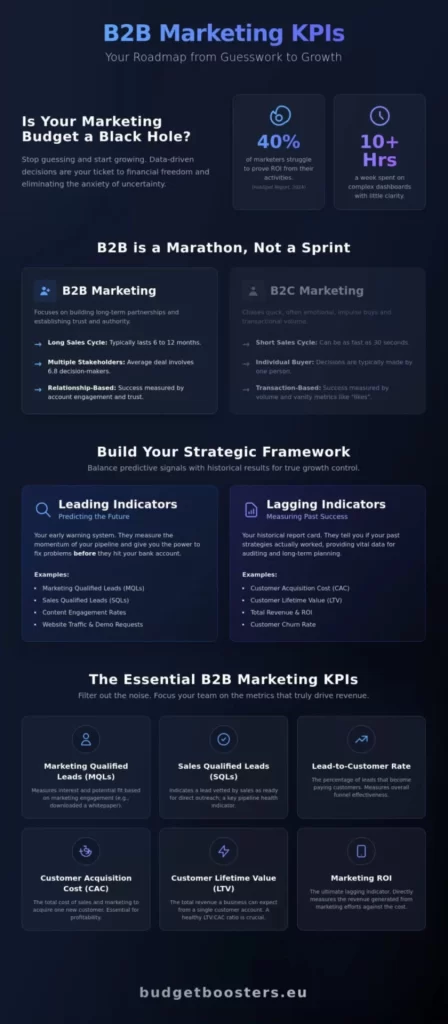

What if your marketing budget wasn’t a black hole, but a precision tool that guaranteed a return? It’s a tough pill to swallow when a 2024 HubSpot report reveals that 40% of marketers still struggle to prove the ROI of their daily activities. You’ve likely spent over 10 hours a week staring at complex dashboards, feeling the weight of 2026 growth targets that seem to drift further away. It’s exhausting to feel like you’re guessing with your hard-earned capital. We understand that frustration because we believe financial control should feel like freedom, not a math test. You deserve to know exactly which b2b marketing kpis are moving the needle for your business.
You probably agree that having more data hasn’t actually led to more clarity. This guide promises to change that. You’ll master the specific metrics that matter for SMB growth and finally eliminate the guesswork from your strategy. We’ve designed a comprehensive checklist to help you align every marketing dollar with actual revenue. We are going to dive into the lead-to-revenue pipeline, customer acquisition costs, and the lifetime value metrics that will give you a clear roadmap to success.
Key Takeaways
Stop guessing and start growing by transforming your marketing data into a clear, empowering roadmap for your business.
Learn to balance hindsight metrics with predictive indicators so you can anticipate growth opportunities before your competitors do.
Master the “Essential 7” b2b marketing kpis that eliminate clutter and focus your team on the actions that truly drive revenue.
Tailor your strategy to your current growth stage, choosing the right metrics to move from a scrappy startup to a confident scale-up.
Explore how a Fractional CMO can build your professional data infrastructure, giving you executive-level clarity without the full-time cost.
What are B2B Marketing KPIs and Why Do They Matter?
Imagine your business as a living, breathing organism. Your b2b marketing kpis act as the vital signs that tell you if you’re thriving or just surviving. For too long, many small business owners relied on “gut feelings” to guide their growth. In 2026, that’s not enough to stay competitive. You deserve the clarity that comes from hard numbers. Moving from intuition to data-driven decision making isn’t a chore; it’s your ticket to freedom. It’s the difference between guessing and knowing exactly where your next client is coming from.
Many people confuse simple metrics with strategic indicators. A metric is just a number, like how many people visited your website yesterday. However, a Key Performance Indicator (KPI) is a quantifiable measure of success against a specific, strategic objective. While metrics track activities, KPIs track progress toward your dreams. They filter out the noise so you can focus on the signals that actually lead to bankable results. By identifying these “vital signs” early, you take back control of your company’s future.
The Antidote to Marketing Anxiety
Stop worrying if your marketing budget is disappearing into a black hole. Data gives you the permission to scale what works and the warning to pivot when something fails. This clarity removes the heavy weight of uncertainty that keeps many founders awake at night. When you see a positive trend in your b2b marketing kpis, you can invest with total confidence. A KPI is a quantifiable measure of success against a strategic objective. It’s your roadmap; it shows you exactly where you are on the path to reaching your 2026 revenue targets.
B2B vs. B2C Metrics: What Changes?
B2B marketing is a marathon, not a sprint. You aren’t chasing impulse buys. You’re building long-term partnerships. While a B2C customer might buy a product in 30 seconds, a B2B sale often involves a cycle lasting 6 to 12 months. Recent industry data shows the average B2B deal now involves 6.8 separate decision-makers. This complexity makes “vanity metrics” like social media likes almost irrelevant. You need to track relationship-based revenue and account engagement instead. Focus on the numbers that reflect trust and authority, as these are the true drivers of B2B growth.
Leading vs. Lagging Indicators: Building Your Strategic Framework
Think of your business like a high-performance engine. If you only look at the fuel gauge after the tank is empty, you’re going to get stranded. In the world of b2b marketing kpis, we call this the difference between leading and lagging indicators. You need both to keep moving forward without hitting a dead end. One tells you where you’ve been; the other tells you where you’re going. Mastering this balance is how you gain true control over your growth.
A healthy B2B strategy requires a delicate balance. Relying only on lagging indicators leads to “revenue shocks” where you realize too late that your pipeline is dry. Relying only on leading indicators creates a “vanity trap” where you have lots of clicks but no cash. You can start by using a marketing diagnostic service to identify which indicators actually move the needle for your specific niche. This clarity is the first step toward financial freedom and total control over your growth journey.
Predicting the Future with Leading Indicators
Leading indicators are your early signals. They tell you what’s coming. When you track Marketing Qualified Leads (MQLs), Sales Qualified Leads (SQLs), or content engagement rates, you’re not just counting numbers. You’re measuring the momentum of your pipeline. High engagement on a technical whitepaper in October often translates to closed deals by January 2026. Data from the 2024 Content Marketing Institute report shows that 78% of successful B2B marketers prioritize these early engagement signals to adjust their tactics in real-time. Leading indicators are the early warning system for your sales pipeline. They give you the power to fix a problem before it hits your bank account. Use these signals to forecast next quarter’s sales with confidence. If your SQL count drops by 15% this month, you don’t wait for the revenue dip. You act now.
Measuring Success with Lagging Indicators
Lagging indicators are the results. These are your “hindsight” metrics like total revenue, Customer Acquisition Cost (CAC), or Customer Lifetime Value (LTV). They tell you if your past strategy actually worked. While these numbers are vital for a historical marketing audit, they can’t change the past. A common mistake is over-reacting to a single month of low ROI. According to Gartner, B2B sales cycles for mid-market companies often last 6 to 12 months. If you panic because last month’s revenue was slightly down, you might scrap a strategy that’s actually about to pay off. Use lagging data to find long-term patterns. It’s about seeing the big picture of your success. Don’t let short-term fluctuations shake your confidence. Instead, use them as lessons to refine your b2b marketing kpis for the next cycle.
Leading: Website traffic, email open rates, MQLs, SQLs.
Lagging: Total revenue, closed-won deals, ROI, LTV.
The Goal: Use leading data to pivot and lagging data to prove.
Are you ready to see what your data is really telling you? Taking a look at your current performance through a professional marketing audit can reveal the gaps in your framework before they become costly mistakes.
The Essential B2B Marketing KPI Checklist
You don’t need a 23-page report to understand your growth. Most SMB owners feel overwhelmed by data, but the secret to scaling isn’t more information. It’s the right information. Tracking a few high-impact b2b marketing kpis gives you the freedom to make decisions with confidence instead of guessing. You’re in control of your numbers, and these seven metrics are your roadmap to a predictable revenue engine.
Top-of-Funnel: Awareness and Interest
This stage is about attracting the right eyes to your business. It’s the start of your relationship with potential partners. Don’t just chase volume; chase fit.
- Marketing Qualified Leads (MQLs): These are people who’ve shown interest and fit your ideal customer profile. Quality matters more than a long list of random emails.
How to calculate: Total number of leads that meet your specific “ready-to-engage” criteria.
- Cost Per Lead (CPL): This tells you if your lead generation is sustainable. HubSpot’s 2024 industry data shows the average B2B CPL sits around $198, so use that as your first benchmark.
How to calculate: Total Marketing Spend / Total Leads Generated.
- Website Conversion Rate: Is your digital storefront actually working? A 2.35% conversion rate is a solid baseline for B2B sites, according to WordStream data.
How to calculate: (Total Conversions / Total Unique Visitors) * 100.
Bottom-of-Funnel: Revenue and Retention
Now we look at the money. These b2b marketing kpis show how efficiently your marketing efforts turn into actual cash flow and long-term stability.
- Sales Qualified Leads (SQLs): This is the handshake between marketing and sales. It represents leads vetted and accepted by your sales team as genuine opportunities.
How to calculate: Total leads moved into the “opportunity” stage of your CRM.
- Customer Acquisition Cost (CAC): This is your efficiency pulse. If you spend $5,000 to acquire a client who only brings in $2,000, your model needs a boost.
How to calculate: (Sales Costs + Marketing Costs) / Number of New Customers.
- Customer Lifetime Value (LTV): How much is a client worth over three or five years? High LTV gives you the breathing room to invest more in growth.
How to calculate: Average Sale Value * Number of Repeat Transactions * Average Retention Period.
- Pipeline Velocity: Speed is your competitive advantage. This measures how fast dollars move through your funnel.
How to calculate: (Number of Opportunities * Deal Value * Win Rate) / Sales Cycle Length (e.g., 180 days).
Focusing on these seven metrics removes the noise. You’ll stop wondering if your marketing works and start seeing exactly where to turn the dial for more power. It’s about progress, not perfection. Start tracking these today and watch your clarity soar.
Aligning KPIs with Your Business Goals
You might feel like you don’t have time to look at all this data. We hear you. Running an SMB often feels like a sprint where the finish line keeps moving. But tracking your b2b marketing kpis isn’t about adding more work to your plate; it’s about finding the freedom to stop doing what doesn’t work. Data is your roadmap to a more balanced, successful business life. It transforms your marketing from a guessing game into a precise engine for growth.
Your growth stage dictates what you should measure. Startups in their first 24 months should obsess over Lead Velocity Rate. If you aren’t growing your qualified lead pipeline by at least 15% month-over-month, you haven’t found your rhythm yet. Scale-ups, usually those with over $5 million in annual revenue, need to pivot toward the LTV:CAC ratio. A 3:1 ratio is the industry gold standard for sustainable growth according to 2024 SaaS benchmarks. Choosing the right stage-specific metrics ensures you aren’t measuring a marathon runner by their sprinting speed.
Choosing Your “North Star” Metric
Your North Star is the single metric that best captures the core value your company delivers. It keeps your team focused and prevents “metric creep,” which is the dangerous habit of trying to track 50 different things at once. When you track everything, you focus on nothing. For a B2B software firm, the North Star might be Monthly Recurring Revenue (MRR). For a specialized manufacturing plant, it could be the number of high-value RFPs received per quarter. Focus on one major goal to turbocharge your team’s energy and clarity.
Data-Driven Communication for Leaders
CEOs and Board members don’t want a 20-page report; they want a one-page dashboard that shows the direct link between marketing spend and revenue. Use your b2b marketing kpis to justify a budget increase by showing that every $1,000 spent on targeted content last quarter generated $4,200 in the sales pipeline. If the numbers look disappointing, don’t hide them. A 12% drop in conversion rates is simply a prompt for a strategic pivot toward a more effective channel or a sharper message. This transparency builds trust and shows you are a proactive leader rather than a passive observer.
A marketing roadmap keeps these goals visible and actionable. It turns abstract numbers into a concrete plan for the next 12 months. When everyone knows the target, the path to success becomes a shared journey rather than a solo struggle. This alignment ensures that every dollar spent is an investment in your company’s future freedom.
Ready to take control of your growth? Start planning your marketing roadmap today and turn your data into your greatest asset.

Implementing Your KPI System with a Fractional CMO
Building a robust tracking engine for your b2b marketing kpis is rarely about the tools you buy. It’s about the strategy behind them. Many SMBs task junior marketers with setting up dashboards, but this often leads to a collection of vanity metrics that don’t drive revenue. Industry benchmarks suggest that 65% of marketing data remains unused because teams lack the seniority to translate numbers into business decisions. You need more than a spreadsheet; you need a blueprint.
A junior team might tell you how many people clicked an ad. They often struggle to tell you how those clicks impacted your pipeline velocity or customer lifetime value. This gap is where growth stalls. Setting up a system that connects a LinkedIn impression to a closed-won deal in your CRM requires a high-level view of the entire sales funnel. It’s a complex architectural task, not a daily maintenance job.
The Fractional CMO Advantage
An interim leader brings an unbiased, data-driven perspective that’s often missing in internal teams. When you hire a Fractional CMO, you’re not just adding a name to the payroll. You’re gaining 15 to 20 years of strategic experience at a fraction of the cost of a full-time executive. They don’t get bogged down in office politics or “the way we’ve always done it.” Instead, they focus on building the data infrastructure that bridges the gap between marketing spend and sales results.
Unbiased Audits: They identify which channels are actually performing and which are just burning cash.
Cost Efficiency: You get corporate-level expertise without the six-figure executive salary and benefits package.
Alignment: They ensure your sales and marketing teams finally speak the same language.
One of the most critical elements they address is ensuring your value proposition stands out in a crowded market. Often, poor KPI performance stems from messaging that sounds exactly like every competitor. A brand positioning sprint can rapidly clarify your unique market position, which directly impacts conversion rates and pipeline velocity across all your marketing channels.
Your Growth Roadmap Starts Here
At Budget Boosters, we specialize in helping SMBs in the Baltics and Poland gain the clarity they need to scale. We’ve seen that 92% of companies using a structured KPI framework report better departmental alignment within the first six months. We don’t believe in dry, boring math. We believe in the freedom that comes from knowing exactly where your next lead is coming from.
Stop guessing and start growing. The first step isn’t buying a new software subscription; it’s learning how to conduct a marketing audit that reveals which channels are actually driving revenue. We’ll look at your current b2b marketing kpis, find the leaks in your funnel, and hand you a roadmap for 2026. You’ve done the hard work of building a business. Now, let’s build the system that lets it fly. Data isn’t a chore; it’s your ticket to freedom.
Take Control of Your Marketing Success in 2026
You now have the framework to transform your data from a source of stress into a powerful engine for growth. By balancing leading indicators with lagging results, you’ll ensure your team stays focused on what truly moves the needle. Tracking the right b2b marketing kpis is the difference between guessing your way through the year and executing a high-precision strategy. A 2024 study by Gartner highlights that marketing leaders who link metrics directly to business outcomes see 27% higher budget approval rates. You deserve that same level of confidence and clarity in your planning.
Implementing a sophisticated tracking system doesn’t require a massive internal department. Our fractional CMO services provide Baltic and Polish SMBs with corporate-level leadership and data-driven growth roadmaps at a fraction of the cost of a full-time executive. We’re here to act as your strategic mentor, helping you navigate the complexities of the 2026 market with ease and precision. You’ve got the vision; we provide the roadmap to reach it without the typical corporate friction.
Ready to stop guessing? Book your B2B Marketing Audit today
Your journey toward professional freedom and market leadership starts with a single, data-backed step. Let’s make this your most successful year yet.
Frequently Asked Questions
What is the most important B2B marketing KPI for a small business?
Return on Investment (ROI) is the most critical metric because it proves your marketing spend generates actual profit. While 45% of SMBs focus on traffic, ROI ensures your business stays sustainable. Tracking this allows you to see which 2 or 3 channels actually pay the bills. It’s the ultimate green light for scaling your growth. You’ve got the power to turn data into profit.
How often should I review my marketing KPIs?
You should review your tactical b2b marketing kpis every 7 days to catch small errors before they drain your budget. A deeper strategic review belongs in a monthly 60 minute session. This rhythm keeps you agile without getting lost in daily noise. Data from 2024 shows that teams reviewing metrics weekly are 3 times more likely to hit their annual targets and stay on track.
What is a good Customer Acquisition Cost (CAC) for B2B?
A healthy B2B ratio is a 3 to 1 relationship between Customer Lifetime Value and Customer Acquisition Cost. If your average client brings in $15,000 over three years, you can comfortably spend $5,000 to acquire them. Industry reports from HubSpot suggest that SaaS companies often see a CAC payback period of 12 months or less. Aim for this balance to keep your cash flow healthy.
Can I track KPIs without expensive software or a CRM?
You can absolutely track your essential b2b marketing kpis using a simple spreadsheet and free tools like Google Analytics 4. Many $1 million startups began by manually logging leads in a shared document every Friday. You don’t need a $200 per month CRM to start being data-driven. Focus on the numbers first; then invest in automation once your manual process becomes too slow.
What is the difference between an MQL and an SQL?
A Marketing Qualified Lead (MQL) has engaged with your content, like downloading a 10 page whitepaper, while a Sales Qualified Lead (SQL) is ready for a direct pitch. Think of it as a 2 step ladder. An MQL shows interest, but an SQL has a confirmed budget and a timeline for purchase. Clear definitions prevent your sales team from wasting 40% of their time on cold prospects.
How long does it take to see meaningful data from a new KPI system?
It takes 90 days to establish a reliable baseline and see clear patterns in your marketing data. The first 30 days are for setup, the next 30 for gathering initial numbers, and the final 30 for identifying trends. Don’t panic if the first 4 weeks look messy. Consistency is your best friend here; stick to the plan until you hit the 3 month mark.
What happens if our KPIs show that our current strategy is failing?
Use failing metrics as a 100% honest map that tells you exactly where to change direction. If your conversion rate stays below 1% for 2 months, it’s time to test a new headline or offer. Failure isn’t a dead end; it’s just data telling you what doesn’t work. Celebrate these insights because they save you from wasting the next $10,000 on a broken path.
Is it worth tracking “vanity metrics” like social media followers?
Tracking followers is only useful if you can link a 10% increase in audience size to a corresponding rise in leads. On their own, likes and follows don’t pay the rent. Focus 80% of your energy on money metrics like lead quality and conversion rates. Keep vanity metrics as a secondary health check to ensure your brand reach is expanding effectively across your digital channels.

![]()
Article by
Aurimas Guoga
Aurimas Guoga is a fractional CMO and founder of Budget Boosters, helping B2B companies turn fragmented marketing into a predictable growth engine. With over a decade of experience leading marketing strategy, he works with business leaders to improve ROI, build scalable systems, and drive measurable revenue growth. Aurimas is also the author of The CMO Edge, a guide for companies looking to gain a competitive advantage through senior marketing leadership.