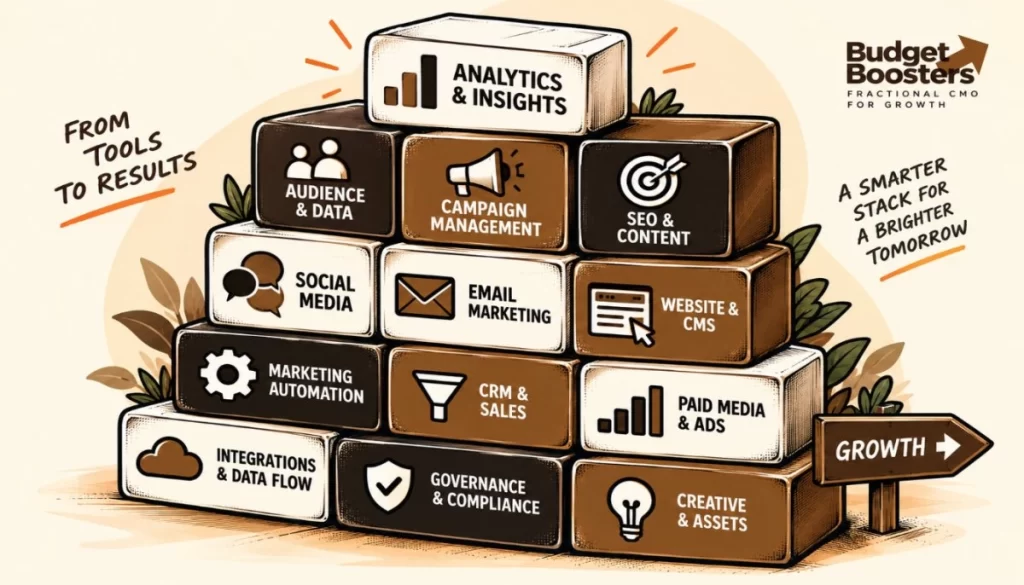
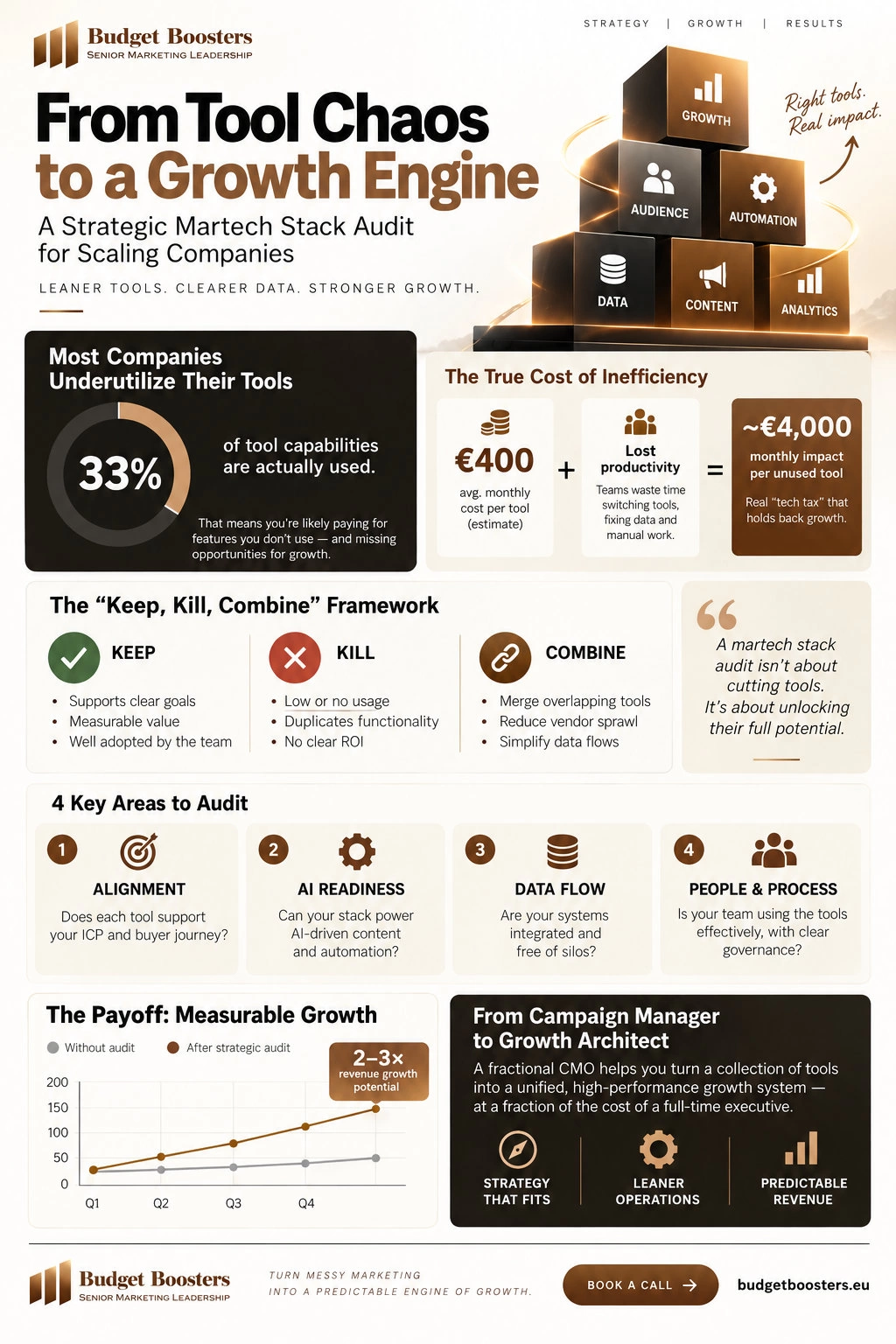
Did you know that your marketing team likely only uses 33% of the capabilities in the tools you’re paying for? It’s a staggering reality that leaves many leaders feeling like they’re burning budget on ghost software. Performing a strategic martech stack audit isn’t about pointing fingers at past mistakes. It’s about empowering your team to work smarter. You’ve probably felt the frustration of data silos and the pressure to integrate AI without a clear map. We’ve all been there. You deserve a system that works for you, not the other way around.
In this guide, you’ll learn how to eliminate tech bloat and transform your tools into a high-performance growth system. We’ll show you how to reclaim your ROI and build a predictable engine that supports your scaling goals in Poland and the Baltics. We’ll cover everything from AI workflows to the system builder approach that prioritizes governance over scattered activities. It’s time to move from being a campaign manager to a true architect of growth.
If you want to stay ahead of these trends, subscribe to our Budget Boosters Newsletter. You’ll get practical insights on marketing systems and a free copy of “The CMO Edge” ebook (a €29 value) to help you lead with confidence. For a deeper look at how regional firms are evolving, you can also explore our Fractional CMO Landscape Research 2026.
Key Takeaways
- Identify and eliminate “zombie subscriptions” that leak revenue and hide your true customer acquisition costs.
- Perform a strategic martech stack audit using the “Keep, Kill, Combine” framework to ensure every tool serves a measurable purpose.
- Assess your system’s AI readiness to build a scalable content engine that integrates seamlessly with your existing workflows.
- Map your technology directly to your ICP and buyer journey to bridge the gap between sales and marketing data.
- Discover how a fractional CMO serves as the architect who builds a leaner, high-performance growth system for your business.
Why Your Tech Stack is Leaking Revenue (and How Audit Fixes It)
Many leaders in the Baltics and Poland feel like their marketing budget is a bucket with a hole in it. It’s not your fault. With 15,384 tools available in 2025, it’s easy to collect “zombie subscriptions” that no one actually uses. A Marketing Automation platform should be a bridge to growth, not a financial anchor. When you perform a martech stack audit, you aren’t just cleaning up IT. You’re reclaiming your gross margin and empowering your team to focus on what matters. You deserve a system that provides clarity instead of confusion.
To better understand how these hidden costs accumulate and how to fight back, watch this useful video:
The Financial Impact of Marketing Inefficiency
Think about the “Tech Tax” on your operations. A tool might cost €400 per month, but if your team spends hours wrestling with its interface or fixing broken data, that cost balloons to €4000 in lost productivity. In 2025, Gartner reported that martech spending dropped to 22.4% of total marketing budgets. This isn’t because technology is less important. It’s because CFOs are demanding financial discipline. You need a system where every euro spent on a license fee generates a clear return. Moving from guesswork to logic means looking at your stack as a governed investment rather than a series of scattered expenses. A leaner stack often leads to higher impact because your team actually masters the tools they have.
Signs Your System is Outgrowing Its Architecture
Is your sales team complaining about lead quality while marketing shows record-high engagement? This is the first sign of tool bloat. Fragmented tools create silos that blind you to your real customer acquisition cost (CAC). When “more data” leads to less strategic clarity, your architecture has failed. Many CEOs find themselves acting as the default marketing decision-maker, which is a heavy psychological burden. You shouldn’t have to choose between a CRM update and a brand strategy. Performing a martech stack audit allows you to step back and see the big picture. It transforms your role from a firefighter into an architect of growth.
Our Fractional CMO Landscape Research 2026 shows that growth-stage firms are moving away from this fragmented execution. They are hiring “system builders” who align technology with sales goals for predictable results. If you’re ready to stop guessing and start growing, join our community through the Budget Boosters Newsletter. You’ll receive practical frameworks and a free copy of “The CMO Edge” ebook (a €24 value) to help you build a high-performing system that lasts.
The Keep, Kill, Combine Framework for Scaling Firms
Most guides assume you have a 90+ tool enterprise stack. That’s irrelevant for scaling companies in the Baltics and Poland. You don’t need more tools; you need a system that feels light and powerful. This is why a martech stack audit is your secret weapon. It helps you distinguish between tools that drive growth and those that just look good on a feature list. You deserve a tech stack that empowers your team rather than slowing them down with unnecessary complexity.
Use the “Keep, Kill, Combine” framework to regain control of your marketing investment. Keep tools that directly support revenue and scalability. Kill friction-heavy tools that drain focus or have a low utilization rate. Recent Gartner research on martech ROI shows that teams only use 33% of their tool capabilities. Why pay for the other 67%? Combine functionalities into all-in-one platforms to reduce vendor sprawl and security risks. This approach moves you from being a campaign manager to a true system builder.
Auditing Your Core Revenue Stack
Your CRM is the heartbeat of your business. It must be the single source of truth for the buyer journey. If your marketing automation doesn’t drive demand generation, it’s just an expensive email blaster. High-performance systems require measurement discipline. You need attribution tools that prove ROI without adding layers of manual data entry. This isn’t just about software; it’s about building a predictable growth engine that supports your long-term vision. When your data is clean, your strategy becomes crystal clear.
Consolidating for Operational Excellence
Reducing the number of vendors simplifies your life and protects your data. It improves integration and ensures that your tools actually talk to each other. A fractional CMO acts as the architect here, selecting “system-first” tools rather than shiny point solutions. They ensure your stack aligns with your strategy and sales goals. This shift from fragmented execution to senior leadership is a key trend in our region. You can learn more about how SMEs are evolving in our Fractional CMO Landscape Research 2026. Building a leaner stack is an exciting path to personal freedom and business success. If you’re ready to take the next step, consider downloading The CMO Edge ebook (a €24 value) for a deeper look at senior marketing leadership.
Auditing for AI Readiness and Content Multiplication
2026 is the year of the AI-enhanced growth engine. Are your tools helping you or holding you back? According to HubSpot research (2026), 86.4% of marketing teams now use AI in some capacity. However, simply having an AI button in your software isn’t enough. A professional martech stack audit focuses on your system’s “API-first” potential. If your tools can’t share data with an AI agent or ingest structured data, they are bottlenecks. You deserve a setup where technology does the heavy lifting, allowing your team to focus on strategy.
Building the AI Content Assistant
Scaling content in Poland and the Baltics requires more than just more writers. It requires a system. You can use the “Bullet-to-Prose” and “Universal Content Converter” methods to turn a single insight into a multi-channel campaign. This isn’t about replacing humans; it’s about empowerment. By auditing your stack for these capabilities, you can identify the friction points that slow you down. Implementing the right toolset can cut your production time by up to 65%. Want to see how? Check out our guide on 7 Practical Ways to Streamline Content Creation with AI. It’s time to maintain your brand voice while exploding your output.
Data-Driven AI Workflows
AI isn’t just for writing. It’s for thinking. You can use AI to cut data analysis time from days to just a few hours. Imagine having total clarity on your ROI in minutes. We’ve seen marketing directors increase conversion rates by 23% simply by using AI to identify patterns in their buyer journey. This is the difference between a campaign manager and a system builder. If you want to stay updated on these shifts, subscribe for practical AI frameworks and a free copy of The CMO Edge (€29 value). Our newsletter focuses on how fractional leadership is changing the game in our region.
The complexity of data is rising. Our Fractional CMO Landscape Research 2026 highlights how firms are shifting toward senior, part-time leadership to manage this tech evolution. Don’t let your tools become a burden. Use a martech stack audit to build a predictable growth engine that gives you back your freedom. Every step you take toward a leaner, AI-ready stack is a step toward a better future for your business. You have the power to turn your tools into a high-performance system.
A 5-Step Process to Execute Your Martech Audit
Executing a martech stack audit shouldn’t feel like a dry IT chore. It’s an exciting path to reclaiming your time and budget. You’re not just looking at software; you’re designing a growth engine that supports your team’s best work. By following a structured process, you move from feeling overwhelmed to having total control over your marketing investment. Let’s build a system that works for you.
Inventory and Mapping
Start by finding every “ghost” in the machine. You need a central registry of every piece of software, every login, and every recurring payment. It’s common to find that you’re paying for three different tools that all do the same thing. Once you have your list, map each tool to your buyer journey and Ideal Customer Profile (ICP). If a tool doesn’t help a prospect move from awareness to a closed deal, why is it there? This is also the perfect time to check in with your sales team. A high-performance stack must support sales alignment to ensure no lead is left behind. You’re building a partner relationship between your tech and your people.
The ROI Diagnostic
Now, let’s look at the numbers with a mentor’s eye. You need to calculate the true cost of each tool, including the time your team spends managing it. Are you getting a clear return, or are you just feeding a “zombie subscription”? Use our framework for Improving Content ROI to see which parts of your system are actually driving revenue. Developing a sustainable cadence for quarterly reviews ensures you never lose this clarity again. It’s about maintaining balance and financial discipline as you scale.
The final steps involve stress-testing your integrations. If data doesn’t flow smoothly between your CRM and your automation tools, your system is broken. Fix the plumbing before you add more features. Finally, build your 2026 Martech Roadmap. This plan should prioritize “system-first” tools that are ready for the AI-driven future we discussed earlier. You have the power to transform your marketing from a cost center into a predictable revenue driver. If you need an architect to lead this transformation, our Fractional CMO services can help you execute this audit and build your marketing operating system.
For more insights on building high-performing systems in the Baltics and Poland, subscribe to the Budget Boosters Newsletter. You’ll join a community of growth-focused leaders and receive a free copy of “The CMO Edge” ebook (a €24 value) to help you navigate these strategic shifts with confidence.
A tool is only as good as the strategy behind it. You’ve seen how a martech stack audit can reveal hidden leaks in your budget. But who is going to plug those holes? Technology alone won’t scale your company. You need an architect. A fractional CMO acts as this architect, transforming your collection of subscriptions into a unified marketing operating system. This is about moving from fragmented execution to predictable outcomes. You deserve a system that works while you sleep.
The shift toward senior leadership is clear. In the Baltics and Poland, firms are moving away from hiring junior managers to solve high-level strategic problems. You can explore these shifts in depth by choosing to Download the Fractional CMO Landscape Research 2026 for the Baltics and Poland. This research shows how growth-stage companies are building governance and accountability into their tech stacks to stay competitive.
Governance over Campaigns
CEOs often become the default marketing decision-makers by accident. It’s a heavy psychological burden. You shouldn’t have to worry about CRM integrations or attribution models. A fractional CMO provides the senior leadership you need at a fraction of the €200,000 full-time executive cost. They don’t just manage campaigns. They build systems. This governance ensures that every tool in your stack aligns with your sales goals and ICP. It’s about creating a structured engine that delivers measurable revenue growth. You gain the freedom to focus on the big picture while your marketing system runs with financial discipline.
Next Steps for Strategic Growth
Are you ready to scale without the overhead of a full-time executive? You can learn more about Marketing Leadership for SMBs and how to build these systems in our latest guide. We’ve seen this approach work in real-time across various sectors. For example, we helped one leader by turning a CEO’s profile into a €80,000 deal pipeline. This wasn’t magic. It was the result of a disciplined system and the right tools working in harmony.
Your journey to a high-performance growth system starts with clarity. Don’t let tool fatigue hold your business back. You have the power to turn your marketing from a cost center into a predictable revenue driver. If you’re ready to see exactly where your tech is leaking revenue, we can help. Request a Marketing Diagnostic Audit today and start your journey toward a leaner, more efficient future. You’re just one audit away from the control you’ve been looking for. It’s time to step up to the next level.
You’ve discovered how a strategic martech stack audit turns wasted budget into a high-performing growth engine. By applying the Keep, Kill, Combine framework and auditing for AI readiness, you’re building a foundation for predictable results. It’s time to stop feeling overwhelmed by tool bloat and start feeling empowered by your data. You deserve a system that supports your vision without the complexity of unmanaged tech.
You don’t need a full-time executive at a €200,000 cost to achieve this level of clarity. Our clients have seen a CAC reduction of ≈18% and slashed content production time by up to 65% through these exact system-building methods. You can access senior expertise at a fraction of the traditional full-time cost to bridge the gap between sales and marketing data. Scaling in Poland and the Baltics is an exciting journey when you have the right architecture in place.
Build your growth engine with a Fractional CMO Audit
You’re ready to take control and lead your company into a more profitable future. Let’s make 2026 the year your marketing tools finally start working for you.
Frequently Asked Questions
How often should a mid-sized company perform a martech stack audit?
You should perform a light review of your tools every quarter to catch unused seats or overlapping subscriptions. A comprehensive, strategic martech stack audit is best handled annually or during major growth shifts. This regular cadence ensures your system stays lean and responsive to market changes. You’ll avoid the “zombie tool” trap and keep your team focused on high-impact activities that drive your scaling goals forward.
What is the average cost of a marketing tech stack for a €5M revenue company?
A typical marketing budget for a company with €5M in revenue is approximately €300,000. Technology costs usually account for about 22% of that total, though this number is shifting as firms prioritize efficiency. You don’t need the most expensive tools to win. You need a system that integrates strategy with execution. Focus on the value each license brings to your gross margin rather than just the sticker price.
Do I need a full-time CTO or CMO to manage these tools?
You don’t need a full-time executive to manage these systems effectively. A fractional CMO provides senior leadership at a fraction of the €250,000 full-time cost. They act as the architect of your growth engine, ensuring tools align with your strategy. This model gives you board-level expertise without the heavy overhead. It’s a smart way to gain control over your processes while keeping your organization lean and agile.
What are the most common “zombie tools” in a typical stack?
“Zombie tools” are often specialized social listening platforms or redundant SEO plugins that no one has logged into for months. You might also find extra CRM seats for employees who have left the company. Identifying these during a martech stack audit is an easy win for your budget. It’s not about being restrictive; it’s about making sure every euro you spend actually supports your team’s daily workflows and success.
Can AI tools replace my existing marketing automation software?
AI tools shouldn’t replace your core automation software; they should enhance it. Think of AI as a personal content assistant that plugs into your existing system. It can cut production time by up to 65% when integrated correctly. You’ll still need a central platform like a CRM to act as your single source of truth. The goal is to build an AI-ready architecture that multiplies your output while preserving your unique brand voice.
How does a martech audit help with sales and marketing alignment?
An audit exposes the data silos that prevent sales and marketing from working together. When you map your tools to the buyer journey, you ensure both teams see the same lead data. This alignment is crucial for reducing your Customer Acquisition Cost (CAC) by ≈18%. You’ll move away from finger-pointing and toward a shared growth roadmap. It transforms your technology into a bridge that connects your entire revenue process.
What is the first tool I should cut if my budget is tight?
Start by cutting niche point solutions that overlap with your core platforms. If your CRM already has basic email marketing, you might not need a separate high-end newsletter tool. Look for anything with a low utilization rate or high friction. Every tool should either directly generate revenue or significantly save time. Pruning the edges of your stack allows you to reinvest in the core systems that truly drive your scaling efforts.
How do I integrate my Baltic or Polish regional tools into a global stack?
You should prioritize “API-first” tools that allow regional software to talk to your global CRM. Many companies in Poland and the Baltics use local accounting or logistics software that needs to sync with marketing data. Using middleware can create these connections without expensive custom coding. This approach keeps your stack flexible and localized where it matters, while maintaining a global view of your performance and growth metrics.

Article by
Aurimas Guoga
Aurimas Guoga is a fractional CMO and founder of Budget Boosters, helping B2B companies turn fragmented marketing into a predictable growth engine. With over a decade of experience leading marketing strategy, he works with business leaders to improve ROI, build scalable systems, and drive measurable revenue growth. Aurimas is also the author of The CMO Edge, a guide for companies looking to gain a competitive advantage through senior marketing leadership.