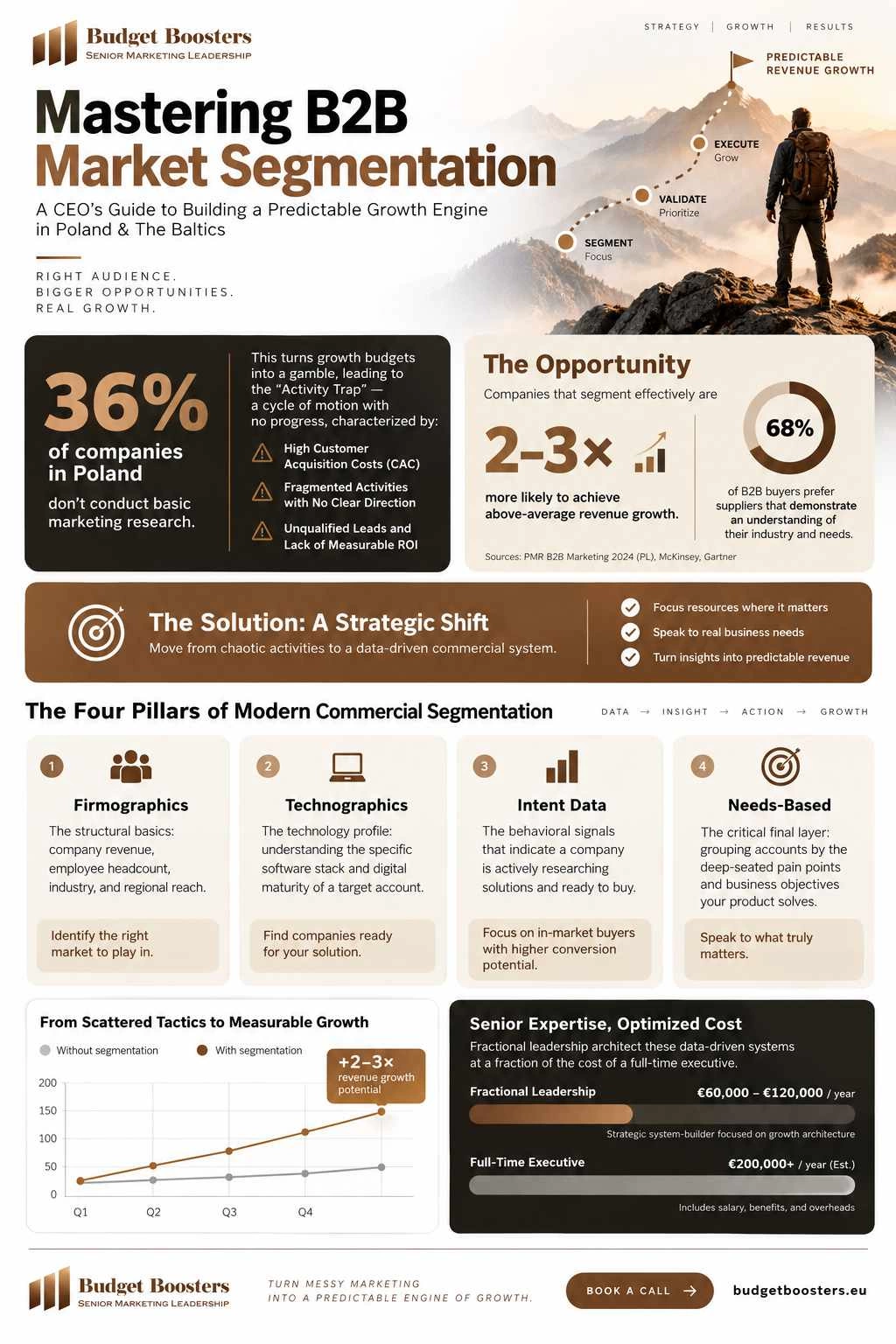
Over 36% of companies in Poland don’t conduct even basic marketing research. This lack of insight turns your growth budget into a gamble rather than a precise investment. If you’re a CEO acting as the default marketing lead, you’ve likely felt the sting of high Customer Acquisition Costs and fragmented activities that yield no clear ROI. It’s time to stop guessing. Mastering B2B market segmentation isn’t just a technical task; it’s the architectural foundation of a data-driven commercial system that eliminates financial waste.
You deserve a system that works as hard as you do. We’re going to show you how to transform those disjointed campaigns into a predictable growth engine designed for the 2026 landscape. By refining your approach, you’ll unlock a clear roadmap to lower your CAC and boost conversion rates across the Baltics and Poland. We’ll move beyond scattered tactics to build a sophisticated commercial structure. This isn’t about adding more dry processes; it’s about gaining the freedom to lead while your marketing system delivers measurable results. Let’s turn your strategy into your most powerful asset.
Key Takeaways
- Break free from the “activity trap” and transform fragmented marketing into a predictable growth engine that finally lowers your acquisition costs.
- Master B2B market segmentation by grouping accounts based on shared commercial value and needs rather than generic firmographic lists.
- Implement the ‘Pinpoint Your People’ framework to identify high-value outliers and map the competitive landscape in Poland and the Baltic states.
- Understand how Tier 1 strategic accounts differ from Volume accounts to drive higher gross margins through needs-based frameworks.
- Leverage fractional leadership to architect these systems for €60,000–€120,000 per year, gaining senior expertise at a fraction of the cost of a full-time executive.
Many CEOs feel trapped in a cycle of constant motion with zero progress. You approve ad budgets, hire agencies, and post content, yet the high-quality leads don’t arrive. This is the “Activity Trap.” It happens when you treat marketing as a series of chores instead of a focused financial strategy. By mastering market segmentation, you stop shouting into the void and start speaking directly to the accounts that actually move the needle for your revenue. This isn’t a creative exercise; it’s a financial discipline that ensures your resources aren’t wasted on the wrong people.
Think of segmentation as a decision framework that protects your mental energy. Instead of being the default decision-maker for every campaign, you set the parameters once. This surgical approach ensures every euro spent is an investment in a specific, high-value target. It shifts your role from a micromanager of “stuff” to a strategic architect of a growth engine. You deserve the clarity that comes from knowing exactly who you’re winning over and why.
To better understand how this applies to complex commercial environments, watch this insightful video:
Escaping the Activity-Driven Marketing Cycle
Signs of a broken system are easy to spot. You see high noise on social media but a silent CRM. Your sales teams might complain about “unqualified” leads that never close. By 2026, the competitive landscape makes guessing who your customers are a luxury you can’t afford. A structured B2B market segmentation system replaces this chaos with a predictable cadence. It gives your team a “North Star.” They no longer ask “What should we do?” but rather “How do we best serve this specific group?” This focus naturally lowers your Customer Acquisition Cost (CAC) and raises your standards.
Defining Segmentation as Board-Level Strategy
The Ideal Customer Profile (ICP) isn’t just a marketing document; it’s a board-level asset. It aligns your sales targets directly with your marketing spend. When you define your audience with senior leadership, you ensure that your commercial cadence is built on data, not gut feelings. This alignment is what allows companies in Poland and the Baltics to scale without exploding their costs. Using The CMO Edge, you can bridge the gap between high-level strategy and daily execution. You aren’t just buying ads; you’re building a path to market dominance through governance and accountability.
The Four Pillars of Modern Commercial Segmentation
Market segmentation for business-to-business is the systematic grouping of accounts based on shared commercial value and needs. It’s a continuous leadership system that ensures your team isn’t just busy, but productive. To build a growth engine that lasts into 2026, you must look beyond static lists and embrace a multidimensional approach. There are four essential pillars that define a high-performing strategy:
- Firmographics: The structural basics like revenue, headcount, and regional reach.
- Technographics: The specific software stack and digital maturity of a company.
- Intent Data: Behavioral signals that indicate a company is actively looking for a solution.
- Needs-Based: The deep-seated pain points and business objectives your product solves.
By integrating these pillars, you move from guessing to knowing. This structured oversight is exactly how companies like Polmet Solutions grew their revenue from €6.1M to €7.4M. It’s about building a system that aligns every department under a single vision of who the customer actually is. If you’re curious about how senior leadership can architect these systems for you, exploring the Fractional CMO Landscape Research 2026 provides a clear picture of how growth-stage firms are evolving.
Firmographics: The Foundation of Your ICP
Firmographics are your first filter. In Poland and the Baltic states, focusing on SMEs with revenue between €1M and €15M often represents the “sweet spot” for high-growth partnerships. However, don’t rely solely on headcount. In the AI era, a small team can generate massive revenue, making employee count a misleading metric for tech maturity. Different methods of segmenting B2B markets highlight that regional reach is often more telling. A firm operating across Lithuania, Latvia, and Estonia faces different regulatory and logistical hurdles than a domestic Polish service provider. You need to map these nuances to ensure your message resonates locally.
Technographics and Intent: The Modern Edge
Modern segmentation gives you a “surgical” advantage. Technographics allow you to identify companies using your competitors’ tools or those lacking the infrastructure to use your service. This prevents wasted effort on accounts that aren’t ready for you. When you combine this with intent data, you can spot behavioral signals before a lead even fills out a form. You can use AI-driven shortcuts to track these market signals efficiently, ensuring your team acts on hot opportunities rather than cold lists. To see this in action, check out these 7 Practical Ways to Streamline Content Creation with AI to see how technology simplifies complex data tasks. This isn’t just about software; it’s about using the right tools to gain a competitive edge in a crowded market.
Strategic Tiers: Comparing Firmographics vs. Needs-Based Frameworks
Not every account carries the same weight for your growth. Building a commercial system requires you to categorize your market into strategic tiers. Tier 1 accounts are your “Strategic” targets. These are high-value partners that deserve account-based precision and personalized attention. On the other end, Tier 3 accounts represent “Volume.” These are smaller opportunities where automation and scalable outreach keep your costs low. Moving from a wide-net approach to this tiered precision is a major level-up for your business. It allows you to focus your best resources where they’ll generate the highest returns.
Calculating your Customer Acquisition Cost (CAC) across these segments is vital. You’ll likely find that Tier 1 accounts have a higher upfront cost but a much higher lifetime value. By contrast, Tier 3 should have a very low CAC to remain profitable. This distinction ensures you don’t overspend on small deals or underserve the big ones. It’s about finding the right balance for your B2B market segmentation strategy to ensure long-term stability.
Firmographics vs. Needs-Based: A Comparison
While firmographics are the easiest way to start, they often lack the depth needed to drive high gross margins. Needs-based frameworks are harder to implement because they require deep customer interviews and data analysis. However, the payoff is significant. When you solve a specific, painful problem for an industrial service client, you aren’t just another vendor. You become a strategic partner. This shift is what allows you to command higher prices and build defensible market positions in Poland and the Baltics.
| Framework Type | Ease of Implementation | Conversion Impact |
|---|
| Firmographics | High (Ready-made lists) | Moderate |
| Needs-Based | Moderate (Requires research) | High (Surgical precision) |
Senior oversight is the key to choosing the right framework. You need an architect who understands which data points actually predict a sale. This leadership ensures your team doesn’t get lost in the “Activity Trap” of list-building without a clear commercial goal.
The ROI Impact of Proper Tiering
The numbers don’t lie. One Polish industrial firm saw its CAC decrease by 18% simply by aligning its sales and marketing teams around a shared tiering system. By stopping the “spray and pray” method, they improved conversion rates by 23%. They focused their energy on the accounts that were most likely to close based on historical data. If you want to see similar results, you must start improving content ROI by tailoring your message to specific tiers. This isn’t just about better ads; it’s about a smarter commercial cadence that respects your budget and empowers your team.
Implementing the ‘Pinpoint Your People’ Framework in the Baltic and Polish Markets
Implementing the ‘Pinpoint Your People’ framework is how you turn theory into revenue. It’s a five-step process designed to give you total control over your growth. First, audit your current customer data to find ‘High-Value’ outliers. These aren’t just your biggest spenders; they’re the accounts that bring in the most profit with the least friction. Look for high Lifetime Value combined with low support needs. Second, map the competitive landscape across Lithuania, Latvia, Estonia, and Poland. You need to know exactly who you’re up against in each territory. Third, define your ‘Unfair Advantage’ for each specific sub-segment. Why should they choose you over a local or global competitor? Fourth, sequence your Go-to-Market (GTM) plan. Don’t try to win everywhere at once. It’s a recipe for resource depletion and team burnout. Finally, establish a measurement cadence to track revenue attribution. If you can’t see which segment is paying the bills, you’re flying blind.
Regional Nuances: SMEs in Poland and the Baltics
In 2026, the landscape in Poland and the Baltics is shifting rapidly. Regional firms are outgrowing the era of fragmented execution. You can’t rely on junior hires or scattered agencies to build a complex commercial system. The Fractional CMO Landscape Research 2026 shows that growth-stage companies are moving toward senior, part-time leadership. This shift ensures your B2B market segmentation isn’t just a static document. It becomes a living part of your business strategy. Senior leaders act as system architects, aligning your sales and marketing efforts with surgical precision to ensure every euro is well spent.
The Pinpoint Framework in Action
Execution is where your vision becomes reality. Moving from guessing to financial discipline requires a clear 90-day GTM roadmap. This framework helps you focus your energy on the most promising sectors first, building momentum through quick wins. It replaces chaos with a predictable cadence, proving that effective B2B market segmentation is about execution, not just research. For a deeper dive into how this fits into your overall plan, read about The Modern Business-to-Business Marketing Strategy. You deserve a system that delivers results without the overhead of a full-time executive. Ready to audit your current strategy? Book a Marketing Diagnostic & Audit to find your high-value outliers today.
How Fractional Marketing Leadership Turns Segmentation Data into Revenue
The transition from a campaign manager to a system architect is the most significant leap a growth-stage company can make. You need an architect to build the engine, not just someone to turn the key. For many firms in Poland and the Baltics, a full-time senior hire isn’t necessary yet. You can access this level of senior leadership for €60,000–€120,000 per year. This professional governs your B2B market segmentation strategy, ensuring your data translates directly into a commercial cadence. It gives you the freedom to focus on the big picture while the system handles the precision.
The Marketing Operating System (MOS)
A high-growth system is built on six core components. The MOS replaces guesswork with a data-driven structure. Segmentation is the engine room of this system. It feeds directly into your channel strategy and provides the logic for your budget. When you have this clarity, your marketing spend becomes predictable. We call this The CMO Edge. Companies with senior marketing leadership consistently outperform the market because they build systems instead of just launching campaigns. They stop reacting to the market and start orchestrating their own growth.
From Strategy to Execution
CEO vision often gets lost when passed to junior hires or agencies. A Fractional CMO bridges this gap. They translate your goals into a clear roadmap that external partners can actually follow. We recently turned a CEO’s LinkedIn profile into an €80,000 deal pipeline by applying these exact segmentation principles. You can see the details in our CMO in Action: CEO LinkedIn Case Study. It proves that senior oversight turns social activity into a measurable financial asset.
Want to master these systems? Join our community by subscribing to the Budget Boosters Newsletter. We share practical insights on demand generation and go-to-market strategy specifically for the Baltics and Poland. You’ll receive our free ebook, “The CMO Edge. Why Companies with Senior Marketing Leadership Outperform – and How to Get There” (a €29 value), to help you make better decisions without a full-time director.
For a deeper look at regional trends, download the Fractional CMO Landscape Research 2026. This research explores why SMEs are moving away from fragmented execution toward senior, part-time leadership to manage today’s rising complexity of data and technology.
Architect Your Commercial Future
Take the first step toward a system that works as hard as you do. By mastering B2B market segmentation, you’re moving from fragmented activities to a surgical commercial engine. You’ve seen how the four pillars and the ‘Pinpoint Your People’ framework transform your approach in Poland and the Baltics. Fractional CMOs provide senior expertise at approximately 40% of the cost of a full-time hire, effectively reducing strategic uncertainty for CEOs. These data-driven systems aren’t just theory; they’ve driven revenue growth up to 25% for regional firms.
It’s time to reclaim your focus. You don’t have to be the default marketing manager when you have a proven system in place. Control over your growth isn’t a dry necessity; it’s your path to professional freedom. Subscribe to our newsletter for practical frameworks and get ‘The CMO Edge’ ebook (€29 value) for free. Start building your predictable growth engine today at budgetboosters.eu. You have the vision, and now you have the roadmap to achieve it.
Frequently Asked Questions
What is the primary difference between B2B and consumer market segmentation?
Business-to-business segmentation involves complex buying committees and longer decision cycles. In 2026, the median buying group for deals over €50,000 involves approximately 11 people. Consumer segmentation often focuses on individual emotions or simple demographics. By contrast, professional segmentation targets account value, technical maturity, and specific commercial needs. It requires a deeper understanding of firmographics and technographics to build a predictable growth engine that aligns with professional procurement processes.
How much does it cost to implement a professional segmentation strategy for an SME?
SMEs typically allocate 5% to 10% of their revenue to marketing. While a full-time executive can cost over €250,000, professional oversight through a fractional model is much more accessible. You can expect to invest between €60,000 and €120,000 per year for senior leadership to architect and govern these systems. This investment ensures your budget isn’t wasted on fragmented activities, focusing instead on the high-ROI segments that drive sustainable revenue.
Do I need a full-time CMO to handle my market segmentation?
You don’t always need a full-time executive. If your company is in a stable growth phase but lacks strategic direction, a fractional leader is often the perfect fit. Full-time CMOs are best for large, complex organizations with revenue exceeding €20M. For most SMEs, having a part-time architect to manage the commercial cadence provides the senior oversight you need without the heavy overhead and commitment of a permanent hire.
What is a Fractional CMO and how do they manage segmentation?
A Fractional CMO is a senior marketing leader who works with your company on a part-time basis, typically one to three days per week. They are embedded in your leadership team as a system builder rather than a campaign manager. They provide the architectural foundation for your B2B market segmentation, managing internal teams and external agencies to ensure your growth strategy is data-driven, accountable, and aligned with sales.
How do I identify my ideal customer profile (ICP) in the Polish market?
Identifying your Ideal Customer Profile in Poland requires the ‘Pinpoint Your People’ framework. Start by auditing your data to find high-value outliers. Since 97% of Polish enterprises are micro-businesses, targeting the small and medium firms with revenue between €1M and €15M often yields the best results. Focus on their specific pain points and remember that founder credibility is often more impactful in this region than institutional brand accounts.
Can AI tools like ChatGPT help with market segmentation in 2026?
Yes, AI is a powerful tool for analyzing large datasets and identifying market signals. 96% of marketers now use AI to streamline workflows. You can use it to summarize customer feedback or draft content outlines, cutting production time by up to 65%. However, AI should act as a personal assistant rather than the lead strategist. A senior leader must still govern the logic to ensure the system remains focused on commercial outcomes.
How often should a company revisit its segmentation strategy?
You should revisit your strategy at least every quarter. The commercial landscape in the Baltics and Poland evolves quickly, and your data must reflect these changes. A 90-day measurement cadence allows you to track revenue attribution and adjust your go-to-market sequencing. Regular audits prevent your marketing from becoming stagnant, ensuring your B2B market segmentation continues to target the most profitable accounts as market conditions and technology shift.
What are the common mistakes SMEs make when segmenting their market?
The biggest error is falling into the ‘Activity Trap’ by spending on ads without a defined audience. Many SMEs rely on fragmented execution without senior oversight to manage the complexity. Over 36% of companies in Poland don’t conduct even basic marketing research, which leads to high Customer Acquisition Costs. Another mistake is relying purely on headcount for firmographics; this is often misleading in an era where AI allows small teams to generate massive revenue.

Article by
Aurimas Guoga
Aurimas Guoga is a fractional CMO and founder of Budget Boosters, helping B2B companies turn fragmented marketing into a predictable growth engine. With over a decade of experience leading marketing strategy, he works with business leaders to improve ROI, build scalable systems, and drive measurable revenue growth. Aurimas is also the author of The CMO Edge, a guide for companies looking to gain a competitive advantage through senior marketing leadership.