For years, digital advertising has operated on a simple premise: you bid on a keyword, and your ad shows up. It was a powerful model, but it always had a fundamental limitation. It could capture a user’s stated query, but not their underlying intent, their constraints, or the complex trade-offs they were weighing. That era is ending. We are entering a new stage of advertising, one driven by conversational context rather than keywords.
ChatGPT Ads represent this new generation. Instead of interrupting a user’s search, they integrate into their decision-making process. For business leaders, especially in growth-stage firms, this isn’t just another channel to manage—it’s a fundamental shift in how you connect with customers. It’s an opportunity to move from shouting at prospects from the sidelines to becoming a trusted advisor in the exact moment they need help.
This guide is designed for leaders in Poland and the Baltics who want to understand this shift. We’ll explore the fundamentals of ChatGPT Ads, how to implement them without the typical complexity of legacy platforms, and why adopting this channel early gives you a powerful strategic advantage. It’s time to stop guessing at intent and start participating in the conversation.
Table of Contents
The Evolution of Digital Advertising: What Are ChatGPT Ads?
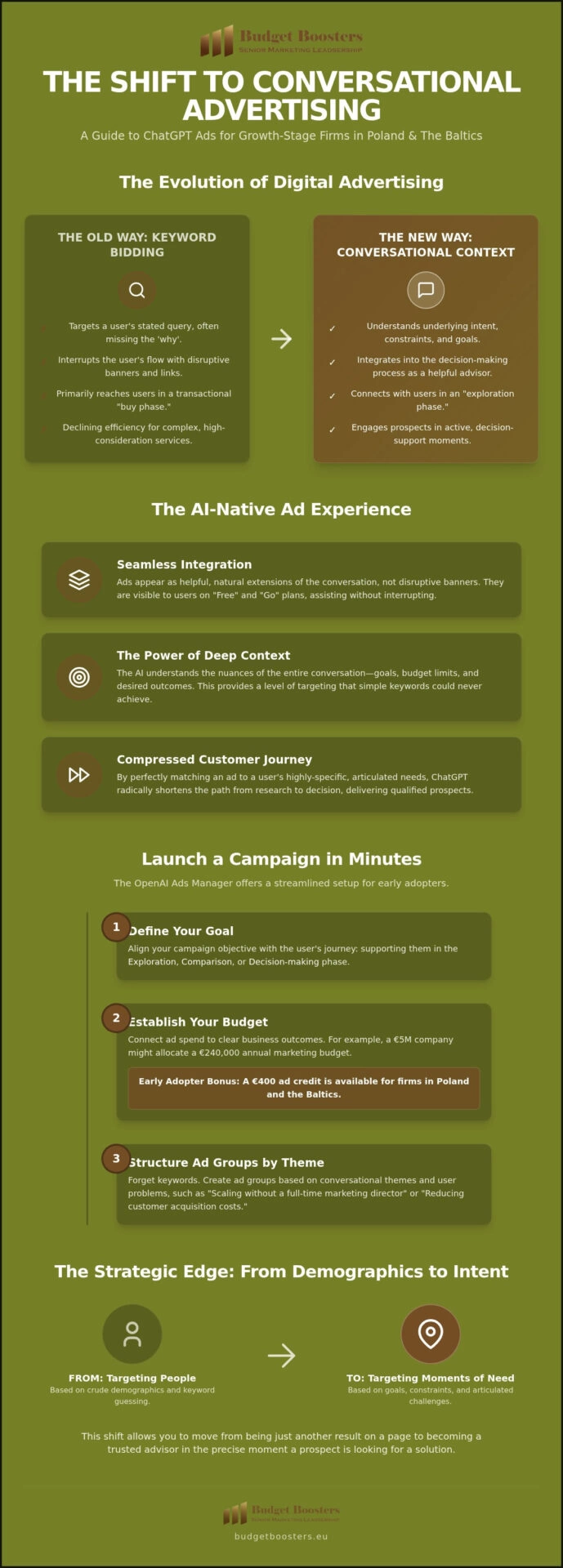
Forget everything you know about bidding on keywords like “CRM software for small business.” The future of digital advertising isn’t about matching words; it’s about understanding problems. ChatGPT Ads are context-native placements that appear within the AI’s conversational interface, serving as helpful suggestions rather than disruptive banners. This marks a seismic shift from keyword-based bidding to a model built on intent-based conversational signals.
As OpenAI rolls out its self-serve ad platform across 31 European markets in 2026, including the Baltic states and Poland, it creates a ground-floor opportunity for agile firms. The core difference lies in the user’s mindset. A person typing a query into a traditional search engine is often in a “buy phase,” looking for a specific solution. A user interacting with ChatGPT is in an “exploration phase,” articulating a complex problem and weighing their options in real time.
Understanding the AI-Native Ad Experience
In this new environment, ads don’t feel like ads. They appear as natural, helpful extensions of the conversation. If a user is asking ChatGPT to compare project management tools for a remote team of ten with a specific budget, a relevant ad isn’t just a link—it’s a solution that directly addresses those constraints. This is a game-changer for advertisers and audiences alike.
- How ads appear: Ads are visible to users on the “Free” and “Go” plans, presented as helpful resources, while premium “Pro” tiers remain ad-free. The goal is to assist, not interrupt.
- The power of context: The AI understands the nuances of the entire conversation—the user’s goals, budget limits, and desired outcomes. These deep context signals provide a level of targeting that simple keywords could never achieve.
- Compressing the customer journey: Because ChatGPT can understand intent down to the minutest details, it can present an ad that perfectly matches the user’s needs. This radically shortens the path from research to decision, connecting you with a highly qualified prospect who has already defined their problem.
Why Traditional Search is No Longer Enough
For complex business-to-business services, the efficiency of keyword advertising has been declining for years. Decision-makers don’t search for “enterprise logistics software”; they think, “How can I reduce shipping costs for my manufacturing firm in Poland without sacrificing delivery times to Germany?”
This is where conversational AI excels. It allows users to explain their unique constraints and trade-offs in natural language. For advertisers, this means you are no longer paying for passive impressions aimed at a broad audience. Instead, you are engaging in active, decision-support moments with prospects who are clarifying their needs. You’re not just a result on a page; you’re part of the solution-finding process.

Navigating the OpenAI Ads Manager: A Step-by-Step Implementation
One of the most refreshing aspects of ChatGPT Ads is its simplicity. Unlike the labyrinthine interfaces of Google and Meta, the OpenAI Ads Manager is designed to be intuitive, allowing you to launch a campaign in minutes. This streamlined process encourages early adoption, giving agile firms a chance to capture attention before the platform becomes saturated.
For firms in the Baltics and Poland, OpenAI is offering a $500 ad credit (approximately €400 after currency adjustments) to encourage early testing. This is your invitation to get in on the ground floor. The platform also supports bulk uploading ad details via structured data, making it easy to test multiple variations without manual effort.
Setting Up Your Campaign Architecture
The setup process is much simpler than traditional platforms because it’s not built around keywords. Instead of guessing what users might type, you align your campaigns with the *problems* they are trying to solve. This is a strategic shift that puts the customer first.
- Define Your Goal: Is your objective to support users in the Exploration phase (introducing your category), the Comparison phase (stacking your solution against alternatives), or the Decision-making phase (providing a clear path to purchase)? Your goal dictates your messaging.
- Establish Your Budget: Connect your ad spend to a clear business outcome. For example, a €5 M company might allocate a €240,000 annual marketing budget. A test campaign on a new channel like ChatGPT Ads should be a calculated percentage of that, tied to specific lead or revenue targets.
- Structure Ad Groups by Theme: Don’t use keyword groups. Instead, create ad groups based on conversational themes or user problems. For example, a fractional CMO service might have themes like “Scaling without a full-time marketing director,” “Reducing customer acquisition costs,” or “Improving marketing ROI.”
Leveraging Rich Context Signals for Targeting
This is where ChatGPT Ads truly shines. You can move beyond crude demographics and target users based on their immediate goals and articulated challenges. It’s a move from targeting a *person* to targeting a *moment of need*.
- Target by Goals and Constraints: The AI identifies users who are discussing specific business challenges that your service solves. This ensures your ad is not only seen but welcomed as a timely solution.
- Identify “Lookalike” Conversations: The platform can identify conversational patterns similar to those of users who have already engaged with your ads, allowing you to find new audiences with similar needs.
- Embrace the “Launch and Learn” Phase: With a new platform, data is your best friend. Use your initial ad credit to test different themes and messages. The goal isn’t immediate perfection but rapid learning. Track which conversational contexts drive the most qualified engagement and double down on what works.
The Strategic Edge: Why Conversational Intent Beats Keyword Search
The ultimate advantage of ChatGPT Ads is its ability to connect you with decision-makers long before they ever land on a competitor’s website. You become part of their internal thought process, building trust and authority from the very first interaction. For firms in the Baltics and Poland, this provides a rare opportunity to leapfrog larger, slower-moving competitors by mastering an AI-native channel first.
Being an early adopter on a new platform is a massive competitive advantage. In the beginning, ad inventory is high and competition is low. This means your message will receive more attention at a lower cost, allowing you to build brand recognition and a pipeline of leads while others are still debating whether to test the waters.
Reaching Decision-Makers in the Research Phase
Think about how business owners use ChatGPT. They use it to draft business plans, compare software vendors, outline logistics for international expansion, or explore new marketing strategies. They are in a vulnerable, open-minded state, actively seeking guidance.
By placing a helpful, non-intrusive ad in this context, you are not an interruption. You are a valuable resource. You are present when alternatives are being weighed and trade-offs are being considered. This allows you to build authority by providing context-aware answers, positioning your brand as a helpful expert rather than just another vendor. This is a crucial step toward building a predictable growth engine. You can learn more about this approach in our guide to a sustainable demand generation strategy.
Lowering CAC with Intent-Based Exploration
One of the biggest drains on marketing budgets is wasted ad spend on broad keywords that lack true purchase intent. Conversational advertising dramatically reduces this waste. By matching your ad message to a user’s specific, articulated problem, you ensure a much higher degree of relevance.
This precision leads to better conversion rates and a lower Customer Acquisition Cost (CAC). For instance, our work with firms like Polmet Solutions S.A. demonstrates how strategic marketing oversight can lead to an approximately 18% reduction in CAC. ChatGPT Ads amplifies this effect by pre-qualifying prospects based on the very nature of their conversational query. You are spending money to reach people who have already raised their hand and described the exact problem you solve.
Optimizing Your Creative for AI-Native Environments
In a conversational interface, traditional, sales-heavy ad copy is not just ineffective—it’s jarring. Users are engaged in a dialogue, and your ad needs to respect that context. The key is to shift your mindset from “selling” to “helping.” Your copy should feel like a useful suggestion from a knowledgeable assistant, not a billboard shouting for attention.
This requires a new approach to content creation. To maintain brand voice and consistency at scale, a Custom AI Content Style Guide is essential. It ensures that any AI-generated ad variations align with your company’s tone and positioning. The goal is to produce helpful copy that answers the user’s implicit question, guiding them toward a solution without aggressive sales tactics.
Copywriting for the Conversational Interface
You are writing for a dialogue, not a monologue. Your ad copy should be concise, clear, and directly relevant to the user’s conversation. Think of it as joining a discussion already in progress.
- Write for a dialogue: Use a natural, helpful tone. Frame your solution as a direct answer to the problem the user is discussing with the AI.
- Draft high-intent copy quickly: Use frameworks like the “90-Second Outline Formula” to structure ad copy around a core problem, a proposed solution, and a clear next step.
- Test different angles: Experiment with different “helper” personas in your copy. Is your ad educational, offering a guide or framework? Is it comparative, helping the user evaluate options? Or is it directional, offering a clear solution?
Integrating AI Content Shortcuts for Rapid Testing
The beauty of AI-native advertising is that you can use AI to streamline the creation of the ads themselves. Manually writing dozens of ad variations is a bottleneck. AI-driven workflows can eliminate it.
For example, a system like the Content Multiplication System can take a single core message and generate numerous ad variations tailored to different conversational themes. This allows you to test and optimize your campaigns with incredible speed. Our clients have found that integrating these AI workflows can cut content production time by up to 65%, enabling rapid, data-driven improvements and freeing up strategic leaders to focus on performance, not production. For more on this, see our guide to scaling content with AI.
Managing AI Advertising as a Predictable Growth Engine
The arrival of ChatGPT Ads is not just a tactical opportunity; it’s a strategic inflection point. Adopting a powerful new technology like this requires senior marketing leadership to ensure it aligns with the company’s overall growth objectives. It cannot be treated as a siloed experiment run by a junior manager. It must be integrated into a structured Marketing Operating System.
This distinction is critical. A campaign manager focuses on clicks and conversions. A system builder, often in the role of a Fractional CMO, focuses on how the channel contributes to predictable revenue growth, its impact on CAC, and its alignment with sales. To understand the growing trend toward this level of strategic oversight, you can explore our Fractional CMO Landscape Research 2026.
Beyond the Campaign: Governance and Accountability
To succeed with ChatGPT Ads, you need to replace guesswork with a data-driven performance cadence. This starts with establishing clear Key Performance Indicators (KPIs) that go beyond vanity metrics. Focus on what matters: qualified leads generated, revenue attribution, and the impact on the sales pipeline.
This is where senior oversight becomes non-negotiable. A Fractional CMO provides that board-level perspective, ensuring that the investment in a new channel is governed by financial discipline and a clear understanding of its role in the larger marketing system. They ask the tough questions: Is this channel delivering a positive ROI? How does it integrate with our other demand-generation efforts? Are we learning and adapting fast enough?
The Role of Fractional Leadership in Scaling Firms
For growth-stage firms with revenues between €1 M and €15 M, navigating the complexity of new channels like ChatGPT Ads can be overwhelming. You need senior strategic guidance, but the cost of a full-time, executive-level CMO can be prohibitive.
This is the precise challenge that fractional leadership solves. By hiring a part-time executive (typically costing €48,000–€96,000 per year), you gain access to top-tier strategic oversight without the full-time expense. This leader acts as the architect of your growth engine, evaluating if and how new channels fit into your company’s roadmap and ensuring that every marketing euro is invested with purpose and accountability.
Conversational advertising is the future. But like any powerful tool, its success depends not on the technology itself, but on the strategy guiding it. By embracing this new paradigm with clear governance and a systematic approach, you can build a formidable, AI-driven advantage for years to come.

Subscribe to the Budget Boosters Newsletter to stay ahead of AI marketing trends and get your free copy of The CMO Edge (€29 value).

Article by
Aurimas Guoga
Aurimas Guoga is a fractional CMO and founder of Budget Boosters, helping B2B companies turn fragmented marketing into a predictable growth engine. With over a decade of experience leading marketing strategy, he works with business leaders to improve ROI, build scalable systems, and drive measurable revenue growth. Aurimas is also the author of The CMO Edge, a guide for companies looking to gain a competitive advantage through senior marketing leadership.