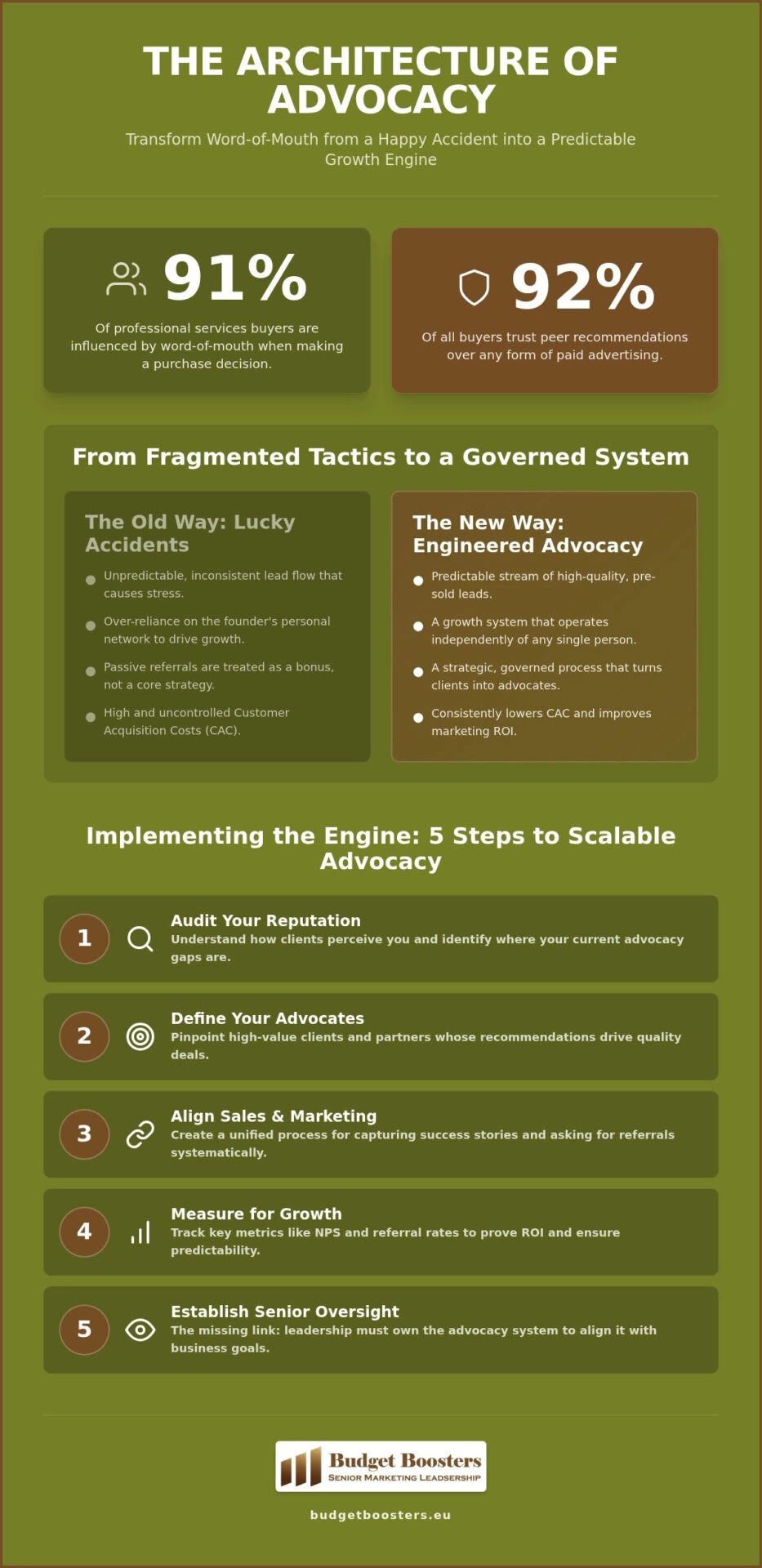
Did you know that 91% of buyers in professional services are influenced by word-of-mouth marketing when making a purchase decision? It’s the ultimate growth lever. Yet, many leaders treat it like a happy accident rather than a deliberate business process. You likely feel the weight of an unpredictable lead flow. Perhaps you’re over-reliant on your personal network, feeling that if you stop networking, the phone stops ringing. This cycle is exhausting, but it’s a hurdle you can clear.
We’re going to change your perspective. You’ll learn how to transform passive referrals into a governed, scalable growth system that consistently lowers your Customer Acquisition Cost. Imagine a referral engine that produces results without your constant involvement. This isn’t just about getting more leads; it’s about gaining personal freedom and control over your firm’s future. We’ll explore the structural shifts needed to align your sales and marketing, moving from fragmented tactics to a sophisticated system of advocacy and measurable reputation.
Key Takeaways
- Transform your reputation from a series of lucky accidents into a governed system that drives predictable growth.
- Discover why 92% of buyers trust peer recommendations and how to leverage this trust to lower your Customer Acquisition Cost.
- Learn how to align your sales and marketing teams to capture client success stories through an engineered word-of-mouth marketing strategy.
- Identify why senior oversight is the missing link in turning tactical marketing activities into a scalable growth engine.
- Follow a practical five-step framework to audit your current reputation and define your most valuable referrers.
Beyond the Buzz: Defining Word-of-Mouth Marketing for Modern Enterprises
Stop viewing word-of-mouth marketing as a lucky break or a series of happy accidents. It isn’t just people talking over coffee.
In a professional context, effective word-of-mouth marketing is a managed process for turning customer success into reputation, recommendations and eventually new business.
The distinction matters. You cannot control whether somebody recommends you. But you can control most of the conditions that make recommendations more likely. You can decide which clients receive extra attention. You can identify moments when satisfaction is highest. You can ask for introductions. You can capture testimonials. You can turn successful projects into case studies. And you can track which recommendations ultimately become revenue.
That is the foundation of a word-of-mouth marketing system.
In the Baltic and Polish markets, where professional networks are relatively interconnected, reputation can be particularly powerful. A recommendation from someone a buyer already trusts can accomplish something advertising struggles to achieve: transfer credibility from one person to another.
The Trust Factor in High-Stakes Markets
Reputation isn’t just a “nice to have” asset. It reduces perceived risk. That becomes increasingly important as the value and complexity of the purchase increase. Imagine two companies competing for a €100,000 contract. One arrives through a Google search. The other is introduced by a CEO whom the buyer respects. They may enter the same procurement process, but psychologically they don’t start from the same position. The referred company has borrowed trust.
This is why word-of-mouth marketing is particularly powerful in consulting, professional services, technology, manufacturing and other B2B markets where the consequences of choosing the wrong supplier can be significant.
Key Metrics for Reputation Success
If you can’t measure word-of-mouth marketing, you can’t improve it.
Start with a simple question on every new opportunity: How did you hear about us? Then make the answer part of your CRM rather than leaving it buried in someone’s memory. Track:
- percentage of leads originating from referrals;
- percentage of referral leads that become qualified opportunities;
- referral-to-customer conversion rate;
- revenue generated through referrals;
- Customer Acquisition Cost of referred versus non-referred clients;
- which customers generate the most valuable referrals.
NPS can help identify advocacy potential, but don’t confuse willingness to recommend with actual referrals. The metric that ultimately matters is whether advocacy creates qualified pipeline and revenue.
The Architecture of Advocacy: How a Systematic Approach Drives Growth
A functioning word-of-mouth marketing system needs more than satisfied customers. It needs a loop.
Deliver value → identify success → capture proof → ask for advocacy → make sharing easy
→ track the result → recognise the advocate → repeat.
Without this loop, companies usually collect isolated marketing assets. Someone remembers to ask for a testimonial. Another employee asks for a Google review. The CEO receives a referral over lunch. Marketing publishes a case study six months later. Good things happen, but they aren’t connected. The objective is to turn these isolated events into an operating process.
Governance and Sales Alignment
Start by assigning ownership.
Someone must be responsible for the word-of-mouth marketing system. Depending on company size, this might be the CMO, fractional CMO, marketing manager, customer success lead or another senior commercial leader. Then divide responsibilities.
Sales identifies referral opportunities. Account management spots moments of high client satisfaction. Marketing captures and amplifies success stories. Leadership reviews the commercial results.
The important thing is that advocacy isn’t “everyone’s responsibility,” because that often means it becomes nobody’s responsibility. Build referral triggers into the customer journey.
For example:
Project successfully completed → client confirms satisfaction → testimonial requested →
introduction requested → case study considered → referral recorded in CRM →
advocate thanked → follow-up scheduled.
Now word-of-mouth marketing has become a workflow rather than a wish.
Predictable Growth Through Financial Discipline
Not every happy client deserves the same attention.
Look at your historical referrals and identify which customers generated the most profitable business.
You may discover that 20 enthusiastic clients are more valuable to your word-of-mouth marketing system than 2,000 passive LinkedIn followers.
Create a simple advocate database. For each potential advocate record:
Client |relationship owner | satisfaction | industry | influence | previous referrals |
potential introductions | next advocacy action
Then prioritise them.
A CEO who knows twenty other CEOs in your target market may deserve considerably more advocacy attention than a client with a large social following but little connection to your Ideal Customer Profile.
The objective isn’t maximum reach. It’s maximum relevant trust.
Strategic Amplification: Why Passive Referrals Are Not a Growth Plan
Waiting for the phone to ring is not a strategy. Many successful firms reach a certain level and then plateau because their word-of-mouth marketing depends almost entirely on the founder. The founder attends conferences. The founder maintains relationships. The founder asks for introductions. When the founder becomes busy, referral activity falls. That is not scalable word-of-mouth marketing. It is founder-dependent business development.
A system works differently.
It creates predictable opportunities for customers, partners and other advocates to talk about the company without requiring the CEO to personally initiate every conversation.
Organic vs. Managed Word-of-Mouth
Organic word-of-mouth marketing happens spontaneously.
Managed word-of-mouth marketing creates triggers.
Consider a consulting engagement.
The client tells your account manager:
“This saved us three weeks of work.”
Most companies reply: “Great to hear!”
A company with a word-of-mouth marketing system recognises an advocacy trigger.
The account manager might respond:
“That’s great to hear. We’re trying to help more companies facing the same problem. Is there anyone in your network dealing with something similar whom you think we should speak to?”
The timing matters.
You aren’t randomly asking for referrals every quarter. You’re connecting the request to a moment when the client has just experienced value.
That makes advocacy feel natural rather than transactional.
The Content Multiplication System
Not every advocate will introduce another buyer directly. That’s fine.
Word-of-mouth marketing can take several forms: a private recommendation, testimonial, review, case study, LinkedIn comment, event appearance, reference call or introduction.
Give clients different ways to advocate. Then multiply the resulting proof.
One 30-minute customer interview might produce:
- a detailed case study;
- three testimonial quotes;
- a LinkedIn post;
- several short social posts;
- a newsletter story;
- a sales presentation slide;
- a website proof point;
- a short video clip.
AI can accelerate this transformation, but the underlying evidence must remain authentic.
The objective isn’t to use AI to manufacture advocacy. It’s to help genuine customer advocacy travel further.
Implementing the Engine: 5 Steps to Scalable Customer Advocacy
This is where word-of-mouth marketing becomes operational.
You don’t need sophisticated referral software to start. A CRM, a spreadsheet, several templates and clear ownership are enough.
Step 1: Audit your current reputation
Look back at your last 20–50 customers and your recent pipeline.
Ask: Who recommended us?
Which customers have already recommended us more than once?
Which referrals became our best customers?
At what moment did the recommendation occur? What exactly did the advocate say about us?
You are looking for patterns.
Perhaps referrals happen after a particularly successful project. Perhaps one service produces far more advocacy than another. Perhaps CEOs refer you while procurement managers don’t.
Before designing a word-of-mouth marketing system, understand the word-of-mouth behaviour already happening naturally.
Step 2: Define your Advocacy ICP
Your best customer isn’t automatically your best advocate. Create a shortlist of clients who combine three qualities:
Satisfaction, credibility, access to your target market.
Score each from 1–5.
A client scoring 5+5+5 becomes a priority advocate.
Then identify what you would ideally like that person to do.
For one advocate it may be an introduction. For another, a testimonial. For another, a case study or speaking appearance.
This prevents the common mistake of sending the same generic “please recommend us” request to everyone.
Step 3: Build the capture system
Now decide exactly when advocacy requests happen.
Create 3–5 standard triggers, such as:
Trigger 1: Successful project completion.
Trigger 2: Client gives unusually positive feedback.
Trigger 3: Measurable business result achieved.
Trigger 4: Contract renewal or expansion.
Trigger 5: Client voluntarily praises your company.
For every trigger, define the next action.
For example:
Positive feedback → relationship owner asks permission to quote it → asks whether the client knows another company facing the same challenge → records outcome in CRM.
Then remove friction. Don’t say: “Please recommend us if you know anyone.”
Give the advocate context: “We’re particularly looking to work with manufacturing companies with 20–100 employees that are expanding into Germany. Does anyone come to mind?”
Specific requests are easier to act upon.
Step 4: Use AI to amplify stories
Every successful referral contains information.
Why did the advocate recommend you?
What problem did they associate with your company?
What language did they use?
Capture it.
AI can then help turn interviews, testimonials and customer feedback into case studies, LinkedIn content, newsletters, sales collateral and website proof.
But amplification comes after advocacy capture.
Technology cannot compensate for a weak customer experience or the absence of a referral process.
Word-of-mouth marketing begins with something worth talking about.
Step 5: Measure and refine
Review your word-of-mouth marketing system monthly. A simple dashboard can show:
Advocates identified → referral requests made → introductions received → qualified
opportunities → customers won → referral revenue.
Suppose you identify 50 advocates.
Twenty receive an appropriate referral request during the quarter.
Eight make introductions.
Five become qualified opportunities.
Two become customers worth €40,000 each.
You now have something far more useful than “word of mouth seems to work.”
You have a measurable commercial funnel.
Then improve the weakest stage.
If customers are happy but few referrals are requested, improve internal
execution.
If many requests produce no introductions, improve timing or messaging.
If introductions arrive but rarely qualify, reconsider your Advocacy ICP.
If qualified referrals rarely close, the problem may no longer be word-of-mouth marketing at all. It may be your offer or sales process.
AI-Driven Content for Advocacy
AI is particularly useful once your word-of-mouth marketing system starts producing raw material.
Customer interviews can be transcribed and transformed into case studies. Sales-call notes can reveal recurring proof points. Testimonials can be organised by industry or customer problem.
AI can also help identify patterns across dozens of success stories.
But maintain one important principle:
AI scales proof. It doesn’t create proof.
The source of effective word-of-mouth marketing remains genuine customer success.
Regional Insights: Poland and the Baltics
Poland and the Baltic states provide an interesting environment for systematic
word-of-mouth marketing.
Business communities are relatively interconnected, particularly within specialised industries. Decision-makers frequently meet through associations, conferences, suppliers, professional networks and LinkedIn.
This creates opportunities for reputation to travel quickly. But the
opposite is also true.
Poor experiences travel through the same networks. That makes reputation management a commercial discipline rather than merely a communications activity.
Senior leadership should therefore understand not only what the company says about itself, but what customers are likely to say when the company isn’t in the room.
Leading the System: Why Senior Oversight is the Missing Link
You now have the mechanics of the advocacy engine.
But systems deteriorate without ownership.
Someone must ensure that advocacy triggers are recognised, requests happen, success stories are captured, referrals are tracked and results are reviewed.
This is where senior marketing leadership becomes important.
The task isn’t simply to produce more testimonials.
It is to connect customer experience, sales, marketing and revenue into one
word-of-mouth marketing system.
Fractional CMO vs. Fragmented Execution
Many SMEs distribute these responsibilities across several people.
Sales asks for referrals occasionally.
Marketing creates case studies.
The CEO maintains relationships.
An agency manages LinkedIn.
Each activity may be perfectly reasonable, but nobody owns the entire system.
A senior marketing leader sees the connections.
Why did this customer recommend us?
Can we reproduce the conditions that caused it?
Can we capture the story?
Can sales use it?
Who else resembles this advocate?
How much revenue resulted?
Those questions transform marketing execution into commercial architecture.
For companies that don’t require a full-time senior marketing executive, a
fractional CMO can provide this system-building capability while execution
remains distributed across internal staff and external specialists.
The CMO Edge in Advocacy
The competitive advantage isn’t simply having more people talking about your
company.
It’s creating the right conversation among the right people.
That requires commercial clarity.
Your word-of-mouth marketing system should ultimately answer five questions:
Who should advocate for us?
What should they be talking about?
When should we invite them to advocate?
How do we make advocacy easy?
How much business does it generate?
When those questions have clear answers, reputation stops being an intangible marketing
concept. It becomes infrastructure for growth.
Take Control of Your Reputation Today
Word-of-mouth marketing isn’t a mysterious force of nature.
You cannot order customers to recommend you, but you can systematically create the conditions that make recommendations more likely.
Start small. Identify your 20 strongest potential advocates.
Define three moments when your team should ask for advocacy.
Create one referral-request template.
Record every referral in your CRM.
Review the results once a month.
Then build from there.
The operating loop is simple:
Create value → recognise satisfaction → request advocacy → capture proof → amplify it
→ track revenue → learn → repeat.
That is the difference between receiving referrals and building a word-of-mouth marketing
system.
The first depends on luck. The second becomes a business asset.
If your current marketing consists of disconnected activities rather than a coherent growth system, a Marketing Diagnostic & Audit can reveal where the gaps are. From there, senior marketing leadership can connect positioning, customer experience, content, sales and advocacy into one operating model.
The goal isn’t merely more referrals.
It’s a business whose reputation continues generating opportunities even when the CEO isn’t personally in the room.
Frequently Asked Questions
Is word-of-mouth marketing really effective for B2B companies?
Yes, it’s one of the most powerful growth levers for professional services. Research shows that 91% of buyers in these sectors are influenced by peer recommendations during their decision-making process. In trust-based markets like the Baltics and Poland, a recommendation from a peer carries more weight than any paid advertisement. It helps you move from being a simple vendor to a trusted advisor before the first meeting starts.
How do I measure the ROI of my word-of-mouth efforts?
Focus on tracking your referral rate and the resulting impact on Customer Acquisition Cost. You should measure how many new leads originate from existing clients and compare their lifetime value to leads from other channels. Use Net Promoter Score (NPS) as a leading indicator of advocacy potential. By linking these metrics to your revenue data, you can see the direct financial impact of your reputation system.
What is the difference between referral marketing and word-of-mouth?
Word-of-mouth is the broad act of people sharing their experiences with your brand, while referral marketing is a specific, incentivized system to encourage that sharing. Think of word-of-mouth as the organic or engineered conversation and referral marketing as the structured program that tracks and rewards those conversations. Both are essential parts of a complete advocacy engine that drives predictable growth for your firm.
Can AI really help with word-of-mouth marketing?
Absolutely, AI is a game-changer for scaling your advocacy. You can use it to turn raw client feedback into polished case studies or to analyze data and identify your most influential advocates. It helps you maintain a consistent brand voice while cutting down production time. By automating the distribution of success stories, you ensure your reputation is visible across multiple channels without overwhelming your team.
How much should an SME budget for an advocacy system in 2026?
You should aim to allocate a specific percentage of your marketing budget to advocacy, typically between 10% and 15%. This covers tools for sentiment analysis, content multiplication, and senior oversight. Investing in a system rather than a one-off campaign ensures long-term efficiency. This disciplined approach replaces the “hope and pray” model with a predictable engine that consistently lowers your long-term acquisition costs.
Do I need a full-time executive to manage our reputation?
Not necessarily, especially for growth-stage firms. A fractional CMO can provide the senior leadership and system-building expertise you need for a fraction of the cost. You can access world-class strategy for approximately €60,000 to €120,000 per year. This allows you to implement a sophisticated governance structure without the overhead of a full-time executive, giving you the freedom to focus on your core business.
What happens if our word-of-mouth is currently negative?
Don’t panic; negative feedback is an opportunity to improve. Start by conducting an audit to understand the root cause of the dissatisfaction. Addressing these issues transparently can actually build more trust than a perfect record. Research shows that shoppers often seek out negative reviews to establish credibility. By fixing the underlying problems and communicating the changes, you can transform critics into your most loyal advocates.
How does word-of-mouth impact Customer Acquisition Cost (CAC)?
It lowers your CAC by reducing the friction in the sales cycle. Leads coming through word-of-mouth marketing are often pre-sold on your value, which means your sales team spends less time on persuasion. In industrial sectors, we’ve seen this approach lead to a CAC reduction of ≈18%. A systematic advocacy engine creates a self-sustaining cycle where every happy client helps bring in the next one at a lower cost.

Article by
Aurimas Guoga
Aurimas Guoga is a fractional CMO and founder of Budget Boosters, helping B2B companies turn fragmented marketing into a predictable growth engine. With over a decade of experience leading marketing strategy, he works with business leaders to improve ROI, build scalable systems, and drive measurable revenue growth. Aurimas is also the author of The CMO Edge, a guide for companies looking to gain a competitive advantage through senior marketing leadership.