What if the reason your marketing feels like a black hole isn’t a lack of effort, but a lack of architecture? You’ve likely felt the frustration of watching your Customer Acquisition Cost climb while your team jumps from one trend to the next. It’s exhausting to manage agencies without a senior architect at the helm to oversee the entire structure. We understand that feeling of being out of control, and we want to show you how to improve marketing roi by turning chaos into a clear path. It’s not your fault that the landscape has become a maze of data. You deserve a system that works for you, not the other way around.
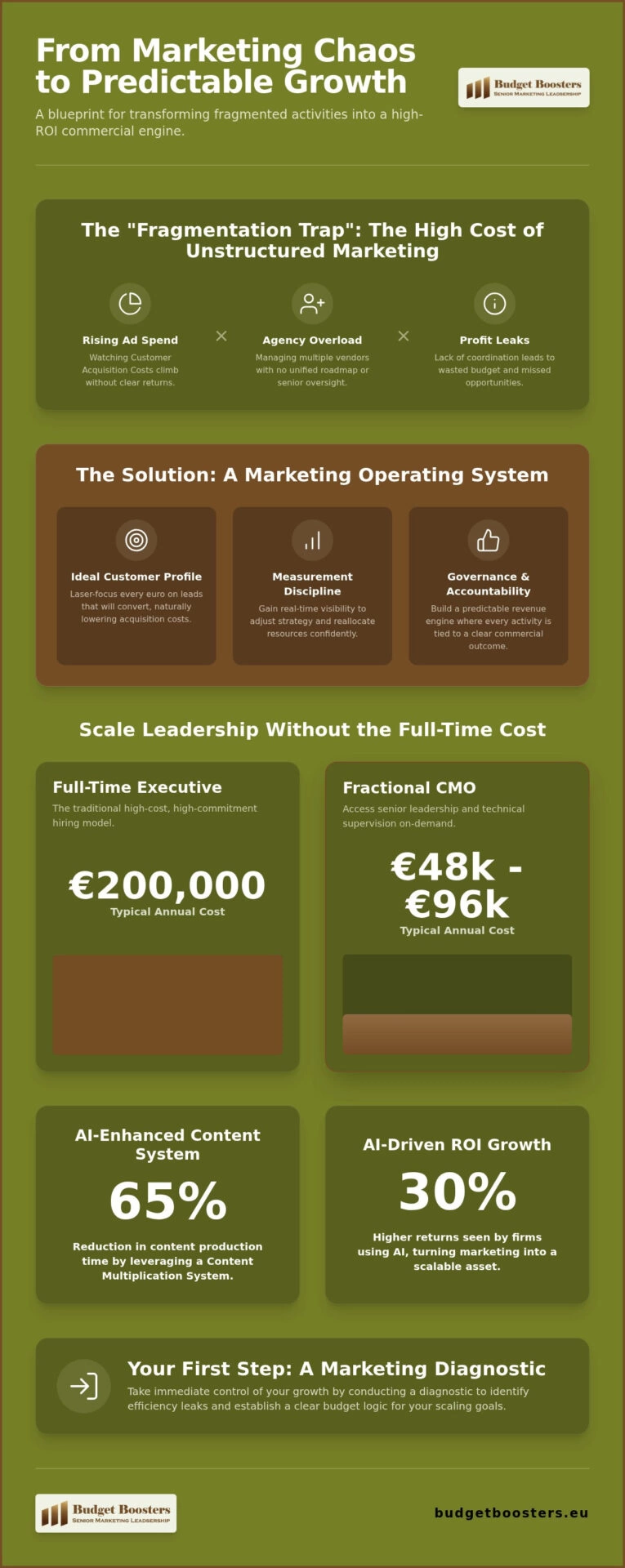
This article reveals how to reclaim your time and your budget by shifting from fragmented activities to a data-driven Marketing Operating System. We’ll show you how to build a predictable revenue engine that lowers costs and clarifies attribution. You’ll discover a strategic framework that replaces guesswork with evidence-based growth, similar to how firms using AI are now seeing returns up to 30 percent higher. It’s time to stop just doing marketing and start building a scalable asset for your company’s future.
Key Takeaways
- Shift your focus from simple ad spend to a holistic Marketing Operating System that integrates strategy, data, and execution for total commercial success.
- Discover how to improve marketing roi by building a structured growth engine that ensures every euro spent targets your ideal customer profile accurately.
- Access senior leadership and technical supervision for your marketing team for approximately €48,000 to €96,000, avoiding the €200,000 cost of a full-time executive.
- Slash your content production time by up to 65% using a Content Multiplication System that leverages AI to scale output while keeping your brand voice authentic.
- Take immediate control of your growth by conducting a Marketing Diagnostic to identify efficiency leaks and establish a clear budget logic for your scaling goals.
Redefining Marketing ROI: Beyond Ad Spend and Clicks
Imagine viewing your marketing department not as a source of endless bills, but as a high-precision investment portfolio. For many scaling companies, marketing feels like a series of fragmented activities; a social media post here, a paid ad campaign there, and perhaps a trade show once a year. When you operate this way, you’re merely “doing” marketing rather than building a commercial engine. True Return on marketing investment isn’t about vanity metrics like likes or clicks. It’s the total commercial return on every euro you commit to your growth strategy.
In the Baltics and Poland, the pressure to perform is intensifying. While Poland’s economy is projected to grow by 3.5% in 2026, the cost of acquiring customers is rising alongside this opportunity. You can’t afford to treat marketing as a tactical cost anymore. It must be a governed investment. If your activities aren’t tied to a clear revenue outcome, they’re likely draining your resources. Are you tired of feeling like you’re throwing money into a black hole? The path to clarity starts by shifting your mindset from activity-based tasks to system-based results. This is the first step in learning how to improve marketing roi effectively.
The ROI Calculation for Growth-Stage Firms
To truly understand your performance, you need a formula that reflects reality. The standard calculation is (Revenue – Marketing Investment) / Marketing Investment. However, many leaders make the mistake of only counting ad spend. To get an honest picture, your “Investment” side must include team salaries, agency fees, and software costs. Managing these vendor relationships effectively requires specialized procurement expertise, such as the training offered by CMI Communications & Management Institute, to ensure that every contract is optimized for the best possible return. You have to look at your Customer Acquisition Cost (CAC) as a primary health indicator. Is your CAC lower than the lifetime value of your customers? If not, your growth isn’t sustainable. By including every cent spent on the commercial engine, you gain the power to make bold, confident decisions about where to scale next.
Why Guesswork is the Enemy of Profit
Managing five different agencies without a unified roadmap is what we call the “fragmentation trap.” It places a massive psychological burden on you as a leader. Do you find yourself acting as the middleman between a SEO agency, a PPC specialist, and a content creator who don’t talk to each other? This lack of coordination is where profit goes to die. Without senior oversight to act as an architect, these individual activities will never form a cohesive system. Discovering how to improve marketing roi requires you to step out of the tactical weeds. To understand how a unified identity drives this process, you can learn more about Brand Central and their strategic approach. When you implement senior-level governance, you stop guessing and start leading a predictable revenue engine.
You don’t need more marketing activities; you need a Marketing Operating System. Think of this system as the architectural blueprint for your company’s growth. It’s a six-component framework designed to turn fragmented efforts into a predictable revenue engine. When you implement a structured system, you stop reacting to the latest trends and start leading with data. This shift is the most effective way to understand how to improve marketing roi because it provides a clear view of which levers actually drive profit.
One of the most powerful components of this system is your Ideal Customer Profile (ICP). Without a razor-sharp ICP, you’re likely wasting a significant portion of your budget on leads that will never close. In growth-stage firms across Poland and the Baltics, every euro counts. By narrowing your focus to the clients you serve best, you naturally lower your acquisition costs. Precision isn’t a limitation; it’s your fastest route to scaling. When your team knows exactly who they’re hunting, your market entry becomes a sequence of calculated wins rather than a series of expensive guesses.
Measurement discipline is the heartbeat of this operating system. It’s not just about looking at spreadsheets at the end of the quarter. It’s about having the visibility to make real-time strategy adjustments. If a channel isn’t performing, the system tells you immediately so you can reallocate those resources. This level of control gives you the freedom to experiment without risking your entire budget. You can explore the latest Fractional CMO Landscape Research 2026 to see how other regional leaders are building these systems to stay ahead.
Governance and Accountability
A system is only as good as the people who run it. You need a cadence of accountability that ensures your marketing efforts are always aligned with your sales goals. Board members and CEOs don’t care about vanity metrics like “brand awareness” in isolation. They care about pipeline velocity and the marketing department’s contribution to the bottom line. By setting outcome-based KPIs, you create a culture where every team member understands their impact on the company’s financial health. It’s about moving from “we’re busy” to “we’re producing results.” For many growing firms, this focus on fiscal discipline is supported by Financial Foothold, which provides the outsourced accounting and payroll administration necessary to maintain a clear view of the bottom line.
Stop trying to be everywhere at once. High-performing companies follow a strict budget logic, typically allocating between 5% and 10% of their annual revenue to marketing. If your firm earns €5,000,000, your budget should be a strategic investment of €250,000 to €500,000. This isn’t a cost to be minimized; it’s the fuel for your growth engine. Your channel strategy must be dictated by where your data shows the highest returns. If you’re looking for a way to verify your current setup, a professional marketing diagnostic can help you spot the efficiency leaks in your current budget allocation.
The Fractional CMO: Scaling Leadership Without the Full-Time Cost
Most scaling firms reach a point where tactical tweaks aren’t enough. You need a leader, but a full-time executive is a massive commitment. A full-time CMO often costs around €200,000 annually. That’s a heavy burden for a growing company. In contrast, a fractional leader provides the same senior expertise for between €48,000 and €96,000. This isn’t just about saving money; it’s about gaining an architect. A fractional CMO acts as a technical supervisor for your growth engine. They aren’t there to manage a single campaign. They are there to build the entire system that drives profit. This leadership shift is a fundamental part of how to improve marketing roi at the structural level.
We are seeing a massive shift in how companies manage growth. Our Fractional CMO Landscape Research 2026 shows that firms in Poland and the Baltics are moving away from fragmented execution toward part-time senior leadership. They want system builders who can align marketing with sales and provide real accountability. This research, grounded in data from Eurostat and global consultancies, highlights how senior oversight is becoming the standard for firms looking to lower their acquisition costs.
Bridging the Leadership Gap in the Baltics
Companies in Lithuania and Estonia often fall into the trap of hiring junior staff to handle complex strategy. It’s an unfair expectation. You wouldn’t ask a junior bricklayer to design a skyscraper. You need an architect to manage your external agencies and internal teams. This structural oversight is a game-changer. Look at how restructuring oversight grew revenue for Polmet Solutions. By having a senior leader at the helm, they turned fragmented efforts into a high-value deal pipeline. This is exactly how to improve marketing roi while freeing up your time to focus on the big picture.
Decision Framework for CEOs
Are you the default decision-maker for every marketing choice? That’s a bottleneck. A fractional leader removes that weight from your shoulders. They provide expert-led commercial oversight, reducing the strategic uncertainty that keeps you up at night. You can learn more about Marketing Leadership for SMBs and how it changes your daily operations. It’s about empowering your team with a roadmap they can actually follow.
To stay ahead of these trends, you should join our community. Subscribe to the Budget Boosters Newsletter for practical insights on demand generation and marketing technology. When you sign up, you’ll receive our free ebook, “The CMO Edge. Why Companies with Senior Marketing Leadership Outperform – and How to Get There” (a €24 value). It’s designed to help you make better decisions without needing a full-time director on the payroll.
Improving Content ROI with AI-Enhanced Systems
Content production is often a hidden profit killer in scaling companies. If your senior experts spend hours drafting articles instead of closing deals, your internal costs skyrocket. You can’t scale a business on manual labor alone. This is where most leaders struggle to understand how to improve marketing roi; they see content as a creative burden rather than a commercial asset. By implementing a Content Multiplication System, you can cut your production time by up to 65%. This isn’t about losing your soul to automation. It’s about using AI shortcuts to handle the structural work so your unique brand voice can shine through more frequently and effectively.
When you treat content as a system, you stop guessing what works. You start producing assets that serve a specific purpose in your revenue engine. This shift is essential for firms in Poland and the Baltics that need to maintain high output with lean teams. Using a structured approach allows you to increase your volume without sacrificing quality. If you want to see the exact frameworks we use to turn ideas into profit, explore our Improving Content ROI digital tool. It’s designed to help you bridge the gap between creative effort and measurable financial returns.
The Content Engine: Idea Bank to Production
The biggest bottleneck in marketing is the “blank page” syndrome. You can eliminate this by building a central Idea Bank that’s strictly aligned with your Ideal Customer Profile. Every piece of content should answer a specific question your prospects are asking. We recommend the “Bullet-to-Prose” method to capture senior expertise quickly. Your leaders don’t need to be writers; they just need to provide the raw insights. AI can then transform those bullets into polished, high-performing prose. To get started with these workflows, you can use these 7 Practical Ways to Streamline Content Creation with AI to refine your process immediately.
Measuring Content Performance
Stop looking at vanity metrics like “likes” or “shares” as signs of success. In a high-growth environment, the only metrics that matter are qualified lead volume and pipeline impact. Data-driven content frameworks can improve your conversion rates by 23% or more because they focus on the buyer’s journey rather than just entertainment. Automation also plays a vital role here. By using personalized email sequences, you can keep your brand top-of-mind without manual intervention. This level of discipline is how to improve marketing roi while keeping your team focused on high-value strategy.
Ready to turn your marketing into a high-precision system? Subscribe to the Budget Boosters Newsletter for practical insights on AI frameworks and demand generation. When you join, you’ll get a free copy of our ebook, “The CMO Edge. Why Companies with Senior Marketing Leadership Outperform – and How to Get There” (a €24 value). It’s your guide to making better commercial decisions without the cost of a full-time director.
5 Steps to Audit and Optimize Your Marketing ROI Today
Are you ready to stop the cycle of fragmented activities and start building a predictable revenue engine? Taking control of your growth doesn’t have to be an overwhelming task. It’s a journey from chaos to governance, and it begins with a few intentional steps. When you treat your marketing as a structured system, you gain the freedom to scale with confidence. To support this journey, MG Affiliate offers access to high-impact business and financial resources designed for scaling companies. Here is how to improve marketing roi through a clear, five-step audit process.
- Step 1: Conduct a Marketing Diagnostic. You can’t fix what you haven’t measured. A professional diagnostic identifies immediate efficiency leaks and spots where your budget is being swallowed by “activity noise.”
- Step 2: Define your Budget Logic. Stop guessing your spend. Align your investment with your growth goals, typically aiming for 5% to 10% of your total revenue. For a firm with €5,000,000 in revenue, this means a strategic investment of approximately €200,000 to €400,000.
- Step 3: Align Marketing and Sales. End the finger-pointing. Both teams must agree on a single, data-backed definition of a “Qualified Lead” to ensure your commercial engine is firing on all cylinders.
- Step 4: Implement a Measurement Cadence. Establish weekly, monthly, and quarterly reviews. This discipline allows you to make real-time adjustments based on performance data rather than gut feelings.
- Step 5: Choose Your Leadership Model. Decide if you need a fractional, interim, or full-time leader. A fractional architect can often provide the senior oversight you need for about €48,000 to €96,000, avoiding the €200,000+ cost of a full-time executive.
The Marketing Audit as a Growth Roadmap
A fixed-fee audit is the lowest-risk way to begin your transformation. It acts as a roadmap, showing you exactly which activities are driving profit and which are just costing you money. By identifying and cutting the “activity noise” immediately, you can often reallocate that budget to high-performing channels without needing a single extra euro. This structural clarity is a core part of our Demand Generation Guide, which helps firms in the Baltics and Poland build sustainable growth engines.
Next Steps: From Chaos to Governance
You deserve to feel in control of your company’s future. Marketing shouldn’t be a source of strategic uncertainty; it should be your most reliable asset. As Aurimas Guoga often says, “Financial discipline in marketing is not a constraint; it’s the foundation of creative freedom.” When you have a system that works, you can finally focus on the big-picture decisions that move the needle. If you’re tired of the guesswork, it’s time to book a Marketing Diagnostic with Budget Boosters and start your journey toward a predictable growth engine today.
To stay ahead of the latest trends in marketing technology and senior leadership, subscribe to our Budget Boosters Newsletter. You’ll gain practical insights and receive our ebook, “The CMO Edge. Why Companies with Senior Marketing Leadership Outperform – and How to Get There” (a €24 value), for free. For a deeper look at regional shifts, download our Fractional CMO Landscape Research 2026 to see how your peers are evolving.
Build Your Predictable Revenue Engine Today
You now have the blueprint to stop the fragmentation trap and start scaling with precision. By shifting to a Marketing Operating System, you turn your spend into a governed investment that board members actually value. We’ve explored how senior leadership provides the technical supervision your engine needs for approximately €48,000 to €96,000, which is a significant saving compared to the €200,000 cost of a full-time executive. Whether it’s slashing content production time by 65% with AI or finally aligning your sales and marketing teams, the path to clarity is open to you.
Learning how to improve marketing roi isn’t just about spreadsheets; it’s about reclaiming your freedom as a leader. We’ve delivered proven results in logistics, tech, and industrial sectors across the Baltics and Poland, and we’re ready to help you do the same. Don’t let another quarter pass in tactical chaos. You deserve a system that delivers predictable growth and peace of mind. Take the first step toward a more efficient future and Book Your Marketing Diagnostic & Audit today. You’re ready to level up.
Frequently Asked Questions
How long does it take to see an improvement in marketing ROI?
You can often see initial results within 90 days as you identify and fix immediate efficiency leaks. Building a complete Marketing Operating System takes longer, typically between three to six months. This timeframe allows you to establish a data-driven baseline and start seeing the impact of higher-quality leads on your pipeline. It’s not about an overnight miracle; it’s about creating a sustainable engine that delivers predictable revenue growth over time.
What is a good marketing ROI benchmark for scaling firms?
Do I really need a fractional CMO to improve my ROI?
Do I really need a fractional CMO to improve my ROI?
You don’t necessarily need a specific title, but you do need senior leadership to bridge the gap between strategy and execution. A fractional CMO provides this expert oversight without the €200,000 cost of a full-time executive. They act as the architect of your commercial system. If you want to know how to improve marketing roi, having someone who can manage specialized agencies like Populis Digital and internal teams with a data-driven roadmap is the fastest way to get there.
Mid-sized companies in Poland typically allocate between 5% and 10% of their annual revenue to marketing. If your company earns €5,000,000, a strategic investment would be approximately €200,000 to €400,000. This budget should cover everything from ad spend to team salaries and technology. Treating this as a governed investment rather than a tactical cost is a fundamental step in building a predictable growth engine that drives real results for your firm.
Can AI really help improve my marketing return on investment?
Yes, AI is a powerful tool for boosting efficiency and personalization. Companies using generative AI in their workflows report a 20% to 30% higher ROI compared to those using traditional methods. You can reduce content production time by up to 65%, allowing your team to focus on high-level strategy. This technology helps you scale your output without skyrocketing your costs, making it a critical component of how to improve marketing roi in 2026.
What is the difference between a fractional CMO and a marketing agency?
A marketing agency focuses on execution; they are the specialists who run your ads or write your blog posts—to see how this works in practice, check out jWeb Media. A fractional CMO is a system builder and a leader who sits on your side of the table. They provide the governance and accountability needed to ensure those agencies are actually delivering profit. Think of the fractional leader as the architect who designs the house, while the agencies are the contractors who build it.
An audit is an excellent low-risk investment for a company at the €5,000,000 revenue mark. It identifies “activity noise” and efficiency leaks that are likely draining your budget right now. By uncovering these hidden costs, you can reallocate funds to the channels that actually drive revenue. It provides a clear growth roadmap, giving you the control and confidence you need to make better commercial decisions as you continue to scale your business.
What are the most common reasons for poor marketing ROI in the Baltics?
The most common issues in the Baltics include fragmented, activity-based marketing and a lack of senior oversight. Many firms rely on junior hires to handle complex strategy, which often leads to high acquisition costs and poor lead quality. Without a sharp Ideal Customer Profile, companies waste budget on prospects who will never convert. Shifting to a governed Marketing Operating System is the solution to these common regional growth challenges and efficiency leaks.

Article by
Aurimas Guoga
Aurimas Guoga is a fractional CMO and founder of Budget Boosters, helping B2B companies turn fragmented marketing into a predictable growth engine. With over a decade of experience leading marketing strategy, he works with business leaders to improve ROI, build scalable systems, and drive measurable revenue growth. Aurimas is also the author of The CMO Edge, a guide for companies looking to gain a competitive advantage through senior marketing leadership.