What if the marketing leadership you need to scale isn’t actually out of reach? Many founders feel trapped by rising customer acquisition costs and a marketing budget that feels like a black box. You’re right to feel that way; guesswork is expensive. You deserve a clear roadmap and the freedom that comes from knowing every Euro is working for you. Understanding fractional CMO pricing is the first step toward reclaiming control over your growth strategy without the heavy overhead of a traditional hire.
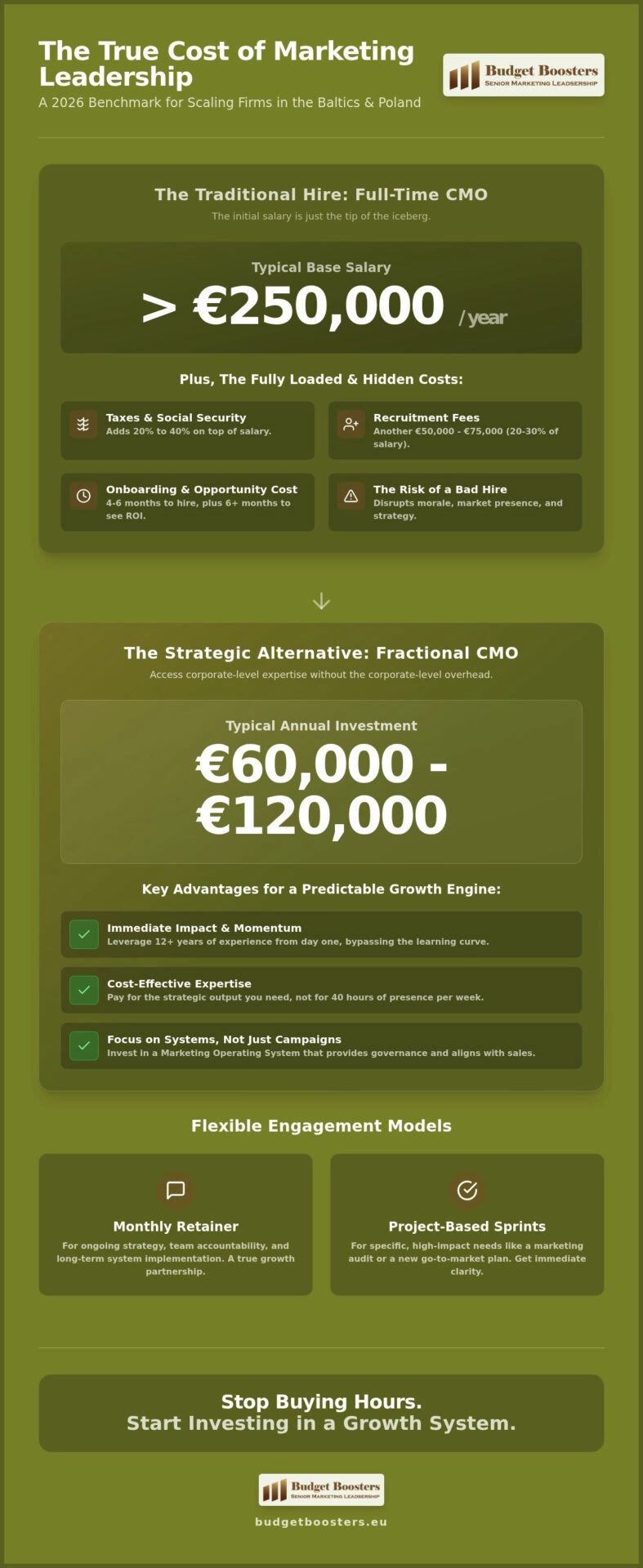
Hiring a full-time executive often carries a price tag exceeding €250 000, which can feel like an impossible hurdle for growing companies in the Baltics and Poland. This article reveals how you can access corporate-level expertise for €60 000 to €120 000 per year. We’ll show you how to stop the talent gamble and start building a predictable marketing machine. You’ll discover 2026 compensation benchmarks, a framework to choose the right model for your revenue stage, and how to finally turn marketing from a cost center into a growth engine.
Key Takeaways
- Stop guessing and start growing. Learn why a full-time CMO costs over €250 000 and how to manage the hidden taxes in your scaling firm.
- Gain a clear edge by understanding fractional CMO pricing to get executive expertise for €60 000 to €120 000 per year.
- Discover the 2026 salary benchmarks for Poland and the Baltics to ensure you aren’t overpaying for senior leadership.
- Move beyond buying hours. See how a structured Marketing Operating System turns your spend into a predictable growth engine.
- Find your complexity threshold. Know exactly when your business needs a fractional leader versus a full-time commitment.
The Total Cost of Hiring a Full-Time CMO in 2026
Thinking about hiring a Chief Marketing Officer (CMO)? It’s a massive step. It signals that you’re ready to stop playing small and start building a real legacy. But before you sign that employment contract, let’s look at the real numbers. In 2026, the sticker price of a full-time executive is rarely the final cost. For scaling firms in the Baltics and Poland, the financial commitment is often much higher than anticipated. You deserve to know exactly where your capital is going.
Base Salary vs. Fully Loaded Costs
A top-tier CMO expects a base salary starting around €250 000. That’s a significant investment for any balance sheet. Now, add local employment taxes and social security. In our region, these costs can add another 20% to 40% to the total. Don’t forget executive perks. Health insurance, car allowances, and performance bonuses are standard expectations. Then there’s the onboarding tax. It usually takes six months for a new leader to fully understand your systems and start delivering ROI. During that time, you’re paying full price for a learning curve. This is why many owners are now looking at fractional CMO pricing as a way to bypass these heavy upfront burdens and gain immediate momentum.
The Opportunity Cost of Recruitment
Finding the right person takes time. The average search for a C-suite leader lasts four to six months. What happens to your growth during that gap? It stalls. You’re also likely paying a recruitment agency 20% to 30% of the first year’s salary just to find them. That’s another €50 000 to €75 000 gone before day one. It’s a steep price for a search that offers no guarantees. Many companies also find themselves over-hiring. They pay for 40 hours of strategy every week when their current complexity only requires ten.
The risk of a bad hire is the biggest hidden danger. Executive churn doesn’t just cost money; it breaks team morale and disrupts your entire market presence. Our Fractional CMO Landscape Research 2026 shows that mid-sized firms are increasingly choosing agility over traditional employment. You gain the same high-level expertise without the recruitment fees or the long-term liability. By understanding how fractional CMO pricing works, you can keep your budget lean while your growth accelerates. Control isn’t about owning someone’s time; it’s about owning the results they produce.
Understanding Fractional CMO Pricing Models and Retainers
Scaling a business in the Baltics or Poland requires financial precision. You can’t afford to waste capital on hours that don’t move the needle. This is where the leadership model shifts. You are no longer buying an employee’s time; you are buying a proven growth system. Modern fractional CMO pricing reflects this focus on outcomes. It allows you to access top-tier talent without the heavy burden of a full-time executive salary. You get the expertise you need exactly when you need it.
The Monthly Retainer Structure
Predictability is the foundation of a healthy business. Monthly retainers are the most common way to engage fractional leadership. Most engagements for growth-stage firms fall between €60 000 and €120 000 per year. This fee covers high-level strategy, team accountability, and the implementation of a Marketing Operating System. You aren’t paying for someone to sit in a chair for 40 hours. You are paying for the 12+ years of experience that allows a leader to solve in four hours what a junior might struggle with for forty.
Retainers usually translate to a few days of dedicated focus per week. In the European market, senior day rates often sit between €1,500 and €3,000. By using a retainer, you lock in this expertise at a fixed rate. This aligns the CMO with your long-term revenue goals. It creates a partnership based on results rather than mere activity. If you want to see how this level of leadership transforms a business, explore our case study on turning leadership into a deal pipeline. This approach turns marketing from a black box into a transparent growth engine.
Project-Based Fees for Strategic Sprints
Not every business is ready for a long-term commitment right away. Sometimes, you need to fix a specific problem or launch a new initiative. Project-based fees are perfect for strategic sprints. This might include a comprehensive marketing audit or a go-to-market plan for a new product. These are often fixed-fee entry points that provide immediate clarity. A diagnostic audit, for example, replaces guesswork with a data-driven roadmap. It allows you to test the partnership before moving into an embedded fractional role. This approach reduces risk and builds trust. You get a clear win, a structured plan, and a taste of what professional marketing governance feels like.
Cost-Benefit Analysis: Fractional vs. Full-Time Leadership
Deciding between a full-time hire and a fractional leader isn’t just a budget exercise. It’s a strategic choice about how you want to scale. Most companies with €1M to €15M in revenue don’t need 160 hours of strategy a month. They need high-impact decisions and a system that runs itself. You don’t need to pay for someone’s presence. You need to pay for their perspective. When you look at fractional CMO pricing, you see more than just a lower number. You see efficiency. A €80 000 fractional leader often delivers a higher ROI than a €250 000 full-time executive because they focus entirely on high-leverage growth activities. They aren’t bogged down by internal politics or endless meetings. They are here to build your engine.
ROI and Efficiency Benchmarks
Senior oversight immediately reduces wasted spend. Think about your current ad accounts or agency fees. Are they truly optimized? A fractional leader brings financial discipline to every Euro you spend. Take Polmet Solutions as an example. By improving efficiency and implementing a structured Marketing Operating System, their revenue grew from €6.1 M to €7.4 M. That’s the power of senior oversight without the full-time overhead. If you want to see similar results, our guide on improving content ROI shows how to stop the bleed in your marketing budget. This structured approach ensures your customer acquisition costs (CAC) stay low while your gross margin grows.
The Cost of Strategic Uncertainty
The most expensive marketing mistake isn’t a bad ad. It’s a lack of leadership. Without a CMO, the CEO often becomes the default decision-maker for every campaign and creative choice. This creates a bottleneck. It slows you down. A fractional CMO removes this weight from your shoulders. They replace guessing with a data-driven roadmap. You gain the freedom to focus on the big picture while your marketing runs on a predictable system. This isn’t just about saving money; it’s about gaining the speed you need to win in the Baltics and Poland. You deserve a marketing department that feels like a well-oiled machine, not a source of constant stress.
Variables Driving Marketing Executive Rates in the Baltics and Poland
The market for marketing leadership is changing fast. In the Baltics and Poland, we are seeing a massive shift in how companies value senior talent. You aren’t just competing with local firms anymore. You’re competing in a global talent pool where agility is the new currency. This regional demand is driven by scaling tech and industrial sectors that need more than just a “head of marketing.” They need a builder. Our Fractional CMO Landscape Research 2026 highlights that 30% of midsize enterprises now prefer fractional roles to stay lean. Understanding the variables behind fractional CMO pricing helps you secure this talent without overextending your runway.
Regional Market Dynamics
Geography still plays a role in executive compensation. In Poland, a full-time CMO can earn between PLN 24,000 and PLN 51,000 per month. Meanwhile, base salaries in Estonia average around €115,900 per year, with Lithuania following at €92,200. These rates are often lower than in Western Europe, but the gap is closing as cross-border expertise becomes essential. If your business operates across multiple markets, you need a leader who understands the cultural nuances of the region. This local insight is a major pricing factor. A fractional leader provides this specialized knowledge at a fraction of the cost of a full-time hire from a Western hub. You get the same level of strategic depth while keeping your local competitive advantage.
Experience and Specialisation
Not all leadership is created equal. Generalists are great for early-stage coordination, but specialists in SaaS or industrial manufacturing command a premium. If you’re looking for someone who has managed growth from €1 M to €10 M+, expect that experience to be reflected in the fee. However, technology is now a great equalizer. Modern leaders use AI to augment their output. We’ve seen AI-driven content systems cut production time by up to 65%. This efficiency allows a fractional CMO to do more in ten hours than a traditional executive does in forty. You’re paying for the system they bring, not just their resume.
Ready to see how this leadership model fits your specific growth stage? Take a deep dive into the data with our Fractional CMO Landscape Research 2026 to benchmark your current marketing spend against the best in the region. Knowledge is power. Once you see the numbers, you can’t unsee the opportunity for better efficiency.
Investing in a System: The Budget Boosters Approach
Growth isn’t a happy accident. It’s the result of a deliberate, well-governed system. Most business owners we meet in the Baltics and Poland are tired of marketing feeling like a series of disconnected experiments. You might feel like you’re throwing money at campaigns without knowing what actually sticks. We change that. At Budget Boosters, we don’t just manage your marketing; we build your Marketing Operating System. This shift from tactical “doing” to strategic governance is what justifies fractional CMO pricing. You aren’t just paying for a person. You are investing in a repeatable asset that generates revenue long after the initial setup.
Our 6-component framework is designed to provide total clarity. We focus on your Ideal Customer Profile (ICP), Go-to-Market (GTM) sequencing, and a rigorous budget logic. This ensures every Euro spent has a clear purpose. We move you away from simple campaign management toward revenue governance. This means your marketing decisions are based on data, not gut feelings. You gain the freedom to lead your company while the system handles the complexity of growth.
The Marketing Operating System
A system provides what a single hire cannot: permanent accountability. Our approach replaces guesswork with financial discipline. This Marketing Operating System acts as a governance tool for your internal teams and external agencies. It sets clear benchmarks and measurement protocols. No more vague reports. No more “black box” spending. By implementing a governed marketing cadence, you ensure that everyone is aligned with your financial goals. This structured environment fosters a culture of performance. It turns your marketing department into a predictable growth engine that scales with your ambition.
Getting Started with a Diagnostic
You don’t have to commit to a full transformation on day one. We believe in proving value quickly. The best way to begin is with our Marketing Diagnostic & Audit. It’s a low-risk way to identify the efficiency gaps that are currently draining your budget. From this audit, we build a 90-day growth roadmap. This plan gives you immediate, actionable steps to improve your ROI and streamline your operations. It’s about finding the “quick wins” while laying the foundation for long-term success.
Ready to take the first step toward marketing mastery? Subscribe to our newsletter to stay ahead of the latest trends in the region. When you join, you’ll also receive our ebook, The CMO Edge, for free. It’s time to stop guessing and start leading with confidence. Let’s build something remarkable together.
Step Into Your Next Level of Growth
You now have the roadmap to move from marketing uncertainty to strategic clarity. Choosing the right leadership isn’t about simply filling a seat; it’s about installing a system that scales with your ambition. We’ve seen how professional oversight helped Polmet Solutions grow revenue from €6.1 M to €7.4 M while boosting marketing efficiency by 22%. By understanding fractional CMO pricing, you can secure 12+ years of senior expertise for your business in the Baltics or Poland without the €250 000 overhead.
Control over your marketing budget is not a dry constraint. It’s the path to personal freedom and business independence. You’ve done the hard work of building your company from the ground up. Now, it’s time to give it the engine it deserves. Your growth is no longer a question of “if,” but “how fast.” You deserve a partner who understands the local market and knows how to turn a budget into a legacy.
Subscribe to the Budget Boosters Newsletter and get ‘The CMO Edge’ ebook for free to start your transformation today. We’re ready to help you level up and reclaim your time.
Frequently Asked Questions
What is the average salary of a full-time CMO in 2026?
A full-time Chief Marketing Officer in 2026 typically commands a base salary exceeding €250 000. In regional markets like Poland, monthly rates range between PLN 24 000 and PLN 51 000. In Estonia, the average base pay is approximately €115 900 per year. These figures represent only the starting point. When you add executive benefits, bonuses, and social security taxes, the total investment for a permanent hire becomes a major commitment for scaling firms.
How much does a fractional CMO cost per month in Poland or the Baltics?
Monthly fractional CMO pricing usually falls between €5 000 and €10 000 for companies in the Baltics and Poland. This translates to an annual investment of €60 000 to €120 000. This model allows you to access senior leadership for 1 to 3 days per week. It’s a strategic way to gain corporate-level expertise without the heavy financial burden of a full-time executive. You pay for high-impact strategy and results rather than just forty hours of presence.
Are there hidden costs when hiring a fractional marketing leader?
One of the biggest advantages of fractional leadership is the lack of hidden overhead. Unlike full-time hires, you don’t pay recruitment fees, which typically cost 20% to 30% of an annual salary. There are no long-term benefit packages, car allowances, or social security taxes to manage. You agree on a fixed retainer or project fee upfront. This transparency in fractional CMO pricing gives you total control over your budget and allows for predictable financial planning as you scale.
Can a fractional CMO manage my existing marketing team and agencies?
Yes, providing senior oversight for your internal team and external agencies is a core responsibility. A fractional leader implements a Marketing Operating System to ensure everyone is held accountable to specific KPIs. They act as a bridge between your business goals and the tactical execution of your staff. This removes the CEO from the daily decision-making loop. Your team gains a mentor, and your agencies receive clearer, more professional direction to improve their performance.
What is the typical length of a fractional CMO engagement?
Engagements typically last between six and twelve months, though many companies maintain the relationship longer as they grow. Some firms start with a 90-day diagnostic sprint to identify efficiency gaps and set a clear roadmap. The goal is to build a repeatable system that eventually runs with less senior intervention. You have the flexibility to adjust the scope as your business complexity changes. This ensures you always have the right level of support at every stage of growth.
How do I know if my business is ready for senior marketing leadership?
You’re ready when marketing feels like a “black box” of wasted spend or when growth has plateaued despite high activity. If you’re an owner-led B2B firm with revenue between €1 M and €15 M, you likely need a strategist rather than more hands-on execution. You’ve outgrown tactical coordination and need a professional to own the revenue outcomes. Senior leadership replaces guessing with a data-driven system that gives you the freedom to focus on scaling your vision.
Does a fractional CMO provide hands-on ad execution or just strategy?
A fractional CMO focuses on high-level strategy, revenue governance, and team leadership. They don’t typically handle hands-on ad execution or technical setup. Instead, they define the budget logic, channel strategy, and messaging that your internal team or external agencies implement. This ensures your tactical spend is aligned with your long-term goals. They provide the “architect’s plans” while supervising the “builders” to ensure the final result meets your growth objectives and professional standards.
How does the ROI of a fractional CMO compare to a marketing agency?
An agency sells you execution services, whereas a fractional leader sells you commercial outcomes and governance. The ROI of a CMO often comes from making your existing agencies more efficient. For example, Polmet Solutions saw a 22% increase in marketing efficiency through better oversight. A CMO ensures you aren’t over-investing in the wrong channels. They provide the financial discipline and strategic focus that an execution-focused agency simply isn’t designed to offer your business.

Article by
Aurimas Guoga
Aurimas Guoga is a fractional CMO and founder of Budget Boosters, helping B2B companies turn fragmented marketing into a predictable growth engine. With over a decade of experience leading marketing strategy, he works with business leaders to improve ROI, build scalable systems, and drive measurable revenue growth. Aurimas is also the author of The CMO Edge, a guide for companies looking to gain a competitive advantage through senior marketing leadership.