Fractional CMO vs Marketing Agency: Choosing the Strategic Path to Growth in 2026

What if the reason your marketing feels like a black hole isn’t a lack of effort, but a lack of architecture? You’re likely tired of acting as the bottleneck for every campaign decision while watching your Customer Acquisition Costs climb. It’s frustrating to manage a team of specialists who execute tasks but don’t own the bottom-line results. You want a system that breathes on its own, not another vendor to micromanage.

We understand that pressure. It’s the weight of wanting to scale while feeling stuck in the tactical weeds. This article clarifies the fractional CMO vs marketing agency choice by highlighting the difference between hiring execution and building a strategic foundation. You’ll learn how to shift from fragmented activities to a predictable, data-driven growth engine that boosts your gross margins and frees up your time.

We’re going to dive into the specific structural roles each path plays in your 2026 growth plan. We’ll explore how to move beyond “doing more” and start “growing better.” By the end, you’ll know exactly how to step out of the marketing director role and back into your seat as a visionary leader.

Key Takeaways

  • Stop confusing execution with strategy. Learn why the fractional CMO vs marketing agency debate is actually about choosing between running campaigns and building a predictable revenue engine.
  • Escape the “Activity Trap” where more marketing tasks only lead to higher costs. Identify the triggers that signal it’s time to stop doing and start governing.
  • Shift your focus from 30-day channel metrics to a 24-month growth horizon. Discover how to build a marketing system that runs without your constant input.
  • Protect your gross margins with executive-level budget logic. A strategic architect ensures every euro spent serves a specific commercial outcome.
  • Scale your leadership without the full-time executive price tag. Understand how fractional expertise provides the high-level guidance you need to hit your 2026 targets.

Beyond Tactical Execution: Why Agencies Often Hit a Ceiling

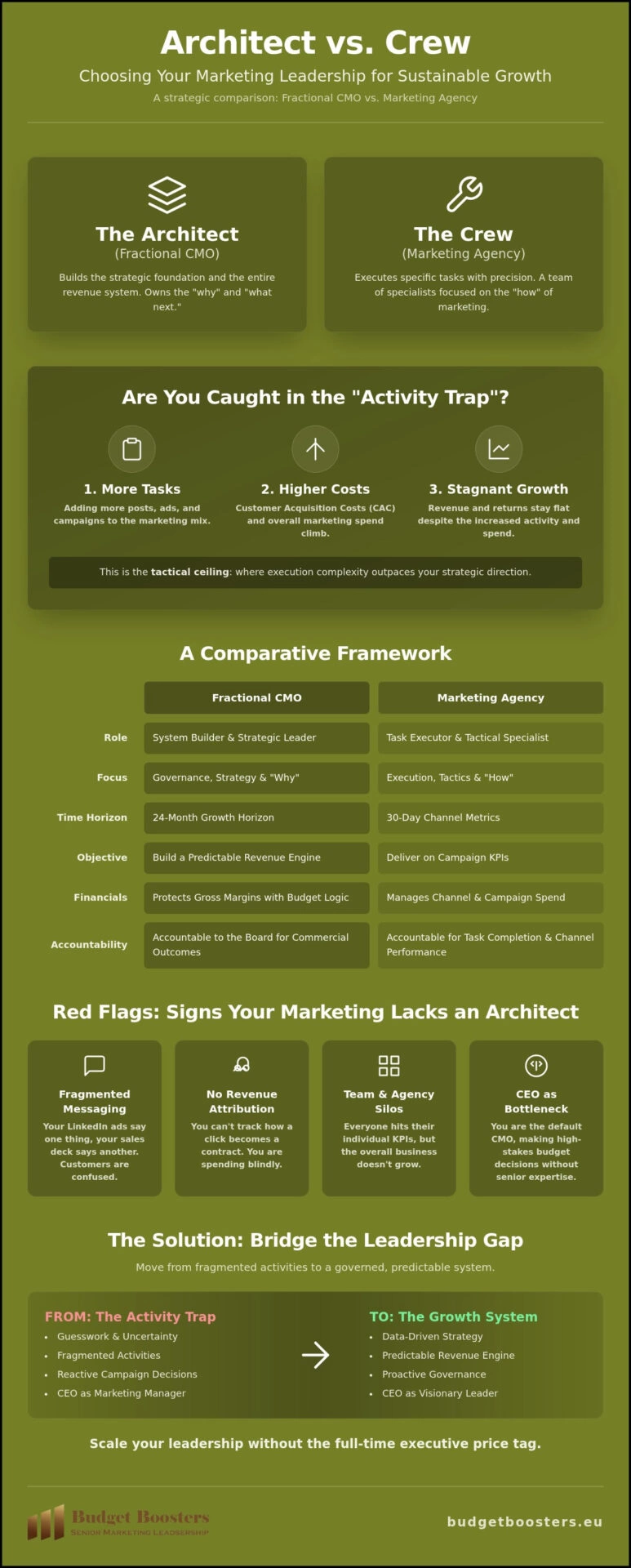
Most agencies are specialists. They live in the details. They master the algorithms, design beautiful layouts, and manage your social channels with precision—you can learn more about Socialift to see how these specialists drive engagement. This is tactical delivery. It’s essential, but it isn’t strategy. When you weigh the choice of a fractional CMO vs marketing agency, you’re really deciding between a crew and an architect. An agency focuses on the “how” of marketing, while your business needs someone to own the “why” and the “what next.”

To better understand the structural differences between these two paths, watch this breakdown:
Fractional CMO vs. Marketing Agency: Which One Should You Choose?

Without a Chief Marketing Officer to set the direction, you’ll likely fall into the “Activity Trap.” This happens when you keep adding more tasks, more posts, and more ads, but your returns stay flat. Your costs climb while your growth stalls. This is the tactical ceiling. It’s the point where the complexity of your execution outpaces your strategic direction. If you don’t have a leader governing the system, you’re just paying for motion, not progress.

The Symptoms of an Under-Led Marketing Operation

How do you know if you’ve hit that ceiling? Look for these signs. Is your messaging fragmented? If your LinkedIn ads say one thing and your sales deck says another, your ideal customers get confused. You might also notice a total lack of revenue attribution. If you can’t see how a lead moves from a click to a contract, you’re flying blind. Often, internal teams and agencies work in silos. They hit their individual KPIs, but the business isn’t actually growing. In the fractional CMO vs marketing agency comparison, the CMO is the one who breaks those silos down to create a unified roadmap.

The Psychological Burden of the CEO-as-Marketer

When you only hire tactical agencies, you remain the default strategy owner. That’s a heavy weight to carry. You’re forced to make high-stakes budget decisions without senior expertise. It leads to guesswork. You wonder if you should be on TikTok or if you should double your Google Ads spend. This uncertainty causes stress and financial waste. It’s exhausting to be the bottleneck for every campaign decision.

You deserve to move from guesswork to a proven system. Control over your marketing shouldn’t feel like a chore; it should feel like freedom. For example, look at this case study on turning LinkedIn into a deal pipeline. It illustrates how shifting from random activity to a strategic system creates a predictable flow of business. You can step out of the weeds and back into your role as a visionary leader.

The Fractional CMO as Architect: Defining Strategic Leadership in 2026

A Chief Marketing Officer isn’t just a senior marketer with a fancy title. They’re a commercial architect. In 2026, the real value isn’t in knowing how to click buttons in an ad manager. It’s in knowing how to protect your gross margins and scale your revenue. When you’re weighing the fractional CMO vs marketing agency path, you’re deciding if you need a pair of hands or a head for strategy. One executes tasks; the other builds a system that works while you sleep.

Think of it as marketing governance. A CMO provides accountability to your company board. They don’t just ask “How do we run this ad?” They ask “How does this investment drive revenue?” By focusing on budget logic and commercial outcomes, they ensure your marketing spend isn’t just a cost, but a calculated investment. When evaluating your options, consider the benefits of a fractional CMO, specifically their ability to provide this executive oversight without the massive overhead of a full-time hire. They don’t just manage tasks; they govern a comprehensive marketing strategy.

The 6 Components of a Marketing Operating System

To scale, you need a repeatable process. Guesswork is the enemy of growth. A fractional CMO implements a Marketing Operating System that focuses on three critical pillars:

  • ICP and Go-to-Market Sequencing: Ensuring you target the right segments at the right time. You stop wasting money on audiences that won’t convert.
  • Channel Strategy and Budget Logic: We move away from “spend and pray” tactics. Every euro has a job to do.
  • Measurement Discipline: We set a performance cadence. This creates a rhythm for predictable growth that the whole company can see.

Cross-Functional Alignment and Sales Synergy

Marketing can’t live on an island. A CMO bridges the gap between your creative efforts and your sales team. They align these departments to fill the demand generation pipeline with high-quality leads. This synergy ensures that when marketing generates interest, sales is ready to close the deal. It’s about positioning your product so clearly that the market can’t ignore you.

This architectural efficiency is often supported by tools like The Content System, which streamlines how your brand communicates across all platforms. If you’re ready to see where your current setup is leaking revenue, exploring The CMO Edge can help you find those gaps and start building your engine. You don’t have to be the bottleneck anymore. It’s time to step into a role where you lead the growth, rather than just managing the chaos.

Marketer and Agency vs Fractional CMO: A Comparative Framework

Agencies do. CMOs direct. This is the fundamental shift you need to grasp when weighing a fractional CMO vs marketing agency. Most agencies are built to manage specific channels. They optimize your Google Ads or design your email templates. They look at the next 30 days. A fractional CMO looks at the next 12 to 24 months. They don’t just report on clicks; they analyze Customer Lifetime Value (CLV) and how it impacts your gross margins. You aren’t just buying hours; you’re buying a vision for your company’s future.

In the Baltics and Poland, we’re seeing a massive shift toward this model. Our Fractional CMO Landscape Research 2026 shows that regional firms are moving away from purely tactical outsourcing. They’ve realized that while you can outsource tasks, you cannot outsource the soul of your business. You need strategic leadership in marketing to remain competitive in a crowded market. A leader ensures that every tactical move serves a larger commercial goal.

Responsibility vs Accountability

There’s a subtle but vital difference between these two concepts. An agency is responsible for the campaign. They ensure the ads run and the posts go live. A CMO is accountable for the revenue result. They sit on your side of the table. They manage your external agencies to make sure they deliver actual ROI, not just vanity metrics like “likes” or “impressions.”

This senior oversight is exactly what’s needed for improving Content ROI. Without someone governing the system, content often becomes a “nice to have” rather than a lead generation machine. A CMO ensures that your content strategy aligns perfectly with your sales pipeline. They turn creative output into a measurable business asset. It’s about moving from “hope” to “certainty.”

The Cost of Strategic Misalignment

Hiring another junior marketer or a low-cost agency won’t solve a leadership deficit. It usually makes it worse. You end up with more people to manage and more fragmented activities that don’t scale. This is the hidden cost of activity-driven marketing. You waste your budget on “random acts of marketing” while missing critical market windows. You don’t need more “doing.” You need a better blueprint. When you align your execution with a high-level strategy, your Customer Acquisition Costs (CAC) drop because your efforts are finally focused on the right targets. You gain the freedom to lead while the system handles the noise.
Fractional CMO vs Marketing Agency: Choosing the Strategic Path to Growth in 2026

Bridging the Leadership Gap: From Activity to Governance

When does a growing company stop needing more “hands” and start needing a “head”? For most mid-sized firms in the Baltics and Poland, the trigger is revenue. We typically see this transition happen when a company hits the €1M to €15M range. At this stage, the complexity of managing multiple channels and a growing internal team becomes too much for a CEO to handle alone. This is the moment when the fractional CMO vs marketing agency debate becomes a critical business decision. You don’t just need more ads; you need a system of governance.

You might be wondering if you need an interim leader or a fractional one. An interim CMO usually fills a temporary gap during a recruitment phase. A fractional CMO, however, is a long-term strategic partner. They embed themselves in your team to build the architectural foundation for growth. If you want practical insights on building this system, subscribe to our newsletter and grab your free copy of The CMO Edge. It’s a €23 value that explains why companies with senior leadership consistently outperform their peers.

The “Is My Business Ready?” Checklist

Ask yourself these three questions to see if you’ve outgrown your current setup. First, do you have a documented marketing leadership plan that spans the next 18 months? Second, are you still the primary person approving every creative asset or budget line? Finally, is your sales team complaining about lead quality despite high marketing activity? If you answered yes to the last two, you’re acting as a bottleneck. You’re stuck in activity when you should be focused on results.

Governance and Financial Discipline

Strategic leadership brings financial discipline to your creative efforts. A CMO helps you set marketing budgets as a percentage of revenue, typically between 5% and 10%. They establish a predictable cadence for performance reviews. This ensures you make strategic adjustments based on data, not gut feelings. You can also leverage AI to streamline content creation. This keeps your costs low while maintaining a consistent strategic voice across all platforms. It’s about working smarter, not just harder.

Growth shouldn’t feel like a constant struggle for control. It should feel like a well-oiled machine that you oversee with confidence. If you’re ready to stop micromanaging and start leading, explore how our Fractional CMO services can build that engine for you. You deserve a marketing system that runs without your constant input, allowing you to focus on the big picture.

The Fractional Solution: Scaling Without the Full-Time Executive Cost

The choice between a fractional CMO vs marketing agency often comes down to one thing: how much value do you place on leadership? You don’t always need a full-time executive sitting in your office for 40 hours a week. For lean organizations, that’s often overkill. You need the expertise, not the hours. The fractional model gives you senior leadership 1 to 3 days per week, embedded directly into your team. It’s the most efficient way to get a corporate-level architect without the corporate-level complexity. This approach clarifies the fractional CMO vs marketing agency dynamic by positioning the leader as the one who builds the engine while others turn the gears.

Financially, the math is simple. A full-time CMO at the executive level can easily cost €200,000 or more annually. A fractional leader provides that same strategic depth for a fraction of the price, typically ranging from €48,000 to €96,000 per year. You save on overhead while gaining a system builder who directs your agency to execute with precision. It’s about buying a result, not just a timesheet. Control over your growth becomes an exciting path to freedom, not a financial burden.

Why Baltic and Polish Firms are Choosing Fractional Leaders

Companies in our region are waking up to the power of flexibility. You can scale your engagement up or down based on your current growth phase. It gives you the freedom to move fast without being weighed down by high fixed costs. Take Polmet Solutions as an example. By implementing fractional leadership, they saw revenue grow from €6.1M to €7.4M. More importantly, they improved their gross margin by 2.3 percentage points through strategic restructuring. They didn’t just do more marketing; they built a more profitable system.

Getting Started: The Marketing Diagnostic

You don’t have to commit to a long-term retainer on day one. We believe in starting with a fixed-fee Marketing Diagnostic & Audit. It’s a low-pressure way to identify immediate efficiency improvements and find the “low-hanging fruit” for ROI. This audit creates a clear roadmap for the next 90 days. It replaces guesswork with data and sets the stage for a predictable growth engine.

If you’re ready to see how your content can drive more value, check out our guide on improving Content ROI. It’s a practical step toward building a system that runs without your constant input. Stop acting as the bottleneck. Step into your role as a visionary leader and let the architecture do the heavy lifting for you.

Ready to Step Into Your Role as a Visionary Leader?

You’ve seen that the choice between a fractional CMO vs marketing agency isn’t just about who does the work. It’s about who designs the system. By shifting from tactical execution to strategic architecture, you stop being the bottleneck in your own business. You move from random acts of marketing to a predictable revenue engine that drives real commercial results. It’s time to reclaim your time and focus on the big picture.

This transition is incredibly powerful. Strategic alignment can reduce your Customer Acquisition Costs by 18%. Growth-stage firms often see revenue increases of 25% when they have a senior leader at the helm. You get this executive expertise at a fraction of the cost of a full-time hire. It’s not just a service; it’s a lifestyle change for you and your company.

Stop managing chaos and start governing growth. Build your predictable growth engine with a Fractional CMO today. You have the vision. Now you just need the blueprint to make it a reality. Let’s build something extraordinary together.

Frequently Asked Questions

Do I need a full-time CMO if my revenue is under €5M?

No, you likely don’t. For firms in the €1M to €5M range, a full-time executive salary is often a heavy and unnecessary overhead. A fractional leader provides the same strategic depth for a fraction of the cost. It’s about getting the right architecture for your current stage without the organizational complexity of a full-time hire.

What is the main difference between a marketing agency and a fractional CMO?

Agencies manage channels and execute tasks; CMOs build systems and own revenue results. When comparing a fractional CMO vs marketing agency, the CMO acts as the architect who directs the agency’s crew. One focuses on the next 30 days of activity, while the other looks at a 12 to 24 month growth horizon for your entire business.

How much does a fractional CMO cost compared to a full-time hire?

A fractional leader typically costs between €48,000 and €96,000 per year. In contrast, a full-time executive often requires a salary of €200,000 or more. This model allows you to access high-level corporate expertise while keeping your organization lean. You pay for the strategic impact rather than just a 40-hour work week.

Can a fractional CMO manage my existing marketing agency?

Yes, and they absolutely should. A fractional CMO takes the burden of micromanagement off your shoulders by holding your agencies accountable for ROI rather than just vanity metrics. They ensure your external vendors align with your long-term commercial outcomes. You can finally stop being the bottleneck for every campaign decision.

What is a Marketing Operating System and why do I need one?

It’s a proprietary framework that replaces guesswork with data-driven processes. You need one to stop the random acts of marketing that waste your budget and drain your energy. A system creates a predictable rhythm for lead volume and performance reviews. It ensures your marketing runs as a disciplined business function rather than a series of experiments.

How long does it take to see results from a CMO-led strategy?

You can often see immediate efficiency gains within the first 90 days after a diagnostic audit. While building a complete revenue engine takes time, fixing budget leaks and identifying low-hanging fruit happens quickly. True strategic shifts usually mature over a 6 to 12 month period as your new systems take hold.

Is a fractional CMO better than hiring a marketing manager?

They serve different purposes. A marketing manager is a doer who handles day-to-day tasks. A CMO is a leader who defines the vision and budget logic. If you lack a clear growth roadmap, hiring more doers won’t solve your leadership deficit. You need someone to build the blueprint before you hire more people to lay the bricks.

What industries in the Baltics and Poland benefit most from fractional leadership?

B2B firms in technology, manufacturing, and professional services see the highest impact. These sectors often face complex sales cycles and high Customer Acquisition Costs. A fractional leader helps these firms in Poland and the Baltics scale by building a structured marketing system. It’s a proven way to level up your performance in a competitive regional market.

Aurimas Guoga

Article by

Aurimas Guoga

Aurimas Guoga is a fractional CMO and founder of Budget Boosters, helping B2B companies turn fragmented marketing into a predictable growth engine. With over a decade of experience leading marketing strategy, he works with business leaders to improve ROI, build scalable systems, and drive measurable revenue growth. Aurimas is also the author of The CMO Edge, a guide for companies looking to gain a competitive advantage through senior marketing leadership.

Fractional CMO vs Marketing Agency: Choosing the Strategic Path to Growth in 2026

What if the reason your marketing feels like a black hole isn’t a lack of effort, but a lack of architecture? You’re likely tired of acting as the bottleneck for every campaign decision while watching your Customer Acquisition Costs climb. It’s frustrating to manage a team of specialists who execute tasks but don’t own the bottom-line results. You want a system that breathes on its own, not another vendor to micromanage.

We understand that pressure. It’s the weight of wanting to scale while feeling stuck in the tactical weeds. This article clarifies the fractional CMO vs marketing agency choice by highlighting the difference between hiring execution and building a strategic foundation. You’ll learn how to shift from fragmented activities to a predictable, data-driven growth engine that boosts your gross margins and frees up your time.

We’re going to dive into the specific structural roles each path plays in your 2026 growth plan. We’ll explore how to move beyond “doing more” and start “growing better.” By the end, you’ll know exactly how to step out of the marketing director role and back into your seat as a visionary leader.

Key Takeaways

  • Stop confusing execution with strategy. Learn why the fractional CMO vs marketing agency debate is actually about choosing between running campaigns and building a predictable revenue engine.
  • Escape the “Activity Trap” where more marketing tasks only lead to higher costs. Identify the triggers that signal it’s time to stop doing and start governing.
  • Shift your focus from 30-day channel metrics to a 24-month growth horizon. Discover how to build a marketing system that runs without your constant input.
  • Protect your gross margins with executive-level budget logic. A strategic architect ensures every euro spent serves a specific commercial outcome.
  • Scale your leadership without the full-time executive price tag. Understand how fractional expertise provides the high-level guidance you need to hit your 2026 targets.

Beyond Tactical Execution: Why Agencies Often Hit a Ceiling

Most agencies are specialists. They live in the details. They master the algorithms, design beautiful layouts, and manage your social channels with precision—you can learn more about Socialift to see how these specialists drive engagement. This is tactical delivery. It’s essential, but it isn’t strategy. When you weigh the choice of a fractional CMO vs marketing agency, you’re really deciding between a crew and an architect. An agency focuses on the “how” of marketing, while your business needs someone to own the “why” and the “what next.”

To better understand the structural differences between these two paths, watch this breakdown:

Fractional CMO vs. Marketing Agency: Which One Should You Choose?

Without a Chief Marketing Officer to set the direction, you’ll likely fall into the “Activity Trap.” This happens when you keep adding more tasks, more posts, and more ads, but your returns stay flat. Your costs climb while your growth stalls. This is the tactical ceiling. It’s the point where the complexity of your execution outpaces your strategic direction. If you don’t have a leader governing the system, you’re just paying for motion, not progress.

The Symptoms of an Under-Led Marketing Operation

How do you know if you’ve hit that ceiling? Look for these signs. Is your messaging fragmented? If your LinkedIn ads say one thing and your sales deck says another, your ideal customers get confused. You might also notice a total lack of revenue attribution. If you can’t see how a lead moves from a click to a contract, you’re flying blind. Often, internal teams and agencies work in silos. They hit their individual KPIs, but the business isn’t actually growing. In the fractional CMO vs marketing agency comparison, the CMO is the one who breaks those silos down to create a unified roadmap.

The Psychological Burden of the CEO-as-Marketer

When you only hire tactical agencies, you remain the default strategy owner. That’s a heavy weight to carry. You’re forced to make high-stakes budget decisions without senior expertise. It leads to guesswork. You wonder if you should be on TikTok or if you should double your Google Ads spend. This uncertainty causes stress and financial waste. It’s exhausting to be the bottleneck for every campaign decision.

You deserve to move from guesswork to a proven system. Control over your marketing shouldn’t feel like a chore; it should feel like freedom. For example, look at this case study on turning LinkedIn into a deal pipeline. It illustrates how shifting from random activity to a strategic system creates a predictable flow of business. You can step out of the weeds and back into your role as a visionary leader.

The Fractional CMO as Architect: Defining Strategic Leadership in 2026

A Chief Marketing Officer isn’t just a senior marketer with a fancy title. They’re a commercial architect. In 2026, the real value isn’t in knowing how to click buttons in an ad manager. It’s in knowing how to protect your gross margins and scale your revenue. When you’re weighing the fractional CMO vs marketing agency path, you’re deciding if you need a pair of hands or a head for strategy. One executes tasks; the other builds a system that works while you sleep.

Think of it as marketing governance. A CMO provides accountability to your company board. They don’t just ask “How do we run this ad?” They ask “How does this investment drive revenue?” By focusing on budget logic and commercial outcomes, they ensure your marketing spend isn’t just a cost, but a calculated investment. When evaluating your options, consider the benefits of a fractional CMO, specifically their ability to provide this executive oversight without the massive overhead of a full-time hire. They don’t just manage tasks; they govern a comprehensive marketing strategy.

The 6 Components of a Marketing Operating System

To scale, you need a repeatable process. Guesswork is the enemy of growth. A fractional CMO implements a Marketing Operating System that focuses on three critical pillars:

  • ICP and Go-to-Market Sequencing: Ensuring you target the right segments at the right time. You stop wasting money on audiences that won’t convert.
  • Channel Strategy and Budget Logic: We move away from “spend and pray” tactics. Every euro has a job to do.
  • Measurement Discipline: We set a performance cadence. This creates a rhythm for predictable growth that the whole company can see.

Cross-Functional Alignment and Sales Synergy

Marketing can’t live on an island. A CMO bridges the gap between your creative efforts and your sales team. They align these departments to fill the demand generation pipeline with high-quality leads. This synergy ensures that when marketing generates interest, sales is ready to close the deal. It’s about positioning your product so clearly that the market can’t ignore you.

This architectural efficiency is often supported by tools like The Content System, which streamlines how your brand communicates across all platforms. If you’re ready to see where your current setup is leaking revenue, exploring The CMO Edge can help you find those gaps and start building your engine. You don’t have to be the bottleneck anymore. It’s time to step into a role where you lead the growth, rather than just managing the chaos.

Marketer and Agency vs Fractional CMO: A Comparative Framework

Agencies do. CMOs direct. This is the fundamental shift you need to grasp when weighing a fractional CMO vs marketing agency. Most agencies are built to manage specific channels. They optimize your Google Ads or design your email templates. They look at the next 30 days. A fractional CMO looks at the next 12 to 24 months. They don’t just report on clicks; they analyze Customer Lifetime Value (CLV) and how it impacts your gross margins. You aren’t just buying hours; you’re buying a vision for your company’s future.

In the Baltics and Poland, we’re seeing a massive shift toward this model. Our Fractional CMO Landscape Research 2026 shows that regional firms are moving away from purely tactical outsourcing. They’ve realized that while you can outsource tasks, you cannot outsource the soul of your business. You need strategic leadership in marketing to remain competitive in a crowded market. A leader ensures that every tactical move serves a larger commercial goal.

Responsibility vs Accountability

There’s a subtle but vital difference between these two concepts. An agency is responsible for the campaign. They ensure the ads run and the posts go live. A CMO is accountable for the revenue result. They sit on your side of the table. They manage your external agencies to make sure they deliver actual ROI, not just vanity metrics like “likes” or “impressions.”

This senior oversight is exactly what’s needed for improving Content ROI. Without someone governing the system, content often becomes a “nice to have” rather than a lead generation machine. A CMO ensures that your content strategy aligns perfectly with your sales pipeline. They turn creative output into a measurable business asset. It’s about moving from “hope” to “certainty.”

The Cost of Strategic Misalignment

Hiring another junior marketer or a low-cost agency won’t solve a leadership deficit. It usually makes it worse. You end up with more people to manage and more fragmented activities that don’t scale. This is the hidden cost of activity-driven marketing. You waste your budget on “random acts of marketing” while missing critical market windows. You don’t need more “doing.” You need a better blueprint. When you align your execution with a high-level strategy, your Customer Acquisition Costs (CAC) drop because your efforts are finally focused on the right targets. You gain the freedom to lead while the system handles the noise.

Fractional CMO vs Marketing Agency: Choosing the Strategic Path to Growth in 2026

Bridging the Leadership Gap: From Activity to Governance

When does a growing company stop needing more “hands” and start needing a “head”? For most mid-sized firms in the Baltics and Poland, the trigger is revenue. We typically see this transition happen when a company hits the €1M to €15M range. At this stage, the complexity of managing multiple channels and a growing internal team becomes too much for a CEO to handle alone. This is the moment when the fractional CMO vs marketing agency debate becomes a critical business decision. You don’t just need more ads; you need a system of governance.

You might be wondering if you need an interim leader or a fractional one. An interim CMO usually fills a temporary gap during a recruitment phase. A fractional CMO, however, is a long-term strategic partner. They embed themselves in your team to build the architectural foundation for growth. If you want practical insights on building this system, subscribe to our newsletter and grab your free copy of The CMO Edge. It’s a €23 value that explains why companies with senior leadership consistently outperform their peers.

The “Is My Business Ready?” Checklist

Ask yourself these three questions to see if you’ve outgrown your current setup. First, do you have a documented marketing leadership plan that spans the next 18 months? Second, are you still the primary person approving every creative asset or budget line? Finally, is your sales team complaining about lead quality despite high marketing activity? If you answered yes to the last two, you’re acting as a bottleneck. You’re stuck in activity when you should be focused on results.

Governance and Financial Discipline

Strategic leadership brings financial discipline to your creative efforts. A CMO helps you set marketing budgets as a percentage of revenue, typically between 5% and 10%. They establish a predictable cadence for performance reviews. This ensures you make strategic adjustments based on data, not gut feelings. You can also leverage AI to streamline content creation. This keeps your costs low while maintaining a consistent strategic voice across all platforms. It’s about working smarter, not just harder.

Growth shouldn’t feel like a constant struggle for control. It should feel like a well-oiled machine that you oversee with confidence. If you’re ready to stop micromanaging and start leading, explore how our Fractional CMO services can build that engine for you. You deserve a marketing system that runs without your constant input, allowing you to focus on the big picture.

The Fractional Solution: Scaling Without the Full-Time Executive Cost

The choice between a fractional CMO vs marketing agency often comes down to one thing: how much value do you place on leadership? You don’t always need a full-time executive sitting in your office for 40 hours a week. For lean organizations, that’s often overkill. You need the expertise, not the hours. The fractional model gives you senior leadership 1 to 3 days per week, embedded directly into your team. It’s the most efficient way to get a corporate-level architect without the corporate-level complexity. This approach clarifies the fractional CMO vs marketing agency dynamic by positioning the leader as the one who builds the engine while others turn the gears.

Financially, the math is simple. A full-time CMO at the executive level can easily cost €200,000 or more annually. A fractional leader provides that same strategic depth for a fraction of the price, typically ranging from €48,000 to €96,000 per year. You save on overhead while gaining a system builder who directs your agency to execute with precision. It’s about buying a result, not just a timesheet. Control over your growth becomes an exciting path to freedom, not a financial burden.

Why Baltic and Polish Firms are Choosing Fractional Leaders

Companies in our region are waking up to the power of flexibility. You can scale your engagement up or down based on your current growth phase. It gives you the freedom to move fast without being weighed down by high fixed costs. Take Polmet Solutions as an example. By implementing fractional leadership, they saw revenue grow from €6.1M to €7.4M. More importantly, they improved their gross margin by 2.3 percentage points through strategic restructuring. They didn’t just do more marketing; they built a more profitable system.

Getting Started: The Marketing Diagnostic

You don’t have to commit to a long-term retainer on day one. We believe in starting with a fixed-fee Marketing Diagnostic & Audit. It’s a low-pressure way to identify immediate efficiency improvements and find the “low-hanging fruit” for ROI. This audit creates a clear roadmap for the next 90 days. It replaces guesswork with data and sets the stage for a predictable growth engine.

If you’re ready to see how your content can drive more value, check out our guide on improving Content ROI. It’s a practical step toward building a system that runs without your constant input. Stop acting as the bottleneck. Step into your role as a visionary leader and let the architecture do the heavy lifting for you.

Ready to Step Into Your Role as a Visionary Leader?

You’ve seen that the choice between a fractional CMO vs marketing agency isn’t just about who does the work. It’s about who designs the system. By shifting from tactical execution to strategic architecture, you stop being the bottleneck in your own business. You move from random acts of marketing to a predictable revenue engine that drives real commercial results. It’s time to reclaim your time and focus on the big picture.

This transition is incredibly powerful. Strategic alignment can reduce your Customer Acquisition Costs by 18%. Growth-stage firms often see revenue increases of 25% when they have a senior leader at the helm. You get this executive expertise at a fraction of the cost of a full-time hire. It’s not just a service; it’s a lifestyle change for you and your company.

Stop managing chaos and start governing growth. Build your predictable growth engine with a Fractional CMO today. You have the vision. Now you just need the blueprint to make it a reality. Let’s build something extraordinary together.

Frequently Asked Questions

Do I need a full-time CMO if my revenue is under €5M?

No, you likely don’t. For firms in the €1M to €5M range, a full-time executive salary is often a heavy and unnecessary overhead. A fractional leader provides the same strategic depth for a fraction of the cost. It’s about getting the right architecture for your current stage without the organizational complexity of a full-time hire.

What is the main difference between a marketing agency and a fractional CMO?

Agencies manage channels and execute tasks; CMOs build systems and own revenue results. When comparing a fractional CMO vs marketing agency, the CMO acts as the architect who directs the agency’s crew. One focuses on the next 30 days of activity, while the other looks at a 12 to 24 month growth horizon for your entire business.

How much does a fractional CMO cost compared to a full-time hire?

A fractional leader typically costs between €48,000 and €96,000 per year. In contrast, a full-time executive often requires a salary of €200,000 or more. This model allows you to access high-level corporate expertise while keeping your organization lean. You pay for the strategic impact rather than just a 40-hour work week.

Can a fractional CMO manage my existing marketing agency?

Yes, and they absolutely should. A fractional CMO takes the burden of micromanagement off your shoulders by holding your agencies accountable for ROI rather than just vanity metrics. They ensure your external vendors align with your long-term commercial outcomes. You can finally stop being the bottleneck for every campaign decision.

What is a Marketing Operating System and why do I need one?

It’s a proprietary framework that replaces guesswork with data-driven processes. You need one to stop the random acts of marketing that waste your budget and drain your energy. A system creates a predictable rhythm for lead volume and performance reviews. It ensures your marketing runs as a disciplined business function rather than a series of experiments.

How long does it take to see results from a CMO-led strategy?

You can often see immediate efficiency gains within the first 90 days after a diagnostic audit. While building a complete revenue engine takes time, fixing budget leaks and identifying low-hanging fruit happens quickly. True strategic shifts usually mature over a 6 to 12 month period as your new systems take hold.

Is a fractional CMO better than hiring a marketing manager?

They serve different purposes. A marketing manager is a doer who handles day-to-day tasks. A CMO is a leader who defines the vision and budget logic. If you lack a clear growth roadmap, hiring more doers won’t solve your leadership deficit. You need someone to build the blueprint before you hire more people to lay the bricks.

What industries in the Baltics and Poland benefit most from fractional leadership?

B2B firms in technology, manufacturing, and professional services see the highest impact. These sectors often face complex sales cycles and high Customer Acquisition Costs. A fractional leader helps these firms in Poland and the Baltics scale by building a structured marketing system. It’s a proven way to level up your performance in a competitive regional market.

Aurimas Guoga

Article by

Aurimas Guoga

Aurimas Guoga is a fractional CMO and founder of Budget Boosters, helping B2B companies turn fragmented marketing into a predictable growth engine. With over a decade of experience leading marketing strategy, he works with business leaders to improve ROI, build scalable systems, and drive measurable revenue growth. Aurimas is also the author of The CMO Edge, a guide for companies looking to gain a competitive advantage through senior marketing leadership.