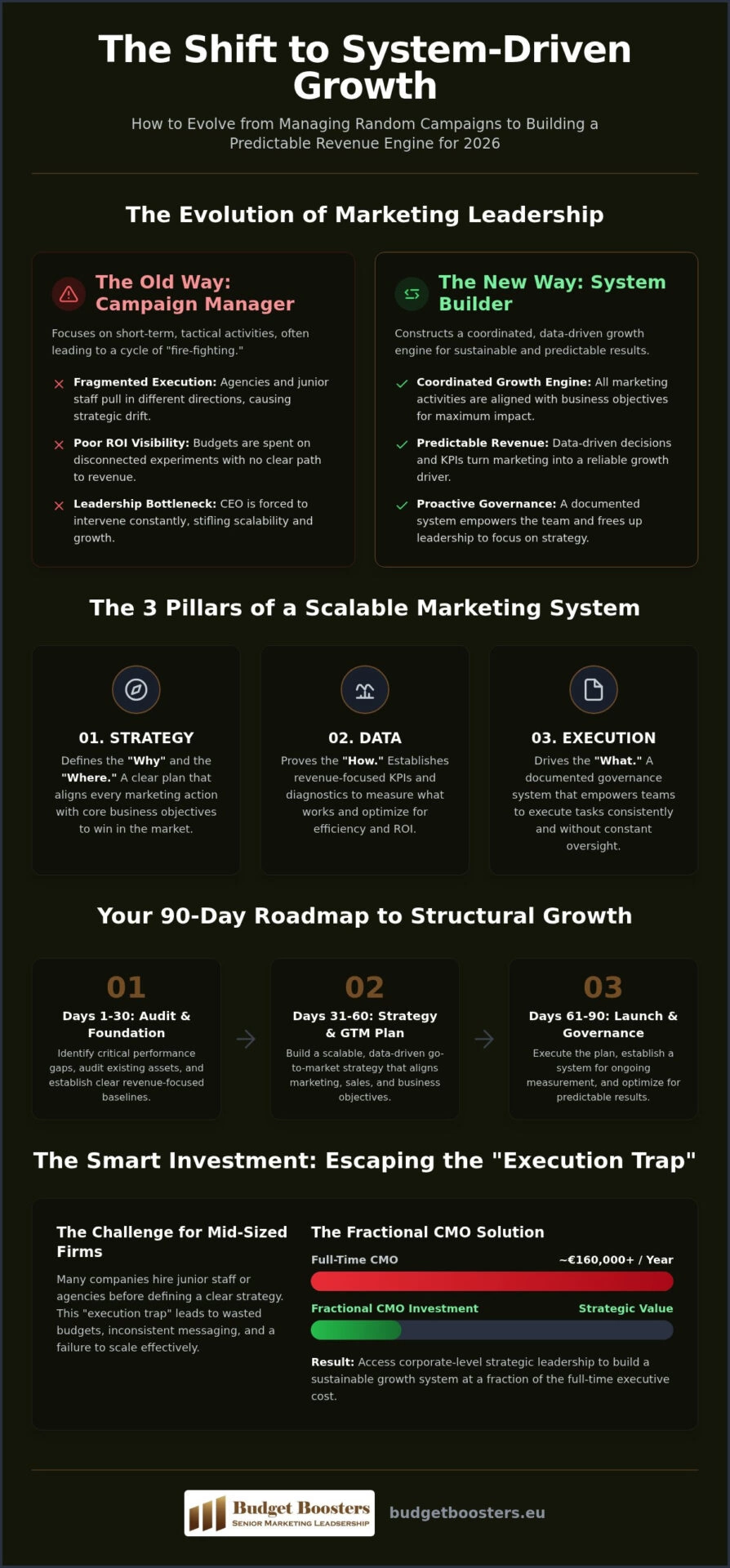
What if the constant pressure to oversee every marketing detail actually vanished tomorrow? You’ve likely felt the sting of fragmented execution where agencies and junior staff pull in different directions. It’s exhausting to deal with a lack of ROI visibility while marketing and sales feel like they’re speaking different languages. You aren’t alone in this frustration. It isn’t your fault that the old ways of “doing more” are failing. To stay competitive, you need CMO growth strategies that prioritize building systems over managing individual campaigns.
In this article, you’ll learn how to transform scattered activities into a coordinated, data-driven growth engine through senior leadership and strategic governance. We’ll show you how to build a marketing system that functions without constant CEO intervention. We’ll explore the roadmap to predictable lead generation and how to align your teams for sustainable revenue. It’s time to stop guessing and start leading with a clear, professional plan that gives you back your freedom. Let’s start building your engine for 2026.
Key Takeaways
- Shift your mindset from isolated campaigns to a coordinated growth engine that secures your market position through strategic choices.
- Discover how to become a “system builder” who creates lasting marketing governance rather than just managing short-term, tactical activities.
- Implement data-driven roadmaps and revenue-focused KPIs to ensure every euro invested aligns perfectly with your business objectives.
- Follow a proven 90-day roadmap to audit your current gaps and launch a scalable, professional go-to-market strategy.
- Learn how fractional CMO growth strategies deliver senior-level expertise to build sustainable revenue systems without the full-time executive price tag.
Defining Modern CMO Growth Strategies in 2026
Growth isn’t a happy accident. It’s the result of a coordinated set of choices you make to win in your market. For many leaders, CMO growth strategies have long felt like a series of disconnected experiments. You launch a campaign, check the leads, and hope for the best. But in 2026, this campaign-first approach is failing. The market is too complex, and your customers are too smart for fragmented tactics. You need a system, not just a schedule of posts or ads.
To better understand how top leaders are rethinking their approach to digital success, watch this helpful video:
A real strategy aligns your business objectives with every single marketing action. It transforms marketing from a cost center into a predictable revenue engine. When you stop looking at marketing as a department and start seeing it as a governance system, you regain control. You move from being reactive to being proactive. This shift is essential for any company that wants to scale without burning out its leadership.
The Evolution of Marketing Leadership
The modern Chief Marketing Officer role has undergone a massive transformation. It’s no longer just about pretty pictures or clever slogans. Today, it’s about data, technology, and owning the entire revenue funnel. We’ve seen the rise of the Growth CMO. This leader doesn’t just spend budget; they manage an investment portfolio. They use sophisticated frameworks to ensure every activity drives a measurable return, often found in resources like The CMO Edge.
Why Mid-Sized Firms Struggle with Scale
Most mid-sized companies fall into the execution trap. You hire junior staff or agencies to do marketing before you’ve actually defined the strategy. This leads to wasted budgets and inconsistent messaging that confuses your audience. Our Fractional CMO Landscape Research 2026 shows that firms in the Baltics and Poland are increasingly moving away from this fragmented model. They are seeking senior governance to stop the strategic drift that happens when daily tasks lose sight of long-term goals. Strategic drift is the slow, silent process where a company’s actions gradually disconnect from its original market purpose. By choosing fractional leadership, you get corporate-level expertise without the €160,000 salary.
Staying ahead of these shifts requires constant learning. You can join our community by subscribing to the Budget Boosters Newsletter at this link. When you subscribe, you’ll receive the ebook “The CMO Edge. Why Companies with Senior Marketing Leadership Outperform – and How to Get There”, which is a €29 value, for free.
From Random Campaigns to Scalable Marketing Systems
Are you running a marketing department or just managing a series of fires? Many leaders get caught in a cycle of random campaigns. They hire “campaign managers” who focus entirely on the next big launch or the next social media post. But in 2026, the real winners are the “system builders.” These leaders don’t just launch; they construct. They develop CMO growth strategies that treat marketing as a repeatable engine rather than a one-off event. It’s an exciting shift that moves you from being the bottleneck to being the architect of your own success, especially when supported by the strategic leadership and execution of Indigo Collective Group.
System building requires governance. Without it, your budget vanishes into a black hole of unmeasurable experiments. Professional governance ensures that every €100 you invest contributes to long-term equity. It turns scattered marketing noise into a clear, resonant signal. To find out where your current system is leaking, you need a marketing diagnostic. An audit identifies failures before they become crises. It’s the only way to move from guessing to knowing exactly where your boosters of efficiency can be applied to see immediate results.
The Architecture of a Marketing System
A robust system has three pillars: Strategy, Data, and Execution. Strategy defines the “why” and the “where.” Data proves the “how.” Execution is the “what.” When these pillars are documented, your team doesn’t need to ask for permission every hour. Standardized processes allow you to scale without losing quality. This documentation reduces the need for constant CEO oversight. You can finally trust the machine to work while you focus on high-level vision. To see how this works in practice, you can explore our content system framework to streamline your output.
Aligning Marketing with Sales Objectives
It’s time to stop talking about “leads.” Sales teams don’t want leads; they want revenue-qualified opportunities. Building a system means creating a shared language between these two departments. When marketing and sales agree on what a “good” prospect looks like, the friction disappears. You need consistent feedback loops to optimize this growth engine. Use a strategic growth matrix to align your market expansion with your internal sales capacity. This alignment is the heartbeat of sustainable revenue. It ensures that every marketing activity is pulling in the same direction as your sales goals, creating a unified front for growth.
Strategic Pillars: Data, AI, and Revenue Governance
Data is your compass, not your anchor. Many leaders feel overwhelmed by the sheer volume of numbers they collect. It’s okay to feel that way. The secret isn’t more data; it’s better governance. Effective CMO growth strategies use historical performance to build predictive roadmaps. You aren’t just looking at what happened last month. You’re using those patterns to decide where to invest next. This shift gives you back your confidence. You stop guessing and start knowing exactly where your next euro of revenue is coming from.
Revenue governance is about establishing KPIs that actually matter to the board. Your board doesn’t want to hear about impressions or click-through rates. They want to see how marketing drives the bottom line. By focusing on metrics like pipeline velocity and customer acquisition cost, you speak their language. A vital part of this system health is improving content ROI. If your content doesn’t eventually lead to a transaction, it’s just noise. When you build a system that measures the entire customer journey, you transform marketing from a cost center into a value driver.
Streamlining Execution with AI
AI is an incredible tool for liberation, not just automation. While many use it to churn out generic text, the real power lies in analysis and production speed. AI-driven content guides can slash your production time by half. Imagine having a system that identifies high-performing patterns in minutes. You can use AI to analyze customer sentiment or predict churn before it happens. It turns your team into a high-speed execution engine. Check out these 7 Practical Ways to Streamline Content Creation with AI to see how to start today. It’s about working smarter, not harder, to achieve your goals.
Building a Reliable Demand Generation Guide
Sustainable growth requires a balance between two distinct activities. First, you must capture the demand that already exists in the market. These are the people ready to buy right now. Second, you must create new demand by educating those who don’t yet realize they have a problem. Our Demand generation guide breaks this down into simple, actionable steps. Your tech stack should support this journey. It needs to track the customer from the first touchpoint to the final sale. This visibility is what transforms marketing into a predictable revenue system that grows with your business.
Your 90-Day Roadmap for Structural Growth
Strategy without a sequence is just a wish. You’ve already seen the vision of a system-driven marketing engine, but how do you actually install it? This 90-day roadmap provides the clarity you need to move from scattered activities to a professional, scalable structure. It’s designed to eliminate the guesswork that often keeps business owners awake at night. By following these steps, you stop reacting to market noise and start shaping your own growth. It’s an empowering process that puts you back in the driver’s seat.
In the first 30 days, we focus on the Diagnostic and Audit. This is a judgment-free phase where we identify the real gaps in your current system. Are your agencies delivering ROI? Does your team have the right skills for 2026? We find the answers here. From day 31 to 60, we transition into Strategy and GTM Planning. This is where we define your positioning and select the channels that actually reach your target audience. Finally, in days 61 to 90, we move to Implementation and Governance. We align your team with the new processes and launch the CMO growth strategies that will drive your future revenue engine.
The Audit: Finding the Growth Levers
The audit isn’t just a list of problems; it’s a treasure map for your business. We evaluate team capability, agency performance, and data integrity to see where your money is actually going. During this phase, we often find “low-hanging fruit.” These are immediate ROI boosters that can provide quick wins while we build the larger system. Setting a baseline now ensures that every future improvement is measurable and visible to the board. You’ll finally have the proof that your marketing spend is working for you.
Governance: Ensuring Long-Term Success
A system only stays healthy if you maintain it with care. Governance means establishing weekly and monthly reporting rhythms that keep everyone focused on the same goals. You need a “North Star” metric that the entire marketing function can rally around. This ensures that your efforts aren’t just busywork; they are moving the needle on revenue. To learn how to structure marketing as a system and stay ahead of trends in the Baltics and Poland, subscribe to the Budget Boosters Newsletter. You’ll join a community of growth-minded leaders and receive the ebook “The CMO Edge. Why Companies with Senior Marketing Leadership Outperform – and How to Get There” (a €29 value) as a gift.
Ready to stop the guessing game? A professional Marketing Diagnostic & Audit is the fastest way to uncover your hidden growth levers and start your 90-day transformation.
Leveraging Fractional Leadership to Execute the Vision
Who leads the growth engine you’ve just designed? Many firms try to scale by hiring junior executors or multiple agencies. This often leads to a fragmented mess. You need a pilot, not just more crew members. A fractional leader offers corporate-level expertise without the heavy €160,000 salary burden. It’s a structural evolution that gives you a system builder instead of just another campaign manager. It’s a smart move. You get the strategic brains without the massive overhead. This approach empowers you to focus on your vision while a professional handles the technical complexity of modern marketing.
According to our Fractional CMO Landscape Research 2026, companies in Poland and the Baltics are rapidly shifting toward this model. This change is driven by intense pressure on ROI and the rising complexity of technology. The research, grounded in Eurostat and Digital Decade indicators, shows that senior, part-time leadership is becoming the standard for growth-stage firms. These leaders don’t just manage; they mentor. They help your internal team grow into their roles while providing strict oversight for your external agencies. This ensures that every partner you hire is actually delivering on their promises. It’s about building a culture of accountability and excellence.
Transforming Scattered Activities into Growth
A fractional leader introduces the structural evolution needed for sustained performance. They stop the “random acts of marketing” and replace them with a coordinated growth engine. By aligning your marketing spend with business objectives through rigorous oversight, they ensure no euro is wasted. You’ll see your scattered activities transform into a measurable system that generates revenue predictably. This level of governance is what separates market leaders from those who simply survive. To understand more about how senior leadership outperforms, explore the frameworks in The CMO Edge. It’s your guide to moving from tactical execution to strategic mastery.
Next Steps for Growth-Stage Firms
How do you know if your firm is ready for this shift? If you feel like you’re constantly intervening in marketing decisions or if you can’t see the direct link between spend and revenue, it’s time. The best way to start is with a professional marketing diagnostic. This audit provides the clarity you need to decide on your next CMO growth strategies. It’s an exciting path to personal freedom and business success. Don’t let the fear of change hold you back. We invite you to explore the global context of fractional leadership in our 2026 research report to see how your peers are leveling up. Your journey toward a scalable, independent marketing system starts with a single, confident choice.
Build Your Revenue Engine for the Future
Your journey toward sustainable revenue doesn’t have to be a solo struggle. We’ve explored how shifting from tactical campaigns to scalable systems creates a foundation for long-term success. By using data-driven roadmaps and senior governance, you can finally align your marketing spend with your actual business goals. Implementing these CMO growth strategies isn’t just about efficiency. It’s about your personal freedom as a leader. You can finally step away from the daily technical grind and focus on the big picture.
As contributors to the Fractional CMO Landscape Research 2026, we’ve seen firsthand how growth-stage firms in Poland and the Baltics are evolving. You deserve a marketing system that delivers predictable results and high ROI without requiring your constant intervention. We specialize in building these ROI-focused growth systems that turn scattered activities into a coordinated machine. Are you ready to stop managing chaos and start building a legacy? It’s time to take the next step and elevate your performance.
Build your growth system with a Fractional CMO and reclaim your focus today. You have the vision; now let’s build the engine to power it. Your future self will thank you for the clarity you create right now.
Frequently Asked Questions
What is the difference between a CMO and a growth strategist?
A CMO is a broad leadership role that builds the entire marketing system, while a growth strategist often focuses on specific acquisition tactics. In 2026, effective CMO growth strategies bridge this gap by treating growth as a structural outcome rather than a project. You get a leader who aligns brand, technology, and sales into one coordinated engine.
How much does a fractional CMO cost for a mid-sized company?
A fractional CMO typically costs significantly less than a full-time executive hire while providing the same level of senior expertise. You pay for strategic value and system building rather than a 40-hour work week. This model allows mid-sized firms to access corporate-level leadership without the massive overhead of a permanent salary and benefits package.
Can a fractional CMO manage my existing marketing agencies?
Yes, providing oversight and accountability for your external partners is a core part of the role. A fractional leader acts as your advocate, ensuring that agencies deliver on their KPIs and that their work aligns with your business goals. This governance stops the execution trap and ensures your budget isn’t wasted on disconnected tactics.
How long does it take to see results from a new growth strategy?
You’ll often see immediate wins within the first 30 to 60 days of a diagnostic. However, building a scalable revenue engine is a 90-day process of audit, planning, and implementation. Sustainable, predictable growth usually becomes visible in your data within six months as the new system gains momentum.
What are the most effective growth strategies for companies in the Baltics and Poland?
The most successful firms in these regions are moving away from fragmented, junior-led execution toward senior governance. By building data-driven roadmaps and using senior leadership to mentor internal teams, companies can navigate the rising complexity of these markets. Shifting to a system builder approach is the most reliable way to ensure long-term performance.
Is AI a necessary part of a 2026 marketing growth strategy?
AI is essential for maintaining a competitive edge in efficiency and data analysis. It isn’t just about generating text; it’s about using tools to predict customer behavior and streamline your production processes. A modern strategy integrates AI to help your team work faster and make decisions based on real-time insights rather than intuition.
What happens during a marketing diagnostic or audit?
A diagnostic is a deep dive into your current team capability, data integrity, and agency performance. We identify exactly where your system is leaking revenue and where your biggest opportunities for growth are hidden. It’s a supportive, evidence-based process that gives you a clear roadmap for the next 90 days of your business evolution.

Article by
Aurimas Guoga
Aurimas Guoga is a fractional CMO and founder of Budget Boosters, helping B2B companies turn fragmented marketing into a predictable growth engine. With over a decade of experience leading marketing strategy, he works with business leaders to improve ROI, build scalable systems, and drive measurable revenue growth. Aurimas is also the author of The CMO Edge, a guide for companies looking to gain a competitive advantage through senior marketing leadership.